A record of the Sportsman's Battalions during the First World War, including a database of soldiers who enlisted in - or served with - the 23rd, 24th and 30th Royal Fusiliers, originally raised by Mrs. Emma Cunliffe-Owen in September 1914. If you have any questions or comments, please send to fmsketches@macbrem.com, thanks!
Showing posts with label Cunliffe-Owen. Show all posts

April 10, 1915

The Times

1st and 2nd SPORTSMEN’S BATTALIONS ROYAL FUSILIERS, Colonel-in-Chief, the King. C. O. 1st Battalion, Col. Viscount Maitland. C.O. 2nd Battalion, Col. A. de B. V. Paget (His Majesty’s Bodyguard). Sportsmen, aged 19 to 45 upper and middle class only. Wanted at Once. Only a few vacancies now left. Entrance fee 3 guineas, or kit. No other financial obligations. Head Recruiting Office, E. Cunliffe-Owen, Hotel Cecil, London. Hours 10 a.m. to 6 p.m. daily.

April 4, 1915

Sunday Mirror

SOLDIERS AT RUGBY.

The Artists won the match against the Sportsman’s Battalion on Richmond Athletic ground yesterday by three goals (one dropped) and two tries to two tries – 20 points to 6. Vaccination and other things prevented the Sportsman’s from mustering its best side; but for all that it was a great game and it was only in the last few minutes, when the Artists put on a couple of goals, that they took a commanding lead.

Quinn dropped a superb goal to begin with, and then followed tries by Padbury and Edlmann – two old Richmond men, who were the Artists’ halves. Tries by Clementson and Curwen for the Sportsman’s left it anybody’s match. But in the last few minutes Fox placed two goals from tries by Quinn and Padbury, for the Artists. The Sportsman’s scrimmage worked very hard, but the side missed the help of its brilliant half backs, Henri and Taylor.

Sunday Mirror

Only 100 Vacancies now left in the

2nd SPORTSMAN’S BATTALLION

(ROYAL FUSILIERS)

In addition to Special Reserve of 500 for 1st and 2nd Battalions.

Colonel-in-Chief – THE KING.

The only Battalion accepting recruits up to 45 years of age.

Age 19 to 45.

Height 5 ft. 6 in. and upwards. Pay and Separation Allowances at Army Rates.

Apply to the Chief Recruiting Officer E. CUNLIFFE OWEN.

HOTEL CECIL, STRAND, LONDON, W.C.

March 23, 1915

Dominion

The Sportsmen’s Battalion – Raised by a Lady.

A very interesting account is given in the “British Australasian” just to hand of the raising of the Sportsmen’s Battalion in England by Mrs. E. Cunliffe-Owen. Like so many of the important things of life, it all apparently happened by chance. The lady in question was walking down Bond Street with her son when she met two well-known big game hunters of her acquaintance and gently rallied them upon not being at the front. They told her they had volunteered but had been rejected because of the age limit. Half-humorously, half-seriously, the suggestion was made that Mrs. Cunliffe-Owen should raise a corps of sportsmen without giving undue prominence to their birth certificates. The lady communicated with Lord Kitchener and, to shorten the story, the Secretary of War gave permission for a battalion of 1600 to be formed.

The duties of recruiting officer were performed by Mrs. Cunliffe-Owen herself, with headquarters at the Hotel Cecil, and so efficiently did she discharge them that on the full strength of the first battalion having been enrolled the War Office requested that a second battalion, also 1600 strong, should be formed, and to this second voluntary task the lady, with the assistance of a competent staff, is now devoting herself. The second battalion is under the command of Colonel a. de V. B. Paget, and both battalions enjoy the distinction of having the King as their honorary colonel. Mrs. Cunliffe Owen is therefore the first lady to raise a regiment since the beautiful and famous Duchess of Gordon “raised the Gay Gordons with a kiss” a century or so ago. A further interesting feature of this battalion is the fact that a very large number of Australians and New Zealanders figure among the commissioned and non-commissioned officers as well as among the ranks. Colonel Viscount Maitland is in command of the first battalion.

Western Times

Sportsman’s Battalion

Although the 2nd Sportsman’s Battalion are now in camp, E Company has still its headquarters at the Hotel Cecil, London, awaiting completion of the extra huts , which, owing to the difficulty of getting supplies of wood, etc., has been delayed. Recruiting is still going on at the Hotel Cecil as before for men up to 4t years of age, and all applicants are greatly welcomed.

E Company is under the command of Capt. A. E. Dunn, who raised an entire West of England company for the Sportsman’s Battalion in the Exeter District. Capt. Dunn served three months in the ranks of the 1st Sportsman’s Battalion. The character of the battalion has attracted recruits quite as much as the extension made by the War Office in the Age limit.

March 19, 1915

Chelmsford Chronicle

NEW SPORTSMAN’S BATTALION AT ROMFORD.

On Wednesday the 2nd Sportsman’s Battalion moved from London to their new headquarters at Hare Hall, Romford, near Gidea Park station. The first Battalion is in Quarters at Grey Towers, Hornchurch, two miles away.

The Battalion came by train to Romford. In London they had been inspected before leaving by Brigadier-General Kellett. Cheers were given for the founders of the Battalion, Mr. and Mrs. Cunliffe Owen. On reaching Romford the Battalion formed up under the command of Col. A. de B.V. Paget, with the Adjutant, Major H. H. Enderby, and the Major Percy Elwell. Numbering well over 1,000 men, the Battalion presented a fine appearance. Marching by the main road to Hare Hall, they entered upon the occupation of what are believed to be the most up-to-date field barracks yet erected. It embodies all the improvements that the experience of the War Office in the last six months can suggest. There are a couple of dozen cubicle shower baths, with hot and cold water laid on; the thirty beds in each dormitory hut, though made of wood, owing to the scarcity of iron bedsteads, turn into the wall in the day time, over lapping each other to form seats and occupying the minimum of space; each hut is lit by electric light; the bootmaker’s, the post-office, the tailor’s, and the barber’s stand in a row, and the wet and dry canteens are spacious and comfortable.

In the hall itself the bedrooms have been neatly and simply furnished to accommodate 36 officers. The subalterns sleep four in a room. The colonel has one of the smallest rooms, looking out over the camp, and as simply fitted as the rest. The canteens and store-rooms are fully stocked with every possible requirement. A hospital with 24 beds had been provided; the drugs were ready in the doctor’s surgery, and sergeant and five men of the R.A.M.C. from Colchester will form the nursing staff.

It is understood that four Companies of 270 men each will be going to the Front in June, or thereabouts, and 5h and 6th depot companies will have to be formed to keep the camp going and fill any gaps that may occur in the other Companies.

March 17, 1915

Devon Exeter Gazette

Au Revoir!

Yesterday the West of England Company of the Sportsman’s Battalion Royal Fusiliers left Exeter, under the Command of Captain A. e. Dunn, after a lengthened period of training.

Devon Exeter Gazette

SPORTSMAN’S BATT.

EXETER DEPARTURE.

The “C” (West-Country) Company of the 24th Service Battalion Royal Fusiliers (2nd Sportsman’s), left Exeter yesterday morning tor camp. The men, numbering 323, assembled at the dinking fountain, in Sidwell-street just before 8 o’clock. Under the command of Captain A.E.Dunn, with Lieuts. Enderby, W. G. Perkins, and F. Templeman and headed by the band of 20, the men marched by way of High-street and Queen-street to S. David’s Station. En route the band, under Sergt. Brock, rendered in spirited fashion the marches “Soldiers of the King” and “Sons of Our Empire.” Despite the comparatively early hour, the streets were thronged with people, and the men were cheered enthusiastically. A special train awaited the men, who responded with a thunderous “No!” to the cry of “Are we downhearted?” Although the railway officials made some attempt to keep the crowds of civilians from thronging the platforms, the station was quickly filled with the friends of the “Tommies.” Cheers were given for the officers and Exonians, and the train, from the windows of which miniature flags were freely displayed, steamed out amid much enthusiasm.

The Times

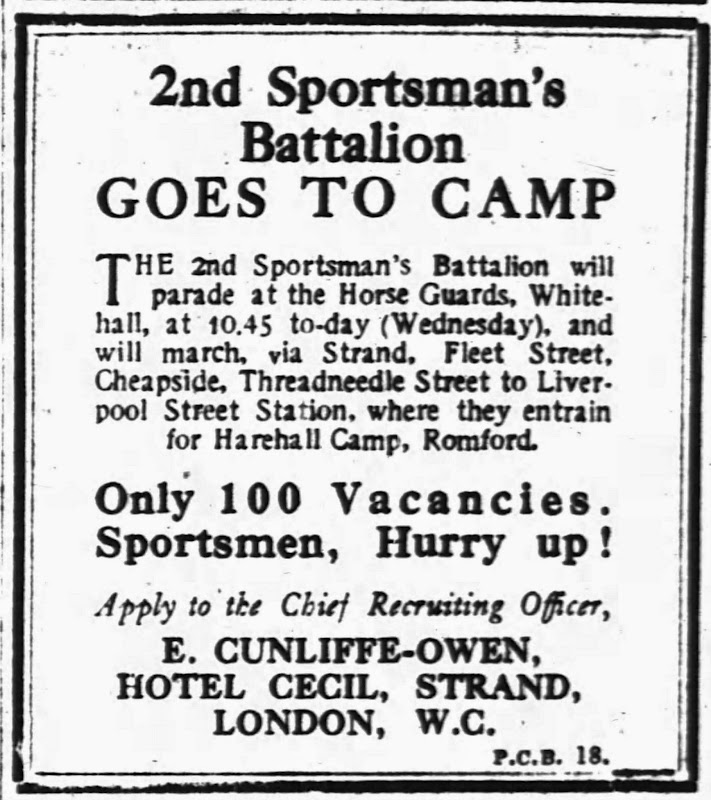
2nd Sportsman’s Battalion

GOES TO CAMP

The 2nd Sportsman’s battalion will parade at the Horse Guards, Whitehall, at 10.45 to-day (Wednesday), and will march, via Strand, Fleet Street, Cheapside, Threadneedle Street to Liverpool Street Station, where they entrain for Harehall Camp, Romford.

Only 100 Vacancies. Sportsmen, Hurry up!

Apply to the Chief Recruiting Officer,

E. CUNLIFFE-OWEN, HOTEL CECIL, STRAND, LONDON, W. C.

Western Times

A GOOD SEND OFF

Departure of the 2nd Sportsman’s Battalion

FROM EXETER

The 2nd Sportsman’s Battalion, which has been raised in the West-country through the instrumentality of Capt A. E. Dunn, and which has since its formation had its headquarters in Exeter, left the City yesterday to go into camp to complete their training for whatever service is before them. The send-off was as encouraging and enthusiastic as could well be, and the cheering crowds that thronged the streets were tribute to the popularity of the Battalion and to a fine body of men.

No won who saw the Battalion – fresh, smart, athletic, and fit as the men are – march through the City with that litheness and swing which betokens perfect physical fitness and vigour, could help congratulating Capt. Dunn on having the proud command of such a splendid body of men. In the best of spirits and keen for service, the men responded cheerily to the ready outbursts of the citizens, the waving of hats and handkerchiefs, and good wishes which were evident on every side. They were not downhearted: they said so themselves many times as they swung through the street between unbroken lines of civilians.

The “fall in” was at 8 o’clock at the top of St. Sidwell’s, and the Battalion mastered promptly and in full force. It numbers 323 of all ranks, and, besides the O.C., the officers are Lieuts Enderby, W.G. Perkins and F. Templeman, with Co. Sergt.-Major C. T. W. Finch.

The Battalion Band, under Sergt. Brock, was there to lead the way with martial music. The band itself, like the Battalion, has made splendid progress and now numbers 20. The played lively and patriotic airs, with “Soldiers of the King” and “Sons of Our Empire” among the numbers rendered.

The route take was through Sidwell-street, High-street, and Queen-street, passing the statue of Devon’s hero, General Buller, and then on to St. David’s Station, where a special train was in waiting. Numbers of friends managed to get on to the platform and there was much hand-shaking and exchange of wishes for good luck. To secure this latter for his battalion on stalwart member had been decorated with an old horseshoe tied with ribbon in the colours of the Allies, which, notwithstanding its hug dimensions, he bravely ad proudly wore upon his breast. The men were soon comfortably aboard the train, which, amid a perfect hurricane of cheering, steamed away on the stroke of 9 on its journey east.

London Standard

BASKET BALL.

An interesting match has been arranged between some members o f the Sportsman’s Battalion of the Royal Fusiliers, commanded by Lord Maitland, and a London basket-ball team. The military side will include Hayes and Hitch, the well-known Surrey cricketers, and amongst their opponents will be J. G. Lee, who has taken an important part in the work of organizing Y.M.CA. recreation tents in various military centres, and Dr. Robert le Cron, the well-known ice-hockey player. No charge will be made to witness the game, which will take place at the Central Y.M.C.A. Tottenham Court-road, on Saturday, at 7.45 p.m.

February 23, 1915

Western Daily Press

CLIFTON FOOT HARRIERS – Owing to the death of Captain Bruce Melville Wills, Wessex R. E (killed in action), and of Mr. Hamlyn H Perham, Sportsmen’s Battalion, Royal Fusiliers these hounds will not meet to-morrow (Wednesday).

The funeral of Mr Hamlyn H. Perham, late of the Sportsman’s Battalion Royal Fusiliers, will take place too-day, at Flax Bourton Parish Church, at 3.45 p.m. The rector (the Rev. F. Tracey) made a feeling tribute, in his sermon on Sunday, to the deceased’s loyalty and devotion to duty.

The Times

BOXING AT THE N.S.C.

DENNY BEATEN BY DELANEY

The chief event at the National Sporting Club last night was a 200-round contest between the light-weights, Private J. Delaney (23rd Royal Fusiliers, Sportsman’s Battalion) and J. Denny (New Orleans) for £330. Delaney won in the 14th round.

After a quiet start Delaney forced the pace finely in the second round. He again took the honours in the third round, and Denny had to act chiefly on the defensive. In the fifth round Delaney kept his opponent away and scored fast, owing to his superior pace and ring tactics. The American was quite out classed, but was game until the end. At the close of the 14th round Denny’s seconds gave in for him.

It was Denny’s first appearance in this country. His record in America is an excellent one, and before the fight he and Kid Lewis were regarded as the most formidable opponents for Fred Welsh.

The Courier

JERRY DELANEY BEATS THE NEW LIGHT-WEIGHT.

YOUNG FOX, OF LEEDS, DEFEATS LAFFERTY.

With a card of a most attractive character arranged it was not surprising to fid a big attendance at the N.S.C. last night.

Jack Denny, the newly-arrived light-weight, was down to meet Jerry Delaney (who is now a private in the Sportsmen’s Battalion) over 20 rounds for £100 a-side and the Club purse. The articles stipulated that the men should weight 9 st. 9 lbs. Delaney was 2 lbs. inside, but the American went a quarter of a pound over, and it was only after severe skipping bouts that he passed the scale at the third time of asking.

The event of the evening, however, was a 20-rounds bout in the eliminating contest for the bantam-weight championship between Young Fox, of Leeds, and Alex. Lafferty, who claims to be the best lad of his weight in Scotland. Looking fit, the Scot pulled down the beam at 8 st. 5 ¾ lbs., Fox being ¾ lb. lighter.

Before the proceedings opened there was a little speculation over both matches, Fox at 6 to 4 on, and Delaney 5 to 2 on being respectively favourites.

FOX RECOVERS FINELY.

Of the two chief events, the bantam-weight contest came first. It went the full twenty rounds, but to a great extent was disappointing, as the Scot failed to justify the high opinion formed of him, and Fox won well on points. The Leeds man had a good pull in the matter of reach, and took full advantage of it, getting over or breaking through Lafferty’s guard time after time. Lafferty tried in-fighting both in season and out, but wasted a lot of well-intentioned right-handers. All the same, the Scott had the better of the opening rounds, and in the third Fox was down. Indeed, the latter looked like a loser for five rounds, but in the sixth he suddenly found his form. He then began to avoid the Scotsman’s left leads, and after doing a lot of good work toppled Lafferty over in the seventh round with a clip on the chin. From this point all the cleverness and generalship were on the side of Fox. Lafferty was always game, and right up to the sixteenth round exhibited pace, but he became very ragged towards the close, and, as already said, Fox won with a bit in hand.

DELANEY’S JUDGEMENT.

The Delaney v. Denny bout was a warm one. Delaney forced the work to commence with, and, hitting with plenty of force whilst paying particular attention to the fence, he outfought the American generally. By the end of the fifth round, Delaney had established a good lead. Denny adopted covering up tactics, but without being able to keep Delaney’s left out of his face. The Yorkshireman’s judgment was first-class, and he inflicted such severe punishment that at the end of the 14th round Denny was hopelessly beaten. The New Orleans man showed nothing like championship form at any part of the contest.

THREE GUINEA RECRUITS.

FRESH APPEAL FOR FUNDS BY MRS. CUNLIFFE'OWEN.

“KIT” MYSTERY.

Mrs. E. Cunliffe-Owcn, the chief recruiting officer of the Sportsman’s Battalions, who recently wrote to the “Daily- Express” stating that “men joining this battalion in future will be expected to pay a minimum of three guineas and be of the upper and middle classes,” has resumed her letter-writing activities and appeals for money.

A “Daily Express” correspondent writes that, although he, “like many others, had sent a subscription (£5) to the Sportsman’s Battalions,” he has now received another appeal in the form of the following letter:—

     Dear Sir,—The War Office have now called for an extra 500 men for the 1st Sportsman’s Battalion, which is in camp at Hornchurch, Essex, and have also authorised the immediate raising of a 2nd Sportsman’s Battalion of 1,600 men, making a total in all of 1,900 men still to be found.
     The camp and men at Hornchurch are considered to be second to none in the New Army, and the 2nd Battalion will be quite as good.
     The raising of these battalions places a severe strain upon our financial resources, and funds are urgently needed, as only a portion of the expense incurred in raising and equipping these battalions is recoverable from the War Office. May I ask you to kindly send a donation?
     Cheques should be made payable to me at above address, and crossed 2nd Sportsman’s Battalion Royal Fusiliers.
     If you could induce any of your friends to assist financially I should be most grateful. —Yours faithfully,
          E. CUNLIFFE-OWEN.
     Hotel Cecil, Strand, Feb. 19, 1915.

What has Colonel Viscount Maitland to say to this now appeal on behalf of his battalion?

UNANSWERED QUESTIONS.

The three questions asked in the “Daily Express” on February 5, however, still await answers.

The questions are :—

    1. How much money has been received ?
    2. How has the money been spent ?
    3. What is the present balance or deficit?

A new element of mystery is introduced, by a sentence in the following remarkable advertisement which has appeared daily in the “Times” for several weeks:—

1st and 2nd SPORTSMEN'S BATTALIONS, ROYAL FUSILIERS. Colonel-in-Chief, the King. C.O. 1st Battalion. Colonel Viscount Maitland. C.O. 2nd Battalion, Col. A. de B. V. Paget (His Majesty’s Bodyguard). Sportsmen, age 19 to 45, upper and middle classes only, Wanted at Once. There are still vacancies. Entrance is 3 guineas, or kit. No other financial obligations. Head Recruiting office, Hotel Cecil, London, Hours, 10 a.m. to 6 p.m. daily.

What is the precise meaning of the phrase:—“ Entrance fee 3 guineas or kit”? The “Daily Express” understands that the Army authorities make an allowance of about £7 or £8 for the kit.

February 13, 1915

Daily Express

Mrs. CUNLIFFE-OWEN REPUDIATED.

APPEAL WITHOUT COLONEL PAGET'S APPROVAL.

We have received the following letter from Colonel A. de B. V. Paget, commanding the 2nd Sportsman’s Battalion, recruits for which are expected by Mrs. Cunliffe-Owen, the chief recruiting officer, to pay not less than three guineas each: —

To the Editor of the “ Daily Express.”
     Sir.—With reference to the paragraph in to-day’s “Daily Express” headed "Mrs. Cunliffe-Owen's appeals,” I beg to state that the appeal for funds to the recruits of the 2nd Sportsman’s Battalion was issued without my knowledge or approval, and that I deprecate in the strongest manner communications passing between the organisers of the battalion and the non-commissioned officers and men without my knowledge.
               A. DE B. V. PAGET. Colonel, Commanding 24th (S) Bn. Royal Fusiliers (2nd Sportsman's).
     Hotel Cecil, Feb. 12

Three appeals from Mrs. Cunliffe-Owen, “Chief Recruiting Officer ” of the Sportsman’s Battalions, for contributions to the funds under her control have been quoted in the “Daily Express."

One was to members of the 1st Battalion, another to those of the 2nd Battalion, and the third to a private householder.

In the appeal to the 2nd Battalion, which Colonel Paget repudiates, Mrs. Cunliffe-Owen not merely asked all the rank and file to “help me as much as possible.” but added. “Will you get as many of your friends to help me as you can ?”

Colonel Viscount Maitland, commanding the 1st Battalion, has already repudiated Mrs. Cunliffe-Owen’s three-guinea tax.”

The First Sportsman’s Gazette – No. 8

EDITORIAL

COMMISSIONS.

Our remarks on this subject last week excited a great deal of comment within and outside the Camp and during the week we received many letters urging us to pursue the matter further. We take the liberty of reproducing two of these letters here: To the Editor (1st Sportsman’s Gazette).

     Dear Sir,—May I be permitted to say how glad I was to read your Editorial Notes in the current issue of the Regimental Gazette, more especially the remarks relating to the question of commissions ? I personally came over 3,000 miles to join the colours, and when I applied at the War Office for a commission I was definitely informed that I should not in any way prejudice my chances of getting one were I to join the Sportsman’s Battalion or any other unit of the King’s forces. Further, I was given to understand that all commissions in the future would be given, not to the men about town who strolled about waiting for them, but to young fellows who had sense enough to join and learn something.
     I now find that I am debarred from even applying for a commission. I consider this distinctly unjust, and, like crowds of other fellows in similar positions, it appears to me that I have been misled and deceived, and that we are being penalised for our patriotism. It is true that some weeks ago, at a time when I believe the Corps was not officially recognised, I was offered my discharge. But what decent man would take a discharge merely in order to “hang about” London on the off chance of obtaining a commission?
     I am, Sir,
          Yours very truly,
               “DISILLUSIONISED.”

To the Editor.
     Sir,- You say in your Editorial Note, re commissions, in your last week’s issue that the Colonel’s point of view is that if the Battalion is ever to become a fighting unit men must come here to stay, and not merely for a transition period of training for something else.” That is, of course, true enough. But surely Commanding Officers realise that when they train men they are not doing it to satisfy themselves or even to forward the interests of their own particular Battalions, but in the service of their King. It is not absolutely essential that the Sportsman’s Battalion should go to the Front as a unit; it is absolutely essential that England should win this war. In my judgment, C.O.’s-—and I number two or three of them among my personal friends, make too much of a fetish of keeping their pet units intact. It is a perfectly understandable and, in many ways, a laudable ambition, but, I think, scarcely the highest or the most altruistic one. Finally, may I say it with all due respect, Lord Maitland should feel proud that the Battalion under his command is able to give the country so many promising young officers.
     Yours, &c.,
          W. M. R.

We print these letters mainly because we believe that they represent the general feeling of the Battalion in the matter, and also because we hope that a frank expression of opinion will help to clear the air somewhat. So far as we ourselves are concerned we believe that professional men, especially engineers, miners, sappers, linguists, etc. are able to render more useful service to their country as officers than as rankers—and it is of this type of men that the Sportsman's Battalion is largely composed.

KEENNESS.

We regret that the spirit of the Battalion is not what it was three months ago, and we hold the opinion that prolonged trenching and inoculation are not sufficient of themselves to account for the change. There are other forces at work, some of them subtle, others more open. Many men were offered commissions before Christmas and cheerfully turned them down. We scarcely think that such would be the case now. Whence the change? Fully recognising the responsibility of our statements we believe that the falling off in keenness, apparent not only here but in all units of a similar character, is largely due to the fact that military authorities have failed to lay hold of a great opportunity. We profoundly wish that it were otherwise, but it is not so. Responsible men, men who have made careers for themselves in all professions and all spheres of energy, enthusiastic youths)—you see them all now, keenness departed, marching about with the same deadly, dull expression on their faces, obeying orders like clockwork machines with the spring nearly run down. Why? Because so many officers and non-commissioned officers labour under the delusion that this is an ordinary war and that the men are ordinary soldiers. We are not going to win many battles in this Olympic campaign by “forming fours” or “saluting by numbers” or “carrying swagger canes through village streets.” These are more or less the unessentials. Any intelligent person can learn to do these things in a week. To have to practice them for four months without end does not speak well for our preparedness as a nation or the resources of our military authorities, and is, of course, the very thing to kill enthusiasm and to breed ennui. We believe and hope that a better time is coming, and quite candidly we sympathise as much with our officers as with the men. We are sure that they, as well as all we humbler folk, will heave a sigh of relief when we can at last leave all this “barrack-square and ceremonial machining” behind us, and seriously tackle that portion of our program which relates to training for active service.

SALUTING.

The other day we walked from the Law Courts by way of the Strand to Trafalgar Square and en route saluted no fewer than sixty officers. In consequence of this and other experiences of a similar character we have come to the conclusion that in war-time saluting should be abolished by Army Order, at least in London and all garrison towns. We understand—although we have not yet been able to obtain official confirmation—that all saluting has been done away with at the Front. Men passing or wishing to speak to officers merely “stiffen up.” We put it forward as a serious recommendation that in the present exceptional circumstances men should only be required to salute (a) the officers of their own regiment, and (b) Staff officers or officers above the rank of Major. That this suggestion would meet with the hearty, approval of the majority of senior officers we have ample evidence.

PASSES.

Some relaxations in the restrictions regarding passes for business purposes would be greatly appreciated by the Battalion generally. It is not always possible to bring business representatives down to the Camp, and many extremely hard cases have come to our notice of men who at the Hotel Cecil were informed that no difficulty would be put in their way of getting up to town for a few hours each week, and who are now often unable to secure passes for really necessary business. Of course there are many instances of men who take advantage of every opportunity for getting a pass, and this makes it all the more of a hardship when those who desire to leave the Camp on strictly business grounds are refused permission.

—Ed.

In Memoriam.

We regret to announce the death, on Feb. 10th, from cerebrospinal meningitis, of Private Edward A. Willett, B Coy. The deceased, who was 35 years old, was a man of powerful physique. He was a lawyer, at Bromley, in Kent, succeeding his father in a long established and honourable business. Willett, who was a Roman Catholic, was a man of character and intellect. He was a keen soldier and most popular with his hut mates, who unable to be present at his funeral, honoured his memory by the sending of a wreath.

MAINLY About PEOPLE.

Notes concerning members of the Sportsman's Battalion.

Cook, H. (Private).—-Concert and Music-hall artist. First appeared on the stage as one of Tom White’s Arabs. Has recently sacrificed remunerative contracts with the Moss, Stoll and Gulliver circuits. Saw active service in South Africa with Driscoll’s Scouts. Is the owner of Jacko, the Regimental monkey, and that popular copyright song “Where have you been all night.”

Darrell, Fredrick (Private).—Born in Cambridge. Began life as a mining engineer. Was a director of the Robinson, Frank Smith and Schuller Diamond Mines, and many others. Has invested in farming properties in Africa. Owned a stud in England of race horses and polo ponies, including first prize winners at the Hackney and Polo stud show. Has hunted and shot in various parts of Africa. Is well known in Johannesburg and other centres of South Africa. When in England he has taken an active part in politics. Is the author of “How to succeed in South Africa.” He has become a recognised authority on South African politics and finance.

Garland, A. R. (Private).—Rugby and Queen’s. Son of the late General Garland. Has travelled round the world several times, and been engaged in cattle-punching, orange growing in Florida, and gold mining in Alaska. Served with the C.M.R.’s in the first Boer War. Previous to joining the Sportsman’s Battalion was a theatrical manager.

Lawford, A. R. M. (Private).—Born in India. Formerly belonged to the L.A.C., when he won the 600 yards Challenge Cup, and represented the club in sprinting. His best time for the 440 yards is 50 seconds, and for the 200 yards 20 seconds. Was a member of the Queen’s Westminster Rifle Volunteers for eight years, attaining the rank of 1st Lieutenant after only a few months service.

Pearson, Hyde B. (Private).—Has lived much in the East. For 15 years captain of various Rugger and Soccer teams, also hockey and general athletics. Is an old stroke of Yokohama Rowing Club. Has played for Japan against China at cricket. Well known gentleman-jockey, won the Ladies’ Purse for three years in succession (the Eastern Derby). Well-known yachtsman. Played against Cambridge and Oxford for Surrey at Soccer. Splendid shot with sporting gun; good painter of sporting dogs. Educated at Sir Watkin Wynn’s School, Wales, and Heidelburg University, Germany.

Rhodes, M. (Private).—Came from Australia to join the Sportsman’s Battalion. An all-round sportsman, he excels in swimming and diving. Has very few rivals at yachting. At one time he owned that celebrated and unique boat—8ft. long and 8ft. wide, mast 18ft. high, boom 17ft., and bowsprit 12ft., which was recorded at the time in the Rudder.

Rogers, V. H. (Private).—Though born in England has had a varied career in America. Was trained in Civil engineering. Has acted in this capacity for the Canadian Northern Railway, Canadian Pacific Railway, and the Grand Trunk Pacific companies. Private Rogers has seen much “cowpunching” in Alberta, California, and Texas. He is a keen follower of base-ball and “soccer,” and has done much big game hunting in Canada.

Scott, R. G. (Private).—Came from Brisbane, Queensland to join us. Very good full back at Rugger. Has played for Queensland. Educated at Brisbane Grammar School. Is a solicitor by profession, and very good at causing quarrels among other people. Loves fighting.

Taylor, R. J. (Private).—Born in Lancashire. Professional cricketer and footballer. Represented Lancashire in cricket from 1892 to 1898, and in League Football for the same county. Has often bowled against Hayes, also a member of the Battalion. Once took 8 wickets for 71 runs at the Oval. For the last 11 years has been engaged by the Marquis of Graham on his estate, Easton Park.

Thornber, Geo. R. (Signaller).—Educated at Winchester. Has travelled extensively, and fought in Spanish-American War as a volunteer, finishing up as marksman. Fought also in the last Sioux Campaign. Keen on all sports. Was in the first rush to the Klondyke.

Tomkins, F. O. (Private).—Is a solicitor, and was educated at Wellington College and abroad. Is a son of General W. P. Tomkins, C.I.E. A member of the Thames Punting Club, and often seen at Maidenhead. Has won numerous prizes for punting. Very keen on Alpine Sport, skiing being the particular form he engages in. For this purpose he goes to St. Moritz every winter. He is very keen on shooting and has lately been making good practice at the Romford miniature rifle range. At one time did a lot of long distance bicycling; by that means has travelled over most of the European Continent.

THE BATHS.

We congratulate the regimental authorities on the successful opening of the Shower Baths. These satisfy one of the most urgent and necessary of the requirements of the men, and already they are appreciated and used to the full.

MAJOR G. H. M. RICHEY, D.S.O.

A PERSONAL APPRECIATION.

By J. W. R. Morgan.

Few officers in the British Army have seen more service than has Major Richey. This fact is amply illustrated by a mere cursory glance at his official record, which we are able to publish this week. Major Richey has succeeded in impressing the regiment with his strong and genial personality. One realises immediately one comes into intimate contact with him that he is more accustomed to action than to academics. He is one of those exceptional men who, urged by restless impulses, yet contrive to convert their energy into useful work.

Educated at Colchester, Winchester and Woolwich, it was originally intended that he should take up gunnery. He first saw service in the Becuanaland Expedition of 1884-5 with Methuen’s Horse, then in the 12th Royal Lancers. From this regiment he exchanged in 1889 into the Queen’s Bays, with whom he served till 1895. He was stationed in India during this period, and whilst there he won many prizes for skill at arms. In 1892 he won the cup for tent-pegging at an assault at arms at Rawal Pindi in open competition. The Major has also won many prizes for skill with sword, lance, and bayonet.

In 1896 he joined the Colonial Forces and served through the Matabele War. He also took part in the quelling of the Mashuna Rebellion in 1897 and 1898. He returned home on sick leave in August, 1899, but was soon to rejoin the colours.

On the outbreak of the Anglo-Boer War, he returned to South Africa as Lieutenant in the Duke of Edinburgh’s Own Volunteers, but later joined Kitchener’s Horse, on the formation of that corps, and was soon promoted Captain and Adjutant.

Major Richey was twice wounded, and was mentioned in despatches on three occasions for gallant conduct in the field. He was decorated with the Distinguished Service Order for conspicuous gallantry, and was recommended for the Victoria Cross for rescuing a trooper, who had fallen and lost his horse. This was at Driefontein in March, 1900. Afterwards he was in succession Chief of the Krugersdorp Division of the Transvaal Police and Staff Officer of Doran’s Column. When war ceased Major Richey took up an appointment in the Cape Colonial Office, and in January, 1904, he was appointed to the Defence and Police Department of the Cape Colonial Forces.

He has done much big game shooting both in Africa and India, and has travelled on the Zambesi, on the West Coast, in Egypt, India, and South America.

On the outbreak of the present war Major Richey journeyed 12,000 miles to join the colours, the voyage home taking 42 days, which was not without incident, for the boat narrowly escaped being sunk by a German cruiser when two hours from Rio.

The interviewer requested Major Richey to give us his opinion of the Sportsman’s Battalion, and was favoured with the following reply : —

“I find it rather hard to express my real opinion of the Battalion in general, but as I have served in at least three other regiments composed of similar men, perhaps a few remarks may not come amiss. In the first place most people seem to think it almost impossible to discipline men who, for the most part have done more or less as they pleased all their lives. On the contrary, it is comparatively easy work. The majority have been disciplined at school, they have learnt it in the larger school of life, and their finer instincts and “sporting” feeling make up for whatever else there may be lacking.

The Battalion has been much handicapped of late from various causes, but with the material we have to work upon I am convinced that there will, be few finer or more efficient bodies (if any) of fighting men of the new armies in the field once we are able to tackle our training properly.

Personally I take great pride in the Regiment, and I feel sure that when the war is over it will mean something for any of us to be able to say “Yes, I served with the 1st Sportsman’s at the front,”

CORRESPONDENCE.

SOME QUERIES.

     To the Editor, 1st Sportsman’s Gazette.
Dear Sir,
     I have received the first copies of the Gazette from late comrades in the Battn., and beg to congratulate all concerned on its publication.
     Perhaps you or some of your readers will kindly answer the following queries:
     Does C.O. mean Commanding Officer, or does it stand for the initials of the Chief Recruiting Officer of the Sportsman’s Battalion, or can one pay one’s money and take one’s choice?
     When the Battn. was C.B. (sometime in November I think) who were the half-dozen lamb-like individuals who could be trusted out of the fold with permanent passes; and what did those six white sheep and the remaining thousand odd goats feel about it ?
     When some of the “privates” meet some of the “tailors” and “Jacks in office” in private life, will all the fighting be over?
     Is it true that there is a “Deutsche dogge” (made in Germany) up at the Hospital, and that the password is now “Cave Canem” and no longer “Cave Cancer” as it was in November.
     Talking of dogs, can any of you let me know where I can get the old strain of black Pointers? I have been so long abroad that I have lost track of them. In return for this information (or without it) I shall be glad to tell any “Sportsman” where, after this infernal war is over, he can live cheaply, in a glorious climate, with grand scenery, good sport and good fellowship, and get 7% or 8% interest on safe investments; and where I should now be shooting and fishing if it were not for the same reason that has brought so many of us back to the “old country,” God bless her!
     Salaams, and good luck to you all,
          T. P. MALLORIE, at “Brookroyd,” Ilkley, Yorks.
     I hope to send you a sporting article for your columns shortly.

A PRIVATES’ BALL?

To the Editor.
     The dance given by the Sergeants last Friday night was a huge success. Everything was splendidly arranged: Decorations charming, catering excellent, refreshments very very good indeed, and decent music. Officers, non-coms, and men spent a delightful evening. Our Regimental Sergeant- Major deserved—and received—the heartiest compliments from all who attended, for the efficient way the whole affair was conducted. There were far more privates present than non-coms, and officers. Being one of the former, I suggested to our R.S.-M. that it was up to us Privates to “retaliate” by giving a ”return match” in the shape of a Privates’ Ball. Regimental Sergeant-Major Merrick told me that if I moved in the matter he would be most happy to back us up, and organise the thing for us. The question is: Will the privates who enjoy a dance, and those who like to look on, or are in favour of one, reciprocate? I suggest that a private from each Hut meet, form a committee, and set the “ball” rolling. With the aid of our R.S.-M. we know beforehand what the result will be. I for one will be glad to lend a hand to bring this about, and would like to hear from others who will join me with that object. A larger hall would be required of course—but a committee could decide that and all other matters. A PRIVATE, Hut. 19.

The Wedding at St. Luke’s, Chelsea, of William Colin Macleod (1st Sportsman’s Battalion, Royal Fusiliers), the only Son of Capt. Macleod, of Orbost Skye, to Miss Georgina Elizabeth Catherine Fitzroy, Grand-daughter of Cluny MacPherson. Our Photo shows the newly married couple and the Guard of Honour.—Wednesday, February 3rd, 1915.

BENEVOLENT FUND DRAMATIC ENTERTAINMENTS.

The success of the above Entertainments at the Drill Hall was due to the energy and ability of the Misses Taylor. Of the three sketches performed by these talented ladies and their friends, “The Bishop’s Candlesticks” proved to be the most popular with the audience. Mr. Beckingham Challis was excellent in the part of the kindly Bishop. In fact we can imagine no better* interpretation of the character. Mr. Harold Morse was sufficiently gruesome as the Convict, and Miss Taylor made a dignified and picturesque Persome. Minor part were filled satisfactorily by Miss Phyllis Taylor and Pte. de B. Thomas. The actors were quite letter perfect and the whole piece went without a hitch.

“The Biter Bit” was an amusing sketch, but hardly worthy of the talents of the Misses Taylor and Mr. Beckingham Challis.

Miss Stephanie Bell and Miss Moyra Nugent gave a very clever song and dance, which was encored by the audience, in response to which Miss Stephanie Bell recited a warlike episode.

On Wednesday night Miss Gorse sang several popular songs, which were much appreciated by the audience. The performance concluded with the sketch “Three Common People,” in which Mr. Harold Morse was very good as a pavement artist^ and Miss Honora Taylor and Miss Taylor played the parts of Poppy Dyke and Sarah Moon in a very charming manner.

The amount realised by the two nights’ performances, including sale of programmes, was £29 7s. 8d. and after paying all expenses the useful sum of £16 4s. 6d. was handed over to Col. Gibbons for the Battalion Benevolent Fund.

The sum handed in by the programme sellers was beyond all expectations, and it is a moot point whether this result is due to the energies of Private Curie or to the beauty of his staff.

Finally, mention must be made of Bandmaster Thompson and his comrades, who so successfully and ably opened the programme on each evening.

THE SUPPER ROOM.

As the above institution is for the benefit of the men, may we respectfully urge the purchase two or three times a week of a sack of coal. A well-warmed place attracts customers n'est ce pas. We have many travellers from Arctic regions in our ranks, and one of them told us the other evening that his experiences in the Supper Room vividly recalled his sojourn in the regions of eternal ice and snow.

SERGEANT J. H. SMEATON.

Sergeant Smeaton, our well-known Sergeant of Police, holds a record of military service which would be extremely hard to beat. He was formerly a Seaforth Highlander, and his war service reads: Afghan, 1878-79-80; actions of Piewall Kotll and Charasia; pursuit of the enemy; expedition to Maid- an; operations against the enemy, including assault and capture of Tahkt-i-shah; assault of the Asmai Heights, and action of December 23rd; action of Childukhtian; march from Kabul to Kandahar in August, and the battle of Kandahar. For his services he received the Afghan modal, with four clasps, and Smeaton was, with 5.0 other “Kandahar men,” specially decorated by the Corporation of the City of Edinburgh on the occasion of the granting of the Freedom of the City to Lord Roberts

This is not all. The gallant Sergeant has four sons: all serving in the Army. Jack, the eldest, who went through the South African War, is now a sergeant in the Royal Scots. Fred is with the Newfoundland contingent, and Gordon is with the R.F.A. The youngest son, H. W. Smeaton, is a member of this 1st Sportsman’s Battalion, and is one of the youngest soldiers in Kitchener’s Army, while the Sergeant himself is one of the oldest. In addition to their four sons serving with the Forces, Sergeant and Mrs. Smeaton have a son-in-law and seven nephews serving with the colours. Sergeant Smeaton has been attached to the Army for the last 40 years and hopes to be good for another 10 at the least. He and an old regimental friend were the only Kandahar veterans present at Lord Roberts funeral last November.

DELANEY’S COMING CONTEST AT THE NATIONAL SPORTING CLUB.

It will be interesting to those who are thinking of visiting the National Sporting Club on 22nd February to learn that Pte. Jerry Delaney has been in correspondence with A. F. Bettinson, Esq., the genial Manager, who is arranging to admit all members of the Sportsman’s Battalion at half-price to all seats. Those desirous of witnessing this contest should send their names to Pte. Jagger, Hut 13, within three days of the above date, when they will be given well-selected seats, and friends will be able to sit together.

The following cutting from “Lloyd’s Weekly” of 7th February is interesting reading: —

In the Sportsman’s Battalion is Jerry Delaney, who has done enough to justify his closest admirer in looking upon him as the natural successor to Fred Welsh, as the holder of the Lonsdale light-weight belt. In London he was seen at his best when he met Harry Stone, of America, at the National Sporting Club. All the monkey tricks of which Stone is capable were useless as far as putting Delaney out of his stride was concerned.

The “Kangaroo hop,” which Stone thought capable of putting almost anyone off his punch, was “used” by Delaney, who watched for it, and while Stone was in no sort of position for punching, would send in a good solid thump to face or stomach. As Stone had not heard of Delaney he imagined that the contest was an easy one. When the bout was over and Delaney had won almost every round, Fred Welsh said to the writer: “That Delaney is a fine boxer”; and coming from such a source, the praise is worth while remembering.

NOTICE.

In our next issue we shall include an account of one of the most interesting personalities in the 2nd Sportsman’s Battalion—Regimental Sergeant-Major E. M. S. Morris.

SOME SPORTSMEN IN THE TRENCHES.

2nd SPORTSMAN’S BATTALION CONCERT.

A Special Variety Concert was held by this Battalion at the Grand Hall, Hotel Cecil, on Friday evening, February 5th. About fifty well-known artistes had most kindly promised to appear, and practically all of them were present. Great credit is due to Sergt. Wilfrid Essex (Queen’s Hall) for his great skill in putting the majority on to the platform. The concert was organised by Mrs. E. Cunliffe Owen, assisted by Corpl. Gaetano Musitano, the tenor of the Battalion, on whom the bulk of the business management fell. The Press work was managed by Pte. G. H. Williams, late of the Press Bureau.

Two Sportsman’s favourites, Claire Romaine, from the London Opera House, and Billy Dee again obliged. The latter greatly pleased a body of Life Guards N.C.Os. who were present, with his song “We do see some life in the Life Guards.” The two appropriate recitations given by Arthur Bourchier Avere much appreciated. Neil Kenyon ably assisted by Lance-Corpl. E. O. Freshwater gave us a description of the Golf Caddy’s life. Jokes left his lips like water running down a gutter spout. Marie Dainton imitated some of our best ragtime singers in great style and George Bolton sent the audience into ecstasies with his humour at the piano. Then Harry Hall in the role of a vicar tried to get them into a serious mood but without avail. Miss Peggy Swaebe borrowed someone’s great-coat and cap to sing “Tommy Boy.” Mons. Rodion Mendelevitch, the famous Russian violinist succeeded in quietening the house during his finished performance and received a great ovation at the close. Little Thomas, late of the Mohawk Minstrels, also obtained great applause. Thomas, who is seventy-six years old, sang before Queen Victoria over fifty years ago, and despite the fact that his agility is not quite the same he is still able to get things off his chest. Thomas has two sons and three grandsons serving in the Army, and this fact was well recognised. Sergeant Essex brought a very pleasant and enjoyable evening to a close by singing “God Save the King,” in which the whole audience joined with fervour. Two very regrettable absentees were Colonel A. De B. V. Paget, who for family reasons could not attend, and Harry Tate, the celebrated comedian, who sent a telegram apologising for his non-appearance and wishing the 2nd Sportsman’s the best of luck.

KEY TO B COMPANY’S ASSOCIATION TEAM. (Winners of the Lord Maitland Cup).

Standing (Left to Right)—Winchcombe, Hitch, Capt. Inglis, Sandham, Atkinson, Whitlock. Sitting (Left to Right)—Skewes, Hendren J., Rawlings, Hendren P., Sawden, Stillwell.

FOOTBALL NOTES

ASSOCIATION. SPORTSMAN’S BATTALION v. ILFORD.

The return match was played on Saturday, February 6th, on the Battalion Parade Ground, which was unfortunately in a very bad condition owing to the rain on Friday night. The advantage of the mud and water certainly rested with the Ilford team who were, taken all round, much lighter and could therefore move much more quickly on the heavy ground.

Ilford kicked off down the incline and within five minutes opened the scoring from a simple shot sent in by the inside-left. The game became fast and exciting and before half-time both teams scored again, Bates doing the needful with a fast shot which gave the Ilford goal-keeper no chance. The teams crossed over, Ilford leading by two goals to one.

After crossing over the Battalion was expected to make a better show down the hill, but Ilford were determined to keep their advantage and played with excellent combination, and considering that the ground was going worse, the speed by which the ball was transferred from one end to the other was very surprising to the large number of spectators present. Ilford again scored, one shot stopped by Kirton in goal hitting him with great force in the stomach and knocking him out.

After a game quite worth watching the Sports team were beaten by three goals to one.

The Ilford team were much interested in the Camp and were gratified at the excellent reception given them by the spectators.

On Saturday the Battalion play Hampstead Town at Hampstead.

On Sunday No. 1 Company have arranged a match with the Border Regiment at the Hornchurch Camp, at 3.30 p.m.

By kind permission of the O.C. (Viscount Maitland) the Battalion Team will visit Chatham on Wednesday, February 17th, to play the (Queen’s Own) 3rd Battalion Royal West Kents. The proceeds of the match will go to the Funds now being raised to provide comforts for the 1st Battalion, Queen’s Own, to be sent to them in the lighting' line.

The match will be played at Gillingham Ground and is expected to draw a good gate.

RUGBY.

17th (SERVICE) BATTALION (R.F) v. SPORTSMAN’S BATTALION.

There had been an enormous quantity of rain overnight at Whyteleaf, and though Saturday morning was full of promise, rain was falling fast when the battalions started play shortly after half-past two, and the ball was greasy and almost impossible to hold. The visitors were unlucky to lose by the only try scored in the match, but the 17th deserved their victory, if only for pulling the game out of the fire by two brilliant rushes just when their chances appeared hopeless. The home side kicked off and at once attacked, but a fine forward rush of the “Sports,'” headed by Clemetson, transferred play to the half-way, where Ley intercepted and ran right down, Farr saving on his own goal-line. Davis make a good mark for the 17th, and Joelson was very conspicuous, but another forward rush put them on the defensive, and later Farr brought off a beautiful kick. Hamilton and Brodie did good work out of touch, and Spurway led a rush and only just failed to score. The home side came again and Williams saved finely, and then Cook was nearly in. Once Gilmour looked certain to score, but the whistle went, and directly afterwards the home side touched down. Then a long experimental kick found touch, the ball travelling half-way across the ground. Before half-time Henri made a fine opening for Williams, but the Bedford man slipped on the greasy ground, and at half-time there was no score. The second half was equally well contested. The rain had stopped, but the ground was a sea of mud. From a kick across by Davis Pearce gathered cleverly, and then Clemetson saved finely, Henri received from touch and took the attack to the other end, Gordon being very conspicuous in the loose. Cook made a good mark but the drop at goal failed, and Wadham gathered and found touch beyond the five and twenty. Henri broke away, but Salveson was forced into touch, and Joelson came away, the 17th only just failing to score. Hereabouts Cook changed his habilaments. Williams had a great chance, but for once failed to gather, and a free kick was well gathered by Ley, another “free” also coming to nothing. The Sportsman’s were now having much the better of the game, and first Wadham and then Williams made big efforts, but the defence prevailed and Farr was called upon. The visiting forwards were playing splendidly, but Joelson proved a stumbling block, and Gordon and Brodie led a great rush, which Wadham saved. The home side again touched down, but then, after Salveson had been conspicuous, a series of brilliant rushes carried the ball to the “Sports’ ’’ end, where Weller scored wide out, and Stanley Cook missed the goal by a foot or two—a fine kick. A great game, in which the last named was always conspicuous, Wadham doing fine work for the visitors. Joelson, for the winners, was very good, and Henri, as usual, for the “Sports.” The forwards, too, were very evenly matched, and Capt. Ward Brown was an efficient referee. Teams: 17th R.F.: Lance-Corpl. Parry; Ptes Fowler, Cook, Lance-Corpls Davis and Wray; Ptes Ley and Joelson; Capt. Gordon, Lieut. Hamilton, Sergt. Brodie, Lance-Corpls. Clarke and Weller, Ptes. Parke, Burtt and Ross.

1st Sportsman’s Battalion: Pte. J. P. Farr: Ptes. L. Williams, H. F. Wadham (capt.), R. Pearce, and G. II. Salvesen; Lieut. H. E. Taylor and Pte. P. R. Henri; Capt. A. B. do Bourbel, Ptes. W. J. Stretton, G. V. Spurway, D. L. Clemetson, S. Thompson, J. M. Gilmour, H. I. Lyster, and G . T. Franey.

Referee: Capt. Ward Brown, 16th Middlesex.

On Saturday next, the 13th inst, the Battalion play the Honourable Artillery Company at Walton- on-Thames, when the only change in the team which lost to the 17th Battalion Royal Fusiliers, will be A. Whitlock in the place of R. Lyster.

ROMFORD COTTAGE HOSPITAL.

The Superintendent and Matron (Mr. and Mrs. Steed) and Officers of the Children’s Cottage Homes, Hornchurch, are organising a Whist Drive to take place on Friday, February 26th. In previous years the proceeds have been devoted to a fund for providing a holiday for the children, but this year all profits are to be presented to the Romford Victoria Cottage Hospital which Institution is in need of funds. Tickets 2/- single and 3/6 double, may be obtained from Pte. Walker, Hut 4.

We can heartily recommend this Institution to the notice of our readers.

THE SERGEANTS’ DANCE.

We regret that pressure of space prevents us from printing a full account of this highly successful function with which one of our correspondents deals briefly in another column. We must not omit, however, to heartily congratulate our popular R.S.M. Merrick on the complete success of all his arrangements, and we trust that this Ball will be a precedent for many others of a like nature.

SMALL ADVERTISEMENTS.

LARGE Cosy Sittingroom, piano, bedroom, bathroom, suitable for Sportsman’s wives or friends, 80 Eastern Road, Romford.

February 10, 1915

Daily Express

FINANCES OF THE SPORTSMANS.

MRS. CUNLIFFE-OWEN'S APPEAL.

An interesting sidelight is thrown on the finances of the Sportsman’s Battalions by a circular which Mrs. E. Cunliffe-Owen, the chief recruiting officer, sent to the men of the 1st Battalion at Hornchurch.

Mrs. Cunliffe-Owen stipulates that recruits shall belong to the “upper and middle classes,” and pay not less than three guineas each on enlistment.

The circular which Mrs. Cunliffe-Owen sent to the men at Hornchurch is dated Hotel Cecil, November 21, 1914, and it begins with the candid statement that “unfortunately the time has come when I am faced with a most serious problem, i.e., the Finance of the Sportsman’s Battalion.”

Mrs. Cunliffe-Owen proceeds to explain that she asked many rich and influential men to subscribe towards the battalion funds and necessaries required for the men over and above what the War Office allowed, but all in vain.

     “My husband and I lost our entire fortunes some ten years ago,” she proceeds. “Had we not done so, I should never have been forced to make any kind of appeal, as we should have been only too proud and glad to finance such a magnificent body of men as you are.
     “At yesterday’s finance meeting my hair nearly turned white, as I have to find sufficient money to pay for the enclosed list of things, for which the War Office will not pay.”

Then follows the list of “things,” which include canteens, hospital (thirty-three beds), barber’s shop, cupboards, mats, looking-glasses, and “administration right up to date.”

    “I do not know,” the circular continues, “if you are aware of the fact that our entire accounts are kept by Messrs. Deloitte, Plender, and Griffiths, chartered accountants, so that all expenditure is carefully watched.
     "Every little helps, and I suggest each hut subscribing whatever the inhabitants feel inclined and disposed to give.”

The circular concludes: “When the work is a little less I hope each hut will ask me to tea, as I should like to get to know each personally.”

February 8, 1915

Daily Express

SPORTSMEN’S EXPENSES.

FIVE DAYS’ SILENCE OF MRS. CUNLIFFE. OWEN.

FIGURES WANTED.

Five days have come and gone, and no more letters to the “Daily Express” from Mrs. E. Cunliffe-Owen! No offer to tell an admiring country all about the terrible expense of raising and equipping the Sportsman’s Battalions, of which Mrs. Cunliffe-Owen is “chief recruiting officer.”

Having roused the wonder and sympathy of her fellow-countrymen by announcing that she has spent £7,000 more than she expects to recover from the War Office, Mrs. Cunliffe-Owen coyly abstains from confiding in the public the little details which might persuade it to throw its money at her feet.

“ Please don’t imagine that we have made any money out of it,” Mrs. Cunliffe- Owen said to a “Daily Express" representative, "for we have not made a single farthing out of it.”

That being so—and Mrs. Cunliffe-Owen volunteered the statement—would it not be better in every way if Mrs. Cunliffe-Owen were to invite the public to come to her aid. instead of asking recruits to pay part of the expense? If the public were told what the money was for, it might subscribe.

Is it that Mrs. Cunliffe-Owen is so busy that she has no time to go into the matter ? If so, the “Daily Express” would be glad to go through the accounts and draw up a statement of receipts and expenditure.

MANY GIFTS.

We understand that many hundreds of pounds have been given—single cheques as large as £200, at least—by men who have joined the Sportsman’s Battalions.

If Mrs. Cunliffe-Owen cared to announce the items on which the money has been spent, some patriotic millionaire might step in and provide for any remaining needs.

She assured a “Daily Express” representative that money has not been spent on luxuries.

“The money in the first instance.” she said last week, “has been expended in clothing, boots, etc., of superior cut and quality.”

It would be interesting to know exactly what price has been paid for these outfits “of superior cut and quality.”

     How much for tunics and trousers? How much for overcoats?
     How much for boots?
     How much for cups?

We understand the War Office allows about £7 10s. for kit per man. Men who think of joining the Sportsman’s—and of paying something towards the £8 to £10 “extra’’—will be glad to know by how much the cost of kit exceeds the War Office figure.

Will Mrs. Cunliffe-Owen say how far these figures differ from those she has paid:

Tunics and trousers ................... 29s.
Overcoats ................................... 35s.
Boots ........................................... 15s.
Caps ............................................ 3s.

That would make a total of £4 2s., leaving £3 8s. for the rest of the kit.

As the “Daily Express” has already stated, Mrs. Cunliffe-Owen and her staff occupy a very large apartment in the Hotel Cecil—large enough for a carriage to drive round in—and on wet days one of the largest halls in the hotel is used for drilling (in rubber shoes); there are said to be a couple of rooms for typists.

MORE QUESTIONS.

It would perhaps induce the public to put up some money if Mrs. Cunliffe-Owen would state:—

How much per week does the recruiting office and work cost?
What allowances are made for expenses?
How much is paid for motor-car hire for the use of the recruiting staff?

The answers to these questions would, at any rate, satisfy the curiosity of men who may have thought of joining the Sportsman's, and may have been deterred from joining by doubt as to bow their money would be spent.

Mrs. Cunliffe-Owen speaks proudly of the camp of the 1st Sportsman’s at Hornchurch.

The expenditure on this camp would, we are sure, be of widespread interest, especially to other less fortunate battalions. How much, for instance, was the furnishers’ bill? What about the officers’ mess?

Were men ever invited to subscribe for plate for the officers’ mess?

UNJUSTIFIABLE.

To the Editor of the " Daily Express.”
     Sir,—As one who has something to do with the control of postmen I must protest against what considerable experience has proved to be an altogether unjustifiable attack on a large portion of the members of his Majesty’s Post Office staff'.
     Mrs. Cunliffe-Owen may have been carried away by the enthusiasm of the cause she has taken up, but surely such au utterance was neither tactful nor called for, and is calculated to cause considerable resentment among a generally cleanly and well-conducted body of public servants.
     Also, judging from the tone of Mrs. Cunliffe-Owen’s statement of Monday night, there appear to be a great risk of one forming the opinion that a strong snobbish element exists in the Sportsman's Battalions—which I, for one, would be extremely sorry to think is so.
          POST OFFICE OFFICIAL.

[There is no reason to suppose that any of the men are snobs.—Ed., “D.E.”]

“ J. F. W.” writes to the “ Daily Express” asking how men can join the Sportsman's Battalions without paying three guineas.

Men are still wanted for the 1st Battalion, of which Viscount Maitland is colonel. The camp is at Hornchurch, Essex. There is no fee for admission.

February 6, 1915

Daily Express

SPORTSMEN’S KITS.

ACCOUNTANTS' OFFER TO MRS. CUNLIFFE-OWEN.

SOUTH AFRICAN MAN REJECTED.

Mrs. E. Cunliffe-Owen, the chief recruiting officer of the Sportsman's Battalions—who stipulates that recruits shall belong to the “upper and middle classes,” and pay not less than three guineas each on enlistment—has not yet obliged the “Daily Express” with any reply to the questions that were asked on Thursday and Friday :—

     1. How much money has been received?
     2. How has the money been spent?
     3. What is the present balance or deficit?

The point is : Why does Mrs. Cunliffe-Owen ask men enlisting in the King's Army to pay her, as chief recruiting officer, three or more guineas?

The exact words of the question in a form which recruits have been asked to fill up is :—

How much can yon pay towards the extra cost (£8 to £10) of your own kit?

This question would probably convey to the mind of the average recruit of the “upper and middle classes” two ideas : —

1. That his own kit would cost from £8 to £10 “extra,” or above War Office allowance.

2. That if he paid up to £8 or £10 to Mrs. Cunliffe-Owen she would spend his money on his “own kit.”

When a “Daily Express” representative asked if the outfit costs from £8 to £10 above the War Office allowance, however, Mrs. Cunliffe-Owen said : “ No, but there are all the other expenses, and we estimate it all works out at £8 to £10 a man, but you can’t print it like that, so we put it down as kit.”

Your own kit!

HOW WAS IT SPENT?

It does not seem an extravagant suggestion that Mrs. Cunliffe-Owen should state how the money has been spent, if it has not, as she says, all been spent on the men’s “own kits.” Her explanation would enable other men to judge whether they were likely to get good value for their “own kit” money.

The public would also be interested if Mrs. Cunliffe-Owen would say how many men have been rejected by her because they would not, or could not, pay three or more guineas.

In October she issued a leaflet on which it was expressly stated “Donations towards the cost of raising and equipping the battalion will be gratefully received; but this is not a condition of enlistment. Everything will be found free of charge.”

Then why charge three guineas now? One man who was rejected told a “Daily Express” representative his experience yesterday.

    “I served in the South African war for two and a half years,” he said, “and, being a tailor by trade, became sergeant- tailor. I am now a married man with children, but I thought I would offer my services for this war, and I went to join the 2nd Sportsman’s Battalion.
     “ I saw several officers and was then passed in to Mrs. Cunliffe-Owen. She asked me about my service, and I told her I served four years in the old Volunteers and two and a half years in South Africa. She then asked me where I had been working since, and I told her the names of the firms I had worked for.
     “ ‘Oh,’ she exclaimed, ‘you had better go to some other regiment.’
     “ I was surprised, and as I was going out I spoke to an officer and told him what had happened. He said: ‘ That’s all nonsense, and went in to see Mrs. Cunliffe-Owen. I was called in again, and she said: ‘Well, are you prepared to pay eight or ten guineas?’
     “I drew myself up and answered: ‘Madam, an old soldier does not expect to pay for giving his services to the King. He expects the country to pay him for his services.’
     “ Mrs. Cunliffe-Owen threw my papers down and said: ‘Well, at your age you had better go and join some other regiment! ’ That ended the interview.
     “What Mrs. Cunliffe-Owen meant by ‘your age ’ I don’t know, as I am thirty- eight, and her battalion is open to men up to forty-five.”

AN OFFER.

As Mrs. Cunliffe-Owen states that she has spent about £7,000 more than the War Office will refund, she may be glad to avail herself of the following generous offer:—

To the Editor of the “Daily Express.”
     Sir,—With reference to your comments in connection with the accounts of the recruiting fund for the Sportsman’s Battalions, we take the opportunity of saying

that we shall be pleased to undertake the work of honorary auditors to the fund, if those in authority would care for us to act in that capacity.—Yours faithfully,
          CECIL PERRY AND CO.
                    (Accountants).
     Hanover-buildings, Maddox-street, W.

ALL GENTLEMAN.

A member of the 2nd Sportsman’s Battalion, in a letter to the “Daily Express,” states that it is superfluous for Mrs. Cunliffe-Owen to say that the battalion is composed only of “gentlemen.”

    “We are all gentlemen,” he adds, “who have realised our duty at a time like this, and donned the King’s uniform. Possibly the polish is not quite so brilliant in some battalions as the Sportsman's, but then every recruiting officer is not such a competent judge of a gentleman as the chief recruiting officer of the Sportsman’s!
     “Unfortunately, some of the best gentlemen have not the necessary three guineas to put down, and also prefer to show their sporting spirit by embracing the society of the rough diamonds one always finds in the majority of Kitchener’s battalions.
     “If gentlemen with their own butlers and three motor-cars are not prepared to sleep on a mat or board if necessary, then Heaven help them when they get into the fighting line; they’ll possibly be glad of a square yard of dry earth. It really is ridiculous to read some of the remarks made concerning the welfare of the Sportsman’s.
     “I do not suppose the Germans will take the trouble, or they may in their absolute ignorance and stupidity not be able to distinguish the social difference between the Sportsman’s and the rest of Kitchener’s Army.
    “ However, from personal acquaintance and continual contact with a number of the Sportsmen, I can safely say that, should we be so fortunate as to get to the front, social distinction will be forgotten, and the Sportsmen will know how to do their duty, and put up with the inconvenience of muddy trenches and damp blankets, etc., the same as any others of ‘Kitchener's Fighting Gentlemen.’ ”

The First Sportsman’s Gazette – No. 7

EDITORIAL

THE “DAILY EXPRESS,” MRS. CUNLIFFE-OWEN, AND CERTAIN OTHER MATTERS.

Mrs. Cunliffe-Owen last week issued an announcement to the effect that men joining the battalion in future will be expected to pay a minimum of three guineas, and be of the upper and middle classes. A controversy with the Daily Express followed, in which the newspaper accused Mrs. Cunliffe-Owen of snobbery and insinuated that the Sportsman’s Battalion are not intended for the front. So far as the latter charge is concerned the editorial interview with Lt.-Col. Gibbons, printed in this issue, and the expression of opinion contained therein is sufficient repudiation. Altogether the controversy is most unfortunate, both from a battalion point of view, and having regard to the greater outside interests involved. We must heartily support our own Colonel and Colonel Paget in their dignified repudiation of any connection with Mrs. Cunliffe-Owen’s manifesto. To a certain extent Mrs. Owen has our sympathy. The idea of the Battalion was hers, and she worked indefatigably to get it established. It is a great pity, therefore, that she apparently fails to realise that there comes a point in every enterprise when, by the mere process of growth and expansion, it seeks to break away from leading strings. Let Mrs. Cunliffe-Owen be satisfied with having raised one of the most promising Battalions of the New Army, and all will yet be well.

For the purposes of record we produce Lord Maitland's letters to the Daily Express in this connection:

Grey Towers, Hornchurch, Essex.
                         To the Editor of the “Daily Express.”
     Sir.—In justice to the battalion under my command, permit me state that no “entrance fee” is, or ever will be, imposed on recruits joining the 1st Sportsman’s Battalion, as you infer by applying the plural in your criticism of the “Sportsman’s Battalions” in your issue of January 30.
     All men offering their services to the King through my orderly-room are welcomed to our ranks, the sole qualifications being a good record and compliance with our somewhat high physical standard.
                         I am, Sir,
                                   Yours faithfully,
                MAITLAND, Col. Commanding 23rd (Service) Bn., Royal Fusiliers (1st Sportsman’s).

Grey Towers, Hornchurch, Essex.
                                                         2nd February, 1915.
                        To the Editor “Daily Express.”
     Sir.—I much regret that a matter of principle should have forced me into public controversy with Mrs. Cunliffe Owen. All who have seen the magnificent battalions she has been instrumental in raising must admit that the Country in general and the War Office in particular owe this energetic and capable lady both thanks and gratitude. If I may say it, she fails only in one respect—she does not recognise her own limitations. Raising a regiment is one thing, training a regiment is another, and this latter is as much beyond the scope of the most capable woman as of any inexperienced civilian. Mrs. Cunliffe Owen has raised this battalion, I, with the (assistance of my Officers, am training it, and I shall be proud if in my sphere, I prove to be as successful as she has been in hers.
     Mrs. Cunliffe Owen asserts that I have no practical concern with recruiting in my battalion. Since the middle of November, my recruiters have enlisted 255 men without the expenditure of one cent, of public money, and with a total cost in advertisement of 7s.! Of course, Mrs. Cunliffe Owen’s expenditure of £8 to L10 cost per head is no private concern of mine, but it would seem that this figure might be materially reduced were less resort had to press advertisement.
     On the other hand, Mrs. Cunliffe-Owen—during the same period—has not increased our ranks by as much as a score of recruits, though complaints have reached me that men offering themselves at the Hotel Cecil for service in the 1st Battalion have been enrolled in the newly formed 2nd Battalion on the pretext that the 1st Battalion is up to strength—the fact being that we are only 1,309 strong, whereas our full compliment is 1,636 officers and men.
     The fact that Mrs. Cunliffe Owen nominated—not appointed as she puts it—me for the Command of this Battalion is irrelevant to the point at issue. I was appointed by the Secretary of State for War and to him, through my General, I am responsible for the discipline and training of the Battalion.
                         I am, Sir,
                                   Yours faithfully,
                MAITLAND, Col. Commanding 23rd (Service) Bn., Royal Fusiliers (1st Sportsman’s).

The esprit de corps of the battalion will enable every member of it to heartily endorse the sentiment of ’these soldier-like replies.

COMMISSIONS.

We have been approached not once, but fifty times during the past month to open our columns to a discussion of the thorny question of commissions. This we feel we cannot do. The Staff of the Regimental Gazette have been considerably helped and encouraged in their work by the Colonel and other officers, and it would scarcely be fair to them to print many of the ill-considered communications which we have received on the matter. Still, there are generally two sides to every question, and as the Gazette is to be a “medium for the expression of free opinion," we feel that we cannot altogether ignore the subject.

A great deal of objection seems to have been taken to the fact that the Colonel has decided to discourage all ‘applications for commissions, the ground of the objection being that many men were officially advised to join this battalion in order to ultimately qualify for commissions. That there are several hundred men here who could be made into successful and efficient officers is quite patent and obvious. But the Colonel's point of view, as we understand it, is this. If the battalion is ever to become a fighting unit men must come here to stay, and not merely for a transition period of training for something else. On the other hand there is a distinct hardship in joining a thing believing, figuratively speaking, that “all things were possible,” and ultimately discovering that you are nobbled to the ranks notwithstanding any superior qualifications which you may possess. It amounts to this, therefore, that from a Battalion point of view the Colonel is unquestionably right, but we respectfully give it as our considered opinion that from a national point of view, his action may possibly be open to legitimate criticism. However, as soldiers we trust that regardless of any pros and cons, every member of this battalion will loyally accept the Colonel's ruling in this as in all other matters. Napoleon said that the baton of the Field-Marshal rested in every private soldier’s haversack, and one- has a sort of feeling that if Lord Kitchener is short of good officers he will get them somehow, and that the Sportsman’s Battalion will be well in the running when that time comes along. We fully agree with Mr. H. C. Woods, the well-known war correspondent, when he says that young men of the right type and with the necessary qualifications, should in the special circumstances be encouraged to prepare themselves with a view to ultimately taking up commissions. Finally, in our judgment, one of the best uses to which the Sportsman's Battalion and all other similar corps could be put would be to provide the country in her hour of need with as many fully trained officers as possible.

DISCIPLINE.

Discipline must be maintained. That is admitted by every intelligent person. But it has become generally known throughout the country that in certain regrettable instances the letter of military law has been carried out in circumstances demanding rather its spirit. In some other cases quite the reverse has been observed, and men have been given latitude which ought never to have been allowed. Granted that the times are difficult and the conditions quite unprecedented, it still seems to us only reasonable to point out that when men take great and lofty sacrifices in order to render service to their country, they are entitled at the very least to expect tactful and sympathetic treatment within the limits of service traditions. We are glad to acknowledge that the majority of the officers of the Sportsman’s Battalion are not only genuine sportsmen but really good fellows, and we are hoping that when trenching operations have been completed and real field training at last begun, the battalion will recover all its old careless gaiety and enthusiasm. Such an end requires that we all pull together, remembering that we are all in the same show and for the same purpose. There may, for the time being, be differentiation of rank, but there is and must be a common bond of service for the national weal. That is a desideratum for ultimate success.

ED.
REGT. SERGT.-MAJOR J. MERRICK.

INOCULATION AND VACCINATION.

A lady reader writes to say that she has heard with surprise that certain members of the battalion have refused to be inoculated for typhoid or vaccinated, and forwards us statistics of the U.S.A. Army and also a letter from a British Cavalry Officer to prove the “great benefit resulting from these respective treatments.” She asks us to bring these particulars to the notice of the objectors in the hope that they might realise the fallacy of refusing to avail themselves of such comparatively harmless safeguards. We carry out our correspondent’s request with pleasure. No man/ in this camp should refuse to benefit by scientific knowledge gained after much experiment and at the cost of great risks to those who originally undertook the work, especially when the inconvenience and discomfort both of inoculation and vaccination are so negligible when compared with the value of certain immunity from the malignant diseases of typhoid and small-pox. We heartily endorse our friend’s appeal to “carry on with the inoculation and vaccination—and be sportsmen.”

REGIMENTAL BAND (A SECTION).

MAINLY About PEOPLE.

Notes concerning members of the Sportsman’s Battalion.

Beeson, V. W. (Lance-Corporal). - Was trained for the musical profession by his father, the well- known bandmaster of the Holborn Union Band and the Peel Institute Military Band. Lance-Corporal Teeson was for some time Bugle-Major in the Volunteer Civil Force, now the Volunteer Territorial Force. Although so young he has conducted several ladies’ and junior bands in the L.C.C. parks and elsewhere. His sporting interests are running and rowing.

Cooke, S. M. (Private).—Born in Cornwall. Is a late member of the London Stock Exchange. Has represented the Thames Rowing Club for some years at the Henley Regattas. Besides being a noted oarsman, Private S. M. Cooke played for the Kensington Football Club when that club was at its zenith.

Crum-Ewing, N. R. (Private).—A native of Glasgow, he comes of an old Dumbartonshire family. Was educated at Harrow and Pembroke College, Cambridge. Won Classical Scholarship at Cambridge, and took his B.A. in ’96, afterwards entering for the Indian Civil Service Examination. He received an Eastern Cadetship in the Federated Malay States. For twelve years he filled several judicial and administrative appointments. In 1910 he left the Civil Service and went in for rubber planting, returning home shortly afterwards. Private Crum-Ewing has travelled a great deal in Asia, America and the West Indies.

Drake, John (Private).—Born in London, but comes of a well-known Devonshire family. During the last fifteen years he has lived in South America, where in Brazil and the Argentine he has been actively engaged in the breeding of fine cattle and horses. He has also been interested in tree planting on the Delta of the Parana. Private Drake really intended coming to England for a holiday, but as he arrived in this country just before the outbreak of war, he decided to show others a good example by being one of the first to join the Sportsman’s. His family have already sacrificed three members, and he has many relations in the service.

Gardner, A. F. (Private).—Born at Exeter. Inventor of the stud tyre and “Auto Anti-Tannic Teapot. Has lectured throughout Great Britain on behalf of the Indian Tea Committee to support the Indian grown plant. Private Gardner has also taken an active part in advocating Tariff Reform. Previous to joining the Sportsman’s he spent two years serving in the Leicestershire Yeomanry. His son was at school in Bruges only two hours before the German occupation, and after some exciting adventures arrived safely in England.

Hawley, Denton (Private).—Figure and portrait painter, was born in Sheffield. Received artistic training at the Academie Royale des Beaux Arts, Antwerp, and at Cormon’s Studio in Paris. Later he studied under Humbert and Carriere. Three years ago he made studies of Arab life and environment in Algeria. Has travelled much in France and Holland. He has exhibited pictures at St. Louis, U.S.A. and the North of England. Private Hawley has also drawn for the press and designed posters.

Henderson, Douglas (Private).—Nephew of Sir Alexander Henderson, Bart., M.P., was born in Middlesex, and educated at Emanuel School and Dulwich College. Twenty-two of his relatives are at present holding commissions in the Army, and one member of his family was killed at Mons. Has ridden across the Andes, South America, where he has been travelling for the last six years. Is well acquainted with Bolivia and North Chili. Private Henderson has experienced many extraordinary adventures in the course of his travels, which he has promised to relate in a future issue of the Gazette. His principal sports are rowing and tennis.

Jacobs, Joseph (Private).—Native of Manchester. Is a keen sportsman. Connected with the Turf for the past ten years, and is well-known amongst the racing fraternity. A turf commission agent by profession. Private Jacobs has acted on behalf of many celebrities in racing circles. He is a member of the leading London sporting clubs.

James, B. Edgar (Private).—Born at Chiswick, and educated at Bedford Modern School and Guy's Hospital. Has a dental practice in Oxford. It will be of interest to know that Private James, together with Corporal Cadman and Private H. E. Ward, was trained under Sergeant-Major Webb in the Oxford Volunteer Training Corps. His chief hobby is amateur gardening.

L. Kirby (Corporal).—Printer and traveller. Has journeyed through the canals of France to Paris,, and is well acquainted with the whole of the Western theatre of war. While on a visit to Chalons he was once arrested as a German spy, and was imprisoned for a week, until he was able to prove his identity. Is chiefly interested in caravaning and yachting, having taken part in yacht racing on the Norfolk Broads for thirteen years. He is also fond of shooting and tennis.

L. D Newitt (Private).— Son of Colonel and Councillor E. J. Newitt, V.D., of Southend-on-Sea, who is well-known in shooting circles, and is the author of “The Citizen Rifleman." Private Newitt is one of the younger members of the Battalion. He was educated at the Royal Technical College, Glasgow, and is now an undergraduate of London University. He is a good all-round shot, having won prizes in open and handicap competitions with rifle and shot-gun. Has travelled in the Netherlands, France and Spain. His hobbies are shooting, golf and motor-cycling.

Pat (The Editor’s Dog).—A faithful shaggy-coated Irishman. Joined the Sportsman’s Battalion a fortnight ago. Owing to indisposition is at present in London “on pass.’’

Tim (A 'Tabbie Cat belonging to Mr. C. T* Perfect, of the Village of Hornchurch).—Is 17 years old, and probably the most ancient feline in existence. Tim is as lively as a kitten at times, is extremely—almost aggressively humorous, and has written many articles and pamphlets, including a Reflection on the Sportsman’s, printed in this issue. We trust that others will follow in due course. Long live Tim !

Ward, H. E. (Private).—Retired steel manufacturer. Belongs to an old Yorkshire family. Educated at Clifton and Hamburg. Knows Australia and New Zealand very well. Has travelled a great deal in Germany, Austria, and parts of Russia. Fond of sports in general, his chief pastime is golf. He is a member of the O.U.G.C,

CIGARETTES FOR WOUNDED SOLDIERS.

Private W. G. Fraser, of Hut 21, brings to our notice a very deserving charity. He has received a letter from Sister Dempster of the Colchester Military Hospital, stating how delighted wounded men from the Front are to receive the packets of Wild Woodbine cigarettes which have been regularly forwarded to them by our own hospital here at Grey Towers. Parcels of cigarettes to the value of about a guinea are sent weekly, and if any men care to join in with this gift, small contributions may be sent either to Private Fraser at Hut 21 or to Private The Hon. W. B. Wrottesley at the Extension Hospital.

N.B.—Only Woodbine cigarettes are appreciated-

THE GUARD ROOM.

It has been suggested to us that a few shelves for the purpose of keeping food would be a great improvement in the Inner Guard Room. At present sugar, butter and other comestibles are placed on the floor, a proceeding not exactly calculated to improve their quality. We believe that our indefatigable Quartermaster will remedy this defect as soon as he hears of it.

LlEUT.-COL. A. ST. H. GIBBONS.

A PERSONAL IMPRESSION.

By William J. Harvey.

Kipling has said that it is “God’s own hour when you lie half-awake on your camp bed somewhere in the wilds, with the fumes of last night’s embers in your nostrils, while the dawn of a new day is swinging over the Eastern horizon.” One always envies men who have these experiences to recall— hunters, trackers, men who work on the “far-flung frontiers of Empire.” Of such a brotherhood is Col. Gibbons, and" a few minutes in his company reveal the man of action, inured to hardship and personal peril, trained to instinctive action and control by long association with Nature in her wildest and most capricious moods.

LIEUT.-COL. A. ST. H. GIBBONS.

The subject of this brief personal sketch was educated at Christ's, Cambridge, and represented his college at nearly all sports, including cricket, Association and Rugby football, and the boat. In addition he played in many matches for the ’Varsity. In 1882 he was gazetted to the 3rd (Militia) Battalion of the East Yorkshire regiment, but did practically permanent service with the Regulars until 1890, when he went to South Africa to serve with the Bechuanaland Border Police until 1893. It was at this point that he began those series of explorations which were ultimately to bring him such wide renown. In 1895-6 he led an expedition through the Kalahari Desert into the Upper Zambesi basin, which was then, with the exception of the section of the Zambesi done by Livingstone, and the east to west route of Capello and Ivens, a blank on the map. Between 1898 and 1900 he led a second expedition into the same country, travelling- up the Zambesi and completing the map of the Upper Zambesi basin, thence journeying via the Great Lakes to the Nile and Egypt. In 1904-5 Col. Gibbons was at the head of a memorable expedition into British East Africa. During the South African War he commanded a squadron of Younghusband’s Horse, and distinguished himself on active service as much as in the fields of exploration and sport.

During his travels Col. Gibbons has collected a great variety of trophies, a selection of which was awarded the gold medal at the St. Louis Exhibition of 1904. Moreover, he is the recipient of the medal of the Royal Scottish Geographical Society and the Grant Memorial of the Royal Geographical Society. In 1910 he retired from the 3rd East Yorks as 2nd in command.

He is the author of “Exploration and Hunting in Central Africa,” 1 vol. (Methuen), and “Africa South to North through Marotseland,” II. vols. (John Lane), as well as numerous papers read before various scientific societies. He is a Fellow of the Royal Geographical Society and the Royal Colonial Institute, and a member of the Junior Carlton and Sports Clubs.

The voyage which brought him home from Northern Rhodesia to offer his services was his 24th ocean voyage.

The writer asked Col. Gibbons to express his opinion of the Sportsman’s Battalion, and was favoured with the statement which follows: —

“I have a very high opinion of the material and quality of the battalion, and until recently rapid progress was being made. We have, however, suffered a check at the hands of the doctor and his inoculating appliances, and are being kept back by the necessity of trench digging over a longer period than is conducive to efficient progress in held training. The first is indispensable to a battalion destined for the front, as regards the second, apart from the experience gained, we have the satisfaction of knowing not only that the work done is officially admitted to be first-class, but that it is undertaken as a matter of national defence. By the end of the week the last word will have been spoken on inoculation, and I believe we will soon afterwards be released from trench work. We will then move rapidly forward, and I am confident will not only go the front with a high reputation, but will leave it with a still higher one.”

A VISIT TO THE IVY TEA ROOMS.

Miss Anton-Laing is to be heartily congratulated on furnishing and opening up High House, Hornchurch, as a kind of Regimental Club, solely and exclusively for the benefit of the officers and men of the Sportsman’s Battalion. There is no doubt that it supplies a long-felt want. Friends visiting the Camp can now be entertained in comfort and in surroundings both cosy and artistic. Miss Anton- Laing, is a charming hostess, and we hope that her venture will meet with all the success it deserves. The Tea Rooms are already popular with the officers and with those of the men who have been fortunate enough to discover them. That there will be many pleasant little dinner and supper parties down there in the near future is one of the “Things we Know.”

INTERIOR OF COOK HOUSE

ASSOCIATION FOOTBALL.

SPORTSMAN’S BATTALION v. ILFORD.

This match, played on Saturday, January 30th, at Ilford, produced one of the finest amateur matches played this season in the London District _(vide London papers). Higgins and Clunas were absent from the Battalion team, Ilford being well represented. Not once throughout the whole ninety minutes did the game slacken or become monotonous.

The ball travelled from end to end with great rapidity, first one goal keeper ,then the other, being hard put to keep out shot after shot. The large number of spectators present were disappointed in not seeing a goal scored up to half-time.

After a short breather the game was resumed, and continued at a ding-dong pace, being more like a cup-tie than a friendly match. At last, however, the brothers Hendren being well fed by Lieut. Hayes, got nicely going, and forced the Ilford backs to concede a corner. Pat Hendren took the corner, and placing the ball fast and accurately across the goal-mouth, Owers with a great effort turned the ball with his head into the corner of the net. It was a splendid goal.

After this both sides tried hard to score. At one time Kirton had shot after shot to repel, which he did in a masterly manner.

The Sports then took up the running, and gave the Ilford defence a very hot ten minutes, looking every minute certain to score, but the defence eventually prevailed; the game ended in a win for the Sportsman’s Battalion by one goal to nil.

For the visitors Kirton, Rawlings and Littlewort in defence were outstanding, while Pat Hendren and Owers gave of their best in the forward line, which is always a treat to spectators. Dines and the goal keeper for Ilford played line football. In fact, Ilford did more pressing than the Sports, but lacked finish in movements well started and carried out until near the goal.

The only fault in the Battalion team was the slowness in getting off their mark. Time after time the Ilford players nipped in and took the ball from the toes of their opponents.

The lack of speed in the Sportsman’s team can be accounted for by their want of proper training. Several trainers, indeed, have expressed the opinion that trench digging and marching would tend to make the team slow, and a short spell of sprinting each day would have a marked effect in removing this defect.

Ilford are anxious to play the Sportsman’s again next Saturday if a match can be arranged.

The Sunday Match between No. 2 and the Left Flank Company was watched by a large number of spectators. Lieut. Hayes kindly consented to referee. It was a well-fought struggle, both sides trying hard to win. No. 2 Company, however, was too fast for No. 4, and eventually won by 4 goals to 2.

The brothers Hendren and Skuse on the one side and Pearce and Glendening on the other played exceptionally well.

On Sunday afternoon Lady Maitland presented the Silver Cups generously given by Viscount Maitland to the winners of the Christmas Inter-company Matches arranged by request of the O.C. for those men remaining in Camp during Yuletiie.

The matches produced fine games. No. 1 defeating No. 4 and No. 2 Company defeating No. 3. The final between No. 1 and No. 2 Company on the same date resulting in a draw.

At the re-play on January 24th, after a fast and exciting game, No. 2 Company beat No. 1 Company and thereby won the Cups. The eleven Cups are beautifully designed, mounted on ebony stands, and richly engraved with the following inscription: “Inter-company Football Cup. Presented by Colonel Viscount Maitland. Won by (name) 23 (service) Battalion Royal Fusiliers (1st Sportsman’s).

Lord Maitland in a short speech expressed his great interest in the Battalion Football Clubs, and said that he was sorry that the match was not finished on Christmas Day, in order that the presentation could have been a public one. He trusted, however, that another Cup would be played for and the games finished on one day, and that the matches would be played in Germany.

The Captain of No. 2 Company team, Pte. E. H. Hendren, called for three cheers for Lady Maitland and three for the Colonel., which were given in a most hearty manner.

RUGBY FOOTBALL.

SPORTSMAN’S BATTALION OUTPLAY IRISHMEN.

Owing to the snowstorm on Friday, Jan. 22nd, the newly-formed Rugby section of the 1st Sportsman’s Battalion, who were to have played the 17th Empire Battalion at Whyteleafq, could not decide their inaugural match until Saturday last. Considerable difficulties are being experienced i;i finding opponents; but on this occasion Mr. Martin Doyle, the hon. sec of the London Irish R.F.C., came to the rescue, and although unable to take down to Grey Towers, Hornchurch, anything like a representative fifteen (twelve of the first team are with the Colours), the scratch side gave quite a creditable show.

Despite the fact that there was a margin of 24 points in favour of the Battalion, the game was never lacking in interest, by reason of the fact that the visiting pack, playing a typical Irish game, kept it very open. i

At the outset the Irishmen by means of strong rushes looked like scoring, but the Sportsmen replied in similar fashion, and twice in quick succession Pte. Williams ran in, the place-kicks failing. From this point to the interval the battalion did the bulk of the attacking. Pte. Wadham, who played in a style reminiscent of his best days, some twelve years back, was most unselfish, and it was mainly due to his excellent work that further tries were added by Lieut. Taylor and Pte. Gilmore. The former’s was improved upon, and the Sportsmen crossed over leading by a goal and three tries (14 points) to nothing.

Directly after renewing a clever intercepted pass by Wadham sent in Williams, who also added the major points. Again and again the Irish came to the attack; but two attempts at goal from marks were unsuccessful. Then after Gilmore had failed to improve upon his own try, O’Grady Walsh, with a good run along the touch line, scored the visitors’ only points. Just before the close Pte. Salvesen forced his way over, and Taylor converting, the Sportsmen won by 3 goals and 4 tries (27 points) to one try.

Sportsman’s Battalion—Pte. J. P. Farr (Christ’s Hospital), Pte. L. Williams (Bedford Grammar School), Pte. H. F. Wadham (U.C.S.O,B, and Middlesex, capt.), Pte. G. A. Salvesen (Vernon, British Columbia, F.C.), Pte. G. T. Fianey (Burton R.P*C,), Lieut. H. Taylor (R.H.S., Edinburgh), Pte. P, Henri (Sherborne Coll.), Pte. W. J. Stretton (Burton R.F.C.), Capt. H. B. de Bourbel (R*P.A,), Pte, D. L. Ciernentson (Clifton College), Pte. J. M. Gilmore (Watsonians), Pte. S. Thompson (Hull and E. Riding), Pte. G. V. Spurway (Sherborne College), Pte. H. N. Lyster (London Irish), Pte. L. T. Sharland (Streatham).

Mr. M. Doyle’s XV.—A. Hussey, P. O. Norton, P. J. Lindsay, R. A. McKinnon, E. O’Grady Walsh, M. R. Gardner, J. Nunnan, G. C. Walsh, Rev. W. N. McCann (capt.), F. N. O’Kelly, M, T- Goulding, A. Fenton, W. Bailey, P. O’Brien, F. Connolly.

Pte. F. G. Harris (Queen’s House, Blackheath), was the referee.

Following upon the football match the visiting team and their friends were entertained to “high tea” in the Institute, at which Viscount Maitland, Lieut-Col. Gibbons, Capt. A. de Bourbel, Capt, Church, Dr. Hill, Lieuts. Cockell, Thompson, Hill- coat, Winter, and Sidney Smith, and many ladies, were present. Subsequently a capital entertainment was provided under the presidency of Lieut. Suckling, and managed by Pte. F. G. Harris.

Included in an excellent programme were a humorous recitation by Lieut. S. Smith, songs by Corpl. Smith, Lee.-Corpl. Moir, Messrs. Thomas and O’Reilly, some amusing stories by Pte. Sullivan, sleight-of-hand tricks by Pte. Williams, and an exhibition three rounds by Ptes. Delaney and Hooper, which were greatly enjoyed. Delaney also gave a fine display of his ground exercises and an exhibition of skipping.

BASKET BALL.

There are in the battalion many men who have played Basket Ball, and it has been suggested that a team be formed to indulge in this pastime, playing under American rules. Games can be arranged with the American Rhodes Scholars at Oxford, the American Students at Guy’s Hospital, the Ealing Y.M.C.A., the London Central, and others. Will any member of the battalion who would care to join a Basket Ball team kindly hand in his name to Private L, S. Lee, Hut 14.