A record of the Sportsman's Battalions during the First World War, including a database of soldiers who enlisted in - or served with - the 23rd, 24th and 30th Royal Fusiliers, originally raised by Mrs. Emma Cunliffe-Owen in September 1914. If you have any questions or comments, please send to fmsketches@macbrem.com, thanks!
Showing posts with label Second Sportsman's. Show all posts

April 30, 1915

Chelmsford Chronicle

ESSEX ART AT THE ROYAL ACADEMY.

Frank Heath, whose address is the 2nd Sportsman’s Battalion Royal Fusiliers, Romford, may therefore be counted as an Essex man for the present. He has an oil painting, “Amateur Gardeners,” on the line – a pair of charming little girls watering a wealth of flowers. The whole is broad and direct in treatment, and entirely successful.

April 28, 1915

Exeter and Plymouth Gazette

The writer of an article in one of the monthly magazines remarks, in the course of some references to the Sportsman’s Battalions, that “A sergeant in the 2st Sportsman’s Battalion, at Romford, was heard correcting a private for his method of swabbing a floor. “Let him alone,” said someone standing by, “he’s only a K.C.; he doesn’t know any better.” As a matter of fact, a member of this corps, who has since been given a commission, served in the ranks for three months as an ordinary soldier, formerly sat in the House of Commons and been Mayor of Norwich. It has occurred to me that the writer may have had in his mind Capt. A. E.Dunn, who entered the corps as a private, and has since been given a commission and promoted. He sat in the House of Commons for the Camborne Division of Cornwall, and was Mayor of Exeter – not Norwich – in 1901 and 1902.

The Gazette

A London solicitor who had joined the First Sportsman’s battalion, Royal Fusiliers, had received the following congratulatory telegram from an old client: “Accept my congratulations on your gallantry in joining the Sportsman’s battalion. Anyway, you know how to charge.”

April 10, 1915

The Times

1st and 2nd SPORTSMEN’S BATTALIONS ROYAL FUSILIERS, Colonel-in-Chief, the King. C. O. 1st Battalion, Col. Viscount Maitland. C.O. 2nd Battalion, Col. A. de B. V. Paget (His Majesty’s Bodyguard). Sportsmen, aged 19 to 45 upper and middle class only. Wanted at Once. Only a few vacancies now left. Entrance fee 3 guineas, or kit. No other financial obligations. Head Recruiting Office, E. Cunliffe-Owen, Hotel Cecil, London. Hours 10 a.m. to 6 p.m. daily.

April 4, 1915

Sunday Mirror

SOLDIERS AT RUGBY.

The Artists won the match against the Sportsman’s Battalion on Richmond Athletic ground yesterday by three goals (one dropped) and two tries to two tries – 20 points to 6. Vaccination and other things prevented the Sportsman’s from mustering its best side; but for all that it was a great game and it was only in the last few minutes, when the Artists put on a couple of goals, that they took a commanding lead.

Quinn dropped a superb goal to begin with, and then followed tries by Padbury and Edlmann – two old Richmond men, who were the Artists’ halves. Tries by Clementson and Curwen for the Sportsman’s left it anybody’s match. But in the last few minutes Fox placed two goals from tries by Quinn and Padbury, for the Artists. The Sportsman’s scrimmage worked very hard, but the side missed the help of its brilliant half backs, Henri and Taylor.

Sunday Mirror

Only 100 Vacancies now left in the

2nd SPORTSMAN’S BATTALLION

(ROYAL FUSILIERS)

In addition to Special Reserve of 500 for 1st and 2nd Battalions.

Colonel-in-Chief – THE KING.

The only Battalion accepting recruits up to 45 years of age.

Age 19 to 45.

Height 5 ft. 6 in. and upwards. Pay and Separation Allowances at Army Rates.

Apply to the Chief Recruiting Officer E. CUNLIFFE OWEN.

HOTEL CECIL, STRAND, LONDON, W.C.

March 24, 1915

Hull Daily Mail

SPORTSMAN’S BATTALION.

MR & MRS T. R. FERENS AT THE PARADE.

Mr T. R. Ferens and Mrs Ferens, also Alderman Taylor and Mrs Tayor, of Hull, were present on the Horse Guards’ Palace Whitehall, as the 2nd Sportsman’s Battalion marched past. The Hull men in the 2nd Sportsman’s Battalion are Lieutenant Frank Edwards of Brunswick Chapel, and Corporal H. Matthews, of Cottingham, Hull.

The 2nd Sportsman’s Battalion of the New Army have left London for their new quarters at Hare Hall, Essex, and they made a brave show as they marched through the Strand and the City to entrain at Liverpool-street.

The 1st Battalion is already in camp near Romford, and the 2nd Battalion’s headquarters have been at the Hotel Cecil. From the hotel they marched to the Horse Guards Parade to be inspected by Brigadier-General Kellet, commanding the brigade to which the Sportsmen are attached.

Drawn up on the lower side of the Parade, the Battalion presented a fine martial appearance, with every man at attention.

CHEERS FOR THE FOUNDERS.

The Brigadier-General evidently thought so, for he addressed the men in terms of high praise.

“I am very proud to have the honour to command such a battalion,” he said, “and, please God, I shall be able to lead you against the enemy in a very short time.”

“I know very well,” he remarked, “the great sacrifices which a large number of you must have made, sacrifices in property and position, to answer your country’s call, and we all thank you. The nation thanks you.

“I am proud to see the makings of such a fine battalion before me. There is much hard work before you – to train the body and brain. The spirit is already trained.”

When the Brigadier-General referred to the splendid work done by Mr and Mrs Cunliffe Owen in raising the battalion, the men’s enthusiasm broke out in a general cheer from all ranks.

March 23, 1915

Dominion

The Sportsmen’s Battalion – Raised by a Lady.

A very interesting account is given in the “British Australasian” just to hand of the raising of the Sportsmen’s Battalion in England by Mrs. E. Cunliffe-Owen. Like so many of the important things of life, it all apparently happened by chance. The lady in question was walking down Bond Street with her son when she met two well-known big game hunters of her acquaintance and gently rallied them upon not being at the front. They told her they had volunteered but had been rejected because of the age limit. Half-humorously, half-seriously, the suggestion was made that Mrs. Cunliffe-Owen should raise a corps of sportsmen without giving undue prominence to their birth certificates. The lady communicated with Lord Kitchener and, to shorten the story, the Secretary of War gave permission for a battalion of 1600 to be formed.

The duties of recruiting officer were performed by Mrs. Cunliffe-Owen herself, with headquarters at the Hotel Cecil, and so efficiently did she discharge them that on the full strength of the first battalion having been enrolled the War Office requested that a second battalion, also 1600 strong, should be formed, and to this second voluntary task the lady, with the assistance of a competent staff, is now devoting herself. The second battalion is under the command of Colonel a. de V. B. Paget, and both battalions enjoy the distinction of having the King as their honorary colonel. Mrs. Cunliffe Owen is therefore the first lady to raise a regiment since the beautiful and famous Duchess of Gordon “raised the Gay Gordons with a kiss” a century or so ago. A further interesting feature of this battalion is the fact that a very large number of Australians and New Zealanders figure among the commissioned and non-commissioned officers as well as among the ranks. Colonel Viscount Maitland is in command of the first battalion.

Western Times

Sportsman’s Battalion

Although the 2nd Sportsman’s Battalion are now in camp, E Company has still its headquarters at the Hotel Cecil, London, awaiting completion of the extra huts , which, owing to the difficulty of getting supplies of wood, etc., has been delayed. Recruiting is still going on at the Hotel Cecil as before for men up to 4t years of age, and all applicants are greatly welcomed.

E Company is under the command of Capt. A. E. Dunn, who raised an entire West of England company for the Sportsman’s Battalion in the Exeter District. Capt. Dunn served three months in the ranks of the 1st Sportsman’s Battalion. The character of the battalion has attracted recruits quite as much as the extension made by the War Office in the Age limit.

March 19, 1915

Chelmsford Chronicle

NEW SPORTSMAN’S BATTALION AT ROMFORD.

On Wednesday the 2nd Sportsman’s Battalion moved from London to their new headquarters at Hare Hall, Romford, near Gidea Park station. The first Battalion is in Quarters at Grey Towers, Hornchurch, two miles away.

The Battalion came by train to Romford. In London they had been inspected before leaving by Brigadier-General Kellett. Cheers were given for the founders of the Battalion, Mr. and Mrs. Cunliffe Owen. On reaching Romford the Battalion formed up under the command of Col. A. de B.V. Paget, with the Adjutant, Major H. H. Enderby, and the Major Percy Elwell. Numbering well over 1,000 men, the Battalion presented a fine appearance. Marching by the main road to Hare Hall, they entered upon the occupation of what are believed to be the most up-to-date field barracks yet erected. It embodies all the improvements that the experience of the War Office in the last six months can suggest. There are a couple of dozen cubicle shower baths, with hot and cold water laid on; the thirty beds in each dormitory hut, though made of wood, owing to the scarcity of iron bedsteads, turn into the wall in the day time, over lapping each other to form seats and occupying the minimum of space; each hut is lit by electric light; the bootmaker’s, the post-office, the tailor’s, and the barber’s stand in a row, and the wet and dry canteens are spacious and comfortable.

In the hall itself the bedrooms have been neatly and simply furnished to accommodate 36 officers. The subalterns sleep four in a room. The colonel has one of the smallest rooms, looking out over the camp, and as simply fitted as the rest. The canteens and store-rooms are fully stocked with every possible requirement. A hospital with 24 beds had been provided; the drugs were ready in the doctor’s surgery, and sergeant and five men of the R.A.M.C. from Colchester will form the nursing staff.

It is understood that four Companies of 270 men each will be going to the Front in June, or thereabouts, and 5h and 6th depot companies will have to be formed to keep the camp going and fill any gaps that may occur in the other Companies.

March 18, 1915

Birmingham Gazette

THE 2nd SPORTSMEN’S BATTALION ON THE MOVE.

The 2nd Sportsmen’s Battalion marching across Trafalgar-square on their way to Liverpool-street to entrain for Harehall Camp near Romford.

Daily Mirror

The 2nd Sportsman’s Battalion marching through the City yesterday. They have gone into camp at Romford, Essex.

GOING INTO CAMP.

This dog has “enlisted” in the 2nd Sportsman’s Battalion as its mascot, and marched with the men through the city yesterday. He is glad to be going into camp. He much prefers the country to the town.
Exeter and Plymouth Gazette

IN CAMP

2nd SPORTSMAN’S BATT.

WEST-COUNTRY BAND

There are few smarter battalions among the New Army than the Second Sportsman’s, which left London yesterday for its new quarters at Hare Hall, Essex. The assembly on the Horse Guards Parade was witnessed by a large crowd of spectators, many of whom had relatives or friends in the ranks. The men, alert and soldierly in their bearing, looked as hard as nails and fit to endure any hardship they may have to encounter. Colonel A. de B. V. Paget, the officer-commanding, congratulated the men on their smart turn-out, their discipline, and zeal. He knew their heart was in the work, and he hoped they would speedily become efficient and ready to go out with the Brigade to help to thrash the Germans. He was sure no battalion would do better than theirs when the opportunity came. Many of them, the Colonel added, had made great sacrifices of property and position, and in other ways, to respond to their country’s call, and the nation thanked them. There was hard work in front of them, and he hoped that in a short time he should be able to lead them against the enemy. He acknowledged the debt of gratitude they owed Mr. and Mrs. Cunliffe-Owen, who had spent time, trouble, and money in the nation’s cause.

The battalion arched to Liverpool street by way of Trafalgar Square, the Strand, Fleet-street, Cheapside, and Old Broad-street. The full band, consisting of 35 instruments, which have been presented by a member who desires to remain anonymous, led the way, and the drum, fife, and bugle section and the Brass Band of C Company, which has been enrolled at Exeter, also accompanied the battalion.

March 17, 1915

Devon Exeter Gazette

Au Revoir!

Yesterday the West of England Company of the Sportsman’s Battalion Royal Fusiliers left Exeter, under the Command of Captain A. e. Dunn, after a lengthened period of training.

Devon Exeter Gazette

SPORTSMAN’S BATT.

EXETER DEPARTURE.

The “C” (West-Country) Company of the 24th Service Battalion Royal Fusiliers (2nd Sportsman’s), left Exeter yesterday morning tor camp. The men, numbering 323, assembled at the dinking fountain, in Sidwell-street just before 8 o’clock. Under the command of Captain A.E.Dunn, with Lieuts. Enderby, W. G. Perkins, and F. Templeman and headed by the band of 20, the men marched by way of High-street and Queen-street to S. David’s Station. En route the band, under Sergt. Brock, rendered in spirited fashion the marches “Soldiers of the King” and “Sons of Our Empire.” Despite the comparatively early hour, the streets were thronged with people, and the men were cheered enthusiastically. A special train awaited the men, who responded with a thunderous “No!” to the cry of “Are we downhearted?” Although the railway officials made some attempt to keep the crowds of civilians from thronging the platforms, the station was quickly filled with the friends of the “Tommies.” Cheers were given for the officers and Exonians, and the train, from the windows of which miniature flags were freely displayed, steamed out amid much enthusiasm.

The Times

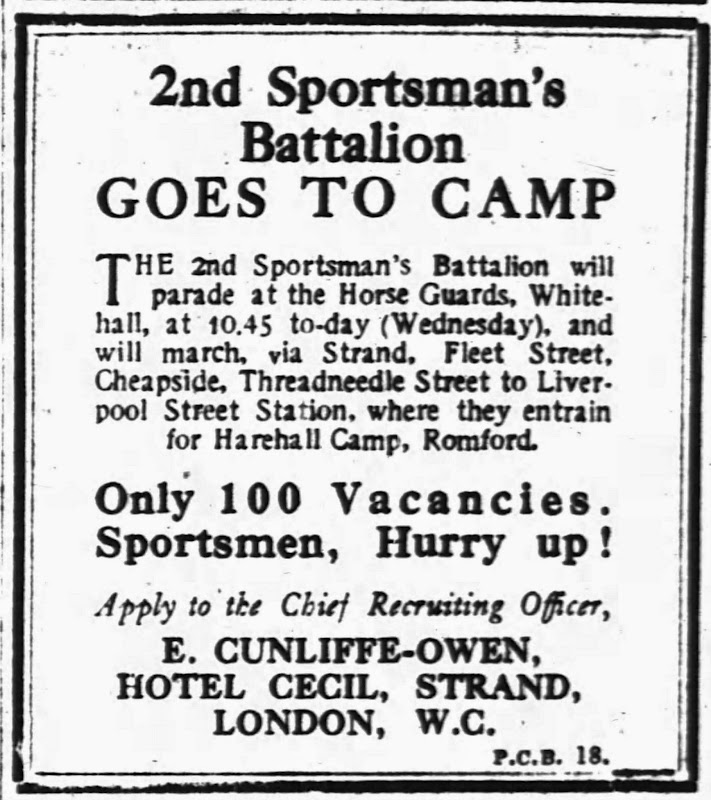
2nd Sportsman’s Battalion

GOES TO CAMP

The 2nd Sportsman’s battalion will parade at the Horse Guards, Whitehall, at 10.45 to-day (Wednesday), and will march, via Strand, Fleet Street, Cheapside, Threadneedle Street to Liverpool Street Station, where they entrain for Harehall Camp, Romford.

Only 100 Vacancies. Sportsmen, Hurry up!

Apply to the Chief Recruiting Officer,

E. CUNLIFFE-OWEN, HOTEL CECIL, STRAND, LONDON, W. C.

Western Times

A GOOD SEND OFF

Departure of the 2nd Sportsman’s Battalion

FROM EXETER

The 2nd Sportsman’s Battalion, which has been raised in the West-country through the instrumentality of Capt A. E. Dunn, and which has since its formation had its headquarters in Exeter, left the City yesterday to go into camp to complete their training for whatever service is before them. The send-off was as encouraging and enthusiastic as could well be, and the cheering crowds that thronged the streets were tribute to the popularity of the Battalion and to a fine body of men.

No won who saw the Battalion – fresh, smart, athletic, and fit as the men are – march through the City with that litheness and swing which betokens perfect physical fitness and vigour, could help congratulating Capt. Dunn on having the proud command of such a splendid body of men. In the best of spirits and keen for service, the men responded cheerily to the ready outbursts of the citizens, the waving of hats and handkerchiefs, and good wishes which were evident on every side. They were not downhearted: they said so themselves many times as they swung through the street between unbroken lines of civilians.

The “fall in” was at 8 o’clock at the top of St. Sidwell’s, and the Battalion mastered promptly and in full force. It numbers 323 of all ranks, and, besides the O.C., the officers are Lieuts Enderby, W.G. Perkins and F. Templeman, with Co. Sergt.-Major C. T. W. Finch.

The Battalion Band, under Sergt. Brock, was there to lead the way with martial music. The band itself, like the Battalion, has made splendid progress and now numbers 20. The played lively and patriotic airs, with “Soldiers of the King” and “Sons of Our Empire” among the numbers rendered.

The route take was through Sidwell-street, High-street, and Queen-street, passing the statue of Devon’s hero, General Buller, and then on to St. David’s Station, where a special train was in waiting. Numbers of friends managed to get on to the platform and there was much hand-shaking and exchange of wishes for good luck. To secure this latter for his battalion on stalwart member had been decorated with an old horseshoe tied with ribbon in the colours of the Allies, which, notwithstanding its hug dimensions, he bravely ad proudly wore upon his breast. The men were soon comfortably aboard the train, which, amid a perfect hurricane of cheering, steamed away on the stroke of 9 on its journey east.

London Standard

BASKET BALL.

An interesting match has been arranged between some members o f the Sportsman’s Battalion of the Royal Fusiliers, commanded by Lord Maitland, and a London basket-ball team. The military side will include Hayes and Hitch, the well-known Surrey cricketers, and amongst their opponents will be J. G. Lee, who has taken an important part in the work of organizing Y.M.CA. recreation tents in various military centres, and Dr. Robert le Cron, the well-known ice-hockey player. No charge will be made to witness the game, which will take place at the Central Y.M.C.A. Tottenham Court-road, on Saturday, at 7.45 p.m.

March 16, 1915

London Standard

SPORTSMAN’S NEW CAMP.

COMFORT FOR THE SECOND BATTALION.

When the 2nd Sportsman’s Battalion (24th Royal Fusiliers) removes its headquarters tomorrow from London to Romford it will enter into the occupation of the most commodious, up-to-date field barracks ever constructed. The new camp in the grounds of Hare Hall, near Gidea Park station on the Great Eastern Railway, has accommodation for the 900 men already enlisted in this battalion, and there is ample room for the erection of many more huts when they are required.

Lieutenant and Quartermaster Stuart, formerly of the 16th Lancers and the Buffs, showed one of our representatives over the officers’ quarters in Hare Hall and the camp in the grounds yesterday.

The only reason why the Hare Hall camp is the best of its kind yet constructed is that it embodies all the very latest improvements that the experience of War Office experts during the past six months could suggest. There are, for instance, a couple of dozen cubicle shower baths, with hot and cold water laid on; the thirty beds in each dormitory hut, though made of wood, owing to the scarcity of iron bedsteads, turn into the wall in the day time, overlapping each other to form seats, and occupying the minimum of space; each hut is lit by electric light; the bookmaker’s, the post office, the tailor’s, and the barber’s stand in a row, and the wet and dry canteens are spacious and extremely comfortable.

In the hall itself the bedrooms have been neatly and simply furnished to accommodate 36 officers. The subalterns sleep four in a room. The colonel has one of the smallest rooms, looking out over the camp, and as simply fitted as the rest. The canteens and store-rooms yesterday were fully stocked with every possible requirement. A hospital with 24 beds had been provided; the drugs were ready in the doctor’s surgery, and sergeant and five men of the R.A.M.C. from Colchester will form the nursing staff.

Already there is a talk of a 3rd Sportsman’s Battalion being formed, but there are still places to be filled in the 2nd. Four companies of 270 men each will be going to the front in June or thereabouts, and 5th and 6gh depot companies will have to be formed to keep the camp going and fill any gaps that may occur in the other companies.

March 12, 1915

Western Times

The 24th Royal Fusiliers (Sportsman’s Battalion) visited Crediton on Wednesday on a route march. About 300 men took part in the march, under Capt. A. E. Dunn and Lieuts. Enderby, Perkins, and Templeman. At the station they were joined by their band, who had come by train. From the station the men marched to High-street, where they were dismissed for three quarters of an hour. On their way to the town they were greeted by the children attending the Haywards Schools. Refreshments were provided at the Liberal Club. The battalion presented a very smart appearance, and greatly impressed the inhabitants.

Western Times

Wishing God Speed to West Country Sportsmen.

Captain A. E. Dunn is justly proud of the West-country men he has recruited at Exeter for the Sportsman’s Battalion. They paraded 280 strong, with their band, this week, and were inspected by the Mayor (Mr. J. G. Owen), who wished them “God-speed, great glory, and a safe return” before they leave for their training quarters in Essex. Our photos show the Mayor, with Captain Dunn and the councillors, inspecting the lines.

March 11, 1915

The Leavenworth Times

RICH; DRAWS ALLOWANCE

But lady Raphael Turns Money Over to Charity Fund.

London, Feb. 25. – (Correspondence of the Associated Press.) – Ever week Lady Raphael, one of the wealthiest women in London, draws the separation allowance of 16 shillings ($4), which the government allows to wives of enlisted men. Sir Herbert Raphael, Bart., member of the House of Commons and trustee of the National Gallery, is now Private Raphael of the 24th Battalion Royal Fusiliers, known as the 2nd Sportsmen’s Battalion, and when not in Parliament is busy drilling in a khaki uniform. He is fifty-six years old, but has led an active life physically by golfing, motoring and shooting. His appearance in a private’s dress in Parliament, of which he is the richest member, while a labor M.P. came there in uniform of an officer, caused considerable comment several weeks ago.

When asked why he enlisted as a private, Sir Herbert replied:

“Because I had no military experience, and I do not think it right to take a position unless one has acquired some experience. I also did it as an example to my constituency.”

He will have to give up his Parliamentary duties when his command moves into its new training camp in Essex, where huts are now being erected. Soldiering, he says, is a fine life and the best kind of exercise.

Lady Raphael adds her government money to her charity fund.

West Briton and Cornwall Advertiser

THE WEST-COUNTRY SPORTSMEN’S BATTALION.

The Westcountry Company of the 2nd Sportsmen’s Battalion of the Royal Fusiliers, which Capt. A. E. Dunn (formerly M.P. for the Mining Division) so splendidly recruited, were inspected at the Castle Yard, Exeter, on Monday, by Col. Western. The Mayor (Mr. J. G. Owen), addressing the troops, said they were men of Devon and Cornwall – Cornwall, whose motto was “One and All,” and Devon, whose motto was “Semper Fidelis.” He was sure that no matter in what tight corner they found themselves they would remember the mottoes of those two counties, and that they would bear in mind not only their oath of allegiance, but also the honour of the dear Westcountry to which they belonged. He was sure they would always uphold the honour of the flag, and in the name of the City of Exeter he wished them God-speed, great glory, and a safe return. – Capt. Dunn tendered his thanks to the Mayor, and, through them, to all the citizens, for the great kindness they had shown the company during the stay in Exeter.

March 5, 1915

Aberdeen Weekly Journal

WELL-KNOWN FOOTBALLERS IN THE SPORTSMAN’S BATTALION.

Lewis R. Lewis (on reader’s left), the Army International footballer, is a corporal in the 2nd Sportmen’s Battalion, and has been appointed captain of the football club of the battalion. With him in the picture is Sergt. Adams, of the same battalion, who played for Fulham this year, and was formerly captain of Southend United.
The Cincinnati Enquirer

HOTEL CECIL, LONDON.

Our attention having been called to the fact that there is an impression in America that this hotel has been taken over by the Red Cross Society, we would take the earliest opportunity to inform you that such is not the case.

The hotel is open to receive visitors as usual. Beyond the fact that certain of the public banqueting rooms are being used for the purpose of recruiting for the Sportsman’s Battalion, there is no interference with the usual course of business.

     Yours faithfully,
          F. M. Hornsby, Manager.

March 3, 1915

London Evening News

“A DRUM! A DRUM!”
          --Macbeth.

The Temple, its cloisters, and its musty old chambers are reverberating with the beat of the drum, and the peace-loving occupants of the fine old rooms in Kings Bench-walk are shutting their windows and “sporting their oaks” in vain.

The sanctity of the various courts is violated by the sound of marching soldiers, hoarse cries of officers, and – the constant beating of a drum.

For some days the 2nd Sportsman’s Battalion has been in possession of Kings Bench-walk and Crown Office-row, owing to the exceedingly “heavy going” at Hyde Park, which ahs made marching a somewhat difficult task.

Crown Office-row is the spot preferred by the men of the battalion because it is on the level, but King’s Bench-walk is the ground more favoured by the officers, for, although it is on the incline, there is more space for manoeuvring.

The Sportsman’s Battalion is a fine body of men, but since their training-ground has been King’s Bench-walk their footsteps show signs of lagging. The “left, right,” of their officers met with slow response from the feet of the men, and so a drum, whose beat should synchronise with the movement of the feet, has been requisitioned.

“It is not the fault of the men,” said an officer to an Evening News representative, “but merely the rise and fall of the parade ground. Our fellows are jolly good on the level, but rather like the ‘bargain motor’ when we tackle King’s Bench-walk. Go well down hill, but a bit slow in climbing and might be relegated to that class styled ‘also ran.’ And the drum is expected to bring about a uniformity of pace.”

In the meanwhile the occupants of the surrounding chambers are begging hospitality from their legal friends who have rooms in more remote corners of the Temple.

And the thousands of birds that usually crowd the score of trees in King’s Bench-walk have migrated to Pump Court, where the branches of the only two trees are bent with their weight.

The Brooklyn Daily Eagle

WAR ECHOES

We strongly deprecate the attempt to introduce snobbery into the New Army by the creation of “class battalions,” and we are by no means surprised that, as in the case of the Sportsman’s Battalions, the attempt has led to criticism and controversy. – London Express

March 2, 1915

Western Times

A SOLDIER’S DEATH

Funeral of a member of the Sportsman’s Battalion at Exeter

At his billet, in Exeter, on Wednesday, there passed away, after a short illness, one of the members of the very fine corps of Fusiliers being raised in the West by Captain A. E. Dunn, and known as the Sportsman’s Battalion. The funeral took place in Exeter yesterday with military honours, the whole battalion, about 200 men and officers, being in attendance under Captain Dunn. The Devon band, under Bandmaster Cox, preceded the gun carriage, playing funeral marches. The coffin, which enclosed the body, was covered with the Union Jack, upon which was placed the deceased soldier’s cap. A firing party was provided by the Devon Regiment, and the buglers sounded the “Last Post.” The Rev. F. W. Gegg was the officiating clergyman. The chief mourner was the father of the deceased, Mr. Powers, of Torquay. The polished elm coffin bore the following inscription on the breastplate: “Private Thomas Powers, of the Sportsman’s Battalion, Died February 36th, 1915, aged 20 years.”

Daily Mirror

CANNOT PUT IT DOWN.

Readers’ High Praise of New “Daily Mirror” Serial Story That Will Make Soldiers.

Our splendid new serial, with its stirring message and charm of romance, has made an instantaneous success!

It is always pleasant to know that our readers are pleased, and throughout yesterday there was abundance of proof of that “Richard Chatterton, V.C.” had found hearty favour.

There is no doubt that it is one of the best serials that have ever been published. Miss Ruby M. Ayers has accomplished a splendid piece of writing.

Many telegrams and letters of congratulation reached The Daily Mirror showing that our readers are in full agreement with our opinion that the new serial is a great story.

Sir William Robertson Nicoll, editor of the British Weekly, telegraphed: --

“The story opens excellently, and I am in the warmest sympathy with its object. It should be read by every shirker to shame him out of his inaction. I look to women with confidence o send their men to the field. I don not doubt you will show the way.”

Another telegram came from the Rev. A. J. Waldron, the vicar of Brixton and the author of “Should a Woman Tell?” His message was:

“Your new serial is very strongly written. It grips from the commencement. You feel that you cannot put it down; you must go on with it. It should prove of great value to both sexes – on behalf of enlistment particularly. I am very pleased to see that it deals with the woman’s side of the war.”

Major H. H. Enderby, Adjutant of the 2nd Sportsman’s Battalion, wired: --

“Your powerful new serial, with its recruiting message, should attract everyone. The interest taken by your paper in the burning question of the hour – the enlistment of soldiers – is laudable in the extreme.”

The further you proceed with the story of “Richard Chatterton, V.C.,” the more you will realize that is it one of the greatest human serials every written.

March 1, 1915

Hull Daily Mail

HULL SOLDIER-MINISTER.

REV FRANK EDWARDS’ ADDRESS

FINAL OF “ENGLISH CUP.”

The Rev Frank Edwards, now sergeant in the 2nd Sportsman’s Battalion in London, left Hull to-day after a brief furlough. Since the Rev Edwards enlisted, other ministers have followed his example. Formerly minister at Brunswick Wesleyan Chapel, Sergeant Edwards would hardly be recognized in his khaki, a well-se up broad figure with the ruddy glow of the open-air life on his face. He had not wasted his short leave, for yesterday afternoon he addressed a large gathering of men. The Rev Edward has had other experiences of being with the troops, for he was a chaplain, or “padrie” as the men say, in South Africa, and had the unique experience for a chaplain of being promoted by Lord Roberts to a captaincy on the field for distinguished conduct. In that campaign he got too near the firing line and was wounded. He joined the Sportsman as a private, and admits that, having had his title changed so many time, it is quite confusing. “I have been called so many names during the last month,” he said, “that I have difficulty in determining my proper title. It is a very short while ago, indeed, that I was minister at Brunswick Chapel. Then I joined the Sportsman’s Battalion as a private; I was promoted to lance-corporal, and swaggered about as such for a fortnight, when they made me corporal, and now I am on the list as a sergeant.”

GREATEST INTERNATIONAL GAME.

When the Rev Sergeant Frank Edwards yesterday afternoon, found himself on the platform of the King’s Hall he should have been inspired by his audience. The bottom of the hall was occupied by the members of the Brotherhood, and in the capacious galleries was a great proportion of the elder children of the 1,500 Sunday School scholars. It was no easy matter to address so diversified an audience, and Sergt. Edwards reminded them that it was a long time since he had addressed a public gathering. He was, however, soon at home, relating little incidents of the South African War, and deducing spiritual lessons. “We are all sportsmen in this great international crisis,” he remarked, “and God and our country is calling us to play the game – the greatest international game ever played. We are living in the greatest time since the birth of Christ. We are playing for the English Cup – the cup from which you and your children must drink for generations to come, and now is the time to determine whether it shall be the cup of liberty, freedom, and honour, or whether it is to be the cup of tyranny, oppression, and servile feat. God and our country is calling upon us to ‘play the game.’”

CALL TO MEN AND WOMEN.

The call which is now coming to us as men and women of England is to do our best for our country; and there is much in common with the call that also comes to us to play our part in the Kingdom of Christ in the great conflict with darkness all around us in this world. Speaking of his battalion, Sergt. Edwards remarked that one of the bases of it was sacrifice. They had men of all professions in it – men who had given up their professions and everything at the call of King, country, and duty. They had a member of Parliament and a millionaire as privates, and the latter was to be seen in his shirt sleeves like the rest, working at the humblest tasks. They had men from all parts of the world – Corea, Japan, South America, the backwoods of Canada, Australia, New Zealand, Shanghai, Russia and Texas, and there had been some remarkable re-unions amongst these travellers.

Sergeant Edwards made a great impression with his address. He was accompanied by his wife, and on the platform were the Rev R. M. Kedward (president of the Brotherhood), Mr Fred Till (the chairman), Mr Fred J. Craft, Mr J. Brown (vice president), Mr R. H. lee, Mr Bowman (stewards), and others. Miss Winnie Henson sang a solo most effectively.

February 25, 1915

Daily Mirror

MISS RUBY AYERS’ ROMANCE IN KHAKI.

Miss Ruby M. Ayers, who is writing our new serial, which begins next Monday, discussing her recruiting idea with Colonel A. de B. V. Paget (in the centre), commanding the Sportsman’s Battalion, and Major Enderby.

February 23, 1915

Western Daily Press

CLIFTON FOOT HARRIERS – Owing to the death of Captain Bruce Melville Wills, Wessex R. E (killed in action), and of Mr. Hamlyn H Perham, Sportsmen’s Battalion, Royal Fusiliers these hounds will not meet to-morrow (Wednesday).

The funeral of Mr Hamlyn H. Perham, late of the Sportsman’s Battalion Royal Fusiliers, will take place too-day, at Flax Bourton Parish Church, at 3.45 p.m. The rector (the Rev. F. Tracey) made a feeling tribute, in his sermon on Sunday, to the deceased’s loyalty and devotion to duty.

The Times

BOXING AT THE N.S.C.

DENNY BEATEN BY DELANEY

The chief event at the National Sporting Club last night was a 200-round contest between the light-weights, Private J. Delaney (23rd Royal Fusiliers, Sportsman’s Battalion) and J. Denny (New Orleans) for £330. Delaney won in the 14th round.

After a quiet start Delaney forced the pace finely in the second round. He again took the honours in the third round, and Denny had to act chiefly on the defensive. In the fifth round Delaney kept his opponent away and scored fast, owing to his superior pace and ring tactics. The American was quite out classed, but was game until the end. At the close of the 14th round Denny’s seconds gave in for him.

It was Denny’s first appearance in this country. His record in America is an excellent one, and before the fight he and Kid Lewis were regarded as the most formidable opponents for Fred Welsh.

The Courier

JERRY DELANEY BEATS THE NEW LIGHT-WEIGHT.

YOUNG FOX, OF LEEDS, DEFEATS LAFFERTY.

With a card of a most attractive character arranged it was not surprising to fid a big attendance at the N.S.C. last night.

Jack Denny, the newly-arrived light-weight, was down to meet Jerry Delaney (who is now a private in the Sportsmen’s Battalion) over 20 rounds for £100 a-side and the Club purse. The articles stipulated that the men should weight 9 st. 9 lbs. Delaney was 2 lbs. inside, but the American went a quarter of a pound over, and it was only after severe skipping bouts that he passed the scale at the third time of asking.

The event of the evening, however, was a 20-rounds bout in the eliminating contest for the bantam-weight championship between Young Fox, of Leeds, and Alex. Lafferty, who claims to be the best lad of his weight in Scotland. Looking fit, the Scot pulled down the beam at 8 st. 5 ¾ lbs., Fox being ¾ lb. lighter.

Before the proceedings opened there was a little speculation over both matches, Fox at 6 to 4 on, and Delaney 5 to 2 on being respectively favourites.

FOX RECOVERS FINELY.

Of the two chief events, the bantam-weight contest came first. It went the full twenty rounds, but to a great extent was disappointing, as the Scot failed to justify the high opinion formed of him, and Fox won well on points. The Leeds man had a good pull in the matter of reach, and took full advantage of it, getting over or breaking through Lafferty’s guard time after time. Lafferty tried in-fighting both in season and out, but wasted a lot of well-intentioned right-handers. All the same, the Scott had the better of the opening rounds, and in the third Fox was down. Indeed, the latter looked like a loser for five rounds, but in the sixth he suddenly found his form. He then began to avoid the Scotsman’s left leads, and after doing a lot of good work toppled Lafferty over in the seventh round with a clip on the chin. From this point all the cleverness and generalship were on the side of Fox. Lafferty was always game, and right up to the sixteenth round exhibited pace, but he became very ragged towards the close, and, as already said, Fox won with a bit in hand.

DELANEY’S JUDGEMENT.

The Delaney v. Denny bout was a warm one. Delaney forced the work to commence with, and, hitting with plenty of force whilst paying particular attention to the fence, he outfought the American generally. By the end of the fifth round, Delaney had established a good lead. Denny adopted covering up tactics, but without being able to keep Delaney’s left out of his face. The Yorkshireman’s judgment was first-class, and he inflicted such severe punishment that at the end of the 14th round Denny was hopelessly beaten. The New Orleans man showed nothing like championship form at any part of the contest.

THREE GUINEA RECRUITS.

FRESH APPEAL FOR FUNDS BY MRS. CUNLIFFE'OWEN.

“KIT” MYSTERY.

Mrs. E. Cunliffe-Owcn, the chief recruiting officer of the Sportsman’s Battalions, who recently wrote to the “Daily- Express” stating that “men joining this battalion in future will be expected to pay a minimum of three guineas and be of the upper and middle classes,” has resumed her letter-writing activities and appeals for money.

A “Daily Express” correspondent writes that, although he, “like many others, had sent a subscription (£5) to the Sportsman’s Battalions,” he has now received another appeal in the form of the following letter:—

     Dear Sir,—The War Office have now called for an extra 500 men for the 1st Sportsman’s Battalion, which is in camp at Hornchurch, Essex, and have also authorised the immediate raising of a 2nd Sportsman’s Battalion of 1,600 men, making a total in all of 1,900 men still to be found.
     The camp and men at Hornchurch are considered to be second to none in the New Army, and the 2nd Battalion will be quite as good.
     The raising of these battalions places a severe strain upon our financial resources, and funds are urgently needed, as only a portion of the expense incurred in raising and equipping these battalions is recoverable from the War Office. May I ask you to kindly send a donation?
     Cheques should be made payable to me at above address, and crossed 2nd Sportsman’s Battalion Royal Fusiliers.
     If you could induce any of your friends to assist financially I should be most grateful. —Yours faithfully,
          E. CUNLIFFE-OWEN.
     Hotel Cecil, Strand, Feb. 19, 1915.

What has Colonel Viscount Maitland to say to this now appeal on behalf of his battalion?

UNANSWERED QUESTIONS.

The three questions asked in the “Daily Express” on February 5, however, still await answers.

The questions are :—

    1. How much money has been received ?
    2. How has the money been spent ?
    3. What is the present balance or deficit?

A new element of mystery is introduced, by a sentence in the following remarkable advertisement which has appeared daily in the “Times” for several weeks:—

1st and 2nd SPORTSMEN'S BATTALIONS, ROYAL FUSILIERS. Colonel-in-Chief, the King. C.O. 1st Battalion. Colonel Viscount Maitland. C.O. 2nd Battalion, Col. A. de B. V. Paget (His Majesty’s Bodyguard). Sportsmen, age 19 to 45, upper and middle classes only, Wanted at Once. There are still vacancies. Entrance is 3 guineas, or kit. No other financial obligations. Head Recruiting office, Hotel Cecil, London, Hours, 10 a.m. to 6 p.m. daily.

What is the precise meaning of the phrase:—“ Entrance fee 3 guineas or kit”? The “Daily Express” understands that the Army authorities make an allowance of about £7 or £8 for the kit.

February 22, 1915

Daily Record

SOLDIER FOOTBALL PLAYERS

(1) Corporal Lewis R. Lewis, captain of 2nd Sportsman’s Battalion Football Club; (2) Sergeant Adams of the same battalion, who played for Fulham.

February 20, 1915

Edinburgh Evening News

Among the recruits for the Sportsman’s Battalion are C. P. McGahey, of the Essex XI; McIvor Jackson, the Surrey cricketer; Harry Packer and Lewis H. Lewis, the Welsh footballers; the big game hunters, Reginald Cooper and W Burlton; C. Mitchell, a son of the champion boxer of the eighties; and Ted Heaton, a noted swimmer, who only failed to cross the Channel by a quarter of a mile.

Essex Newsman

FIRST COURT

BEFORE E. NE. BUXTON, ESQ.

(With whom sat Jus. Tabor, Dale Womersley, and Al. L. Woodhouse, Esqrs.)

Charge Against Contractor.

Joseph Bysouth, 43, a contractor, on bail, was indicted for stealing 28 lb. bacon, 6 lb. of meat, and other goods of Colonel Viscount Maitland, at Hornchurch, on Jan. 30. – Mr. E. H. Tindal Atkinson prosecuted; Mr. C. E. Jones defended.

Lieut. and Quar.-Mastr. Robert de Vere Stacpoole, attached to he 1st Sportsman’s Battalion, stationed at Grey Towers, Hornchurch, stated that owing to the shortage of rations which had been noticed orders were given that all persons passing out of the Barracks on a certain day should be stopped. He had control of the contracts for removal of refuse from all parts of the Barracks, with the exception of the canteen. On the afternoon of the day in question he went to the guardroom in consequence of a report, and there saw the goods which were the subject-matter of that indictment. The bread was Army rations bread, and had nothing to do with the canteen at all. Cross-examined, witness said the stores were contracted for at so much per day per man. He could not say whether the bacon and meat were ever issued by the contractors to the regimental storekeeper. The bread was sub-contracted to a local baker. Witness could not say whether or not the baker would make more loaves than were requisitioned; he might do so.

Pt. Chas. F. Branson gave evidence as to stopping prisoner as he was leaving the main gates with a van. He had received orders to stop everyone. -- Cross-examined: He did not know how prisoner got into the Barracks. He did not see him go in.

Sergt. Gill, who examined the content s of prisoner’s van, and took prisoner to the guardroom, stated that he found in sacks the goods mentioned in the charge. Prisoner, asked to account of for the goods, said he got the stuff from the pig swill tubs. The bread was quite new, good bread.

P.s. Crowe stated that when he questioned prisoner at his house prisoner said he had a contract to remove the swill and rubbish from the canteen. He saw the two sacks and removed them as rubbish.

Jas. Dawson, a farmer and contractor, said prisoner gave him a pass into the barracks for the purpose of collecting swill and rubbish. On the Saturday in question he collected the refuse as usual in the morning. His arrangement for collecting the refuse was made with the prisoner; he was to pay prisoner what he thought the refuse was worth.

William John Beck, clerk at the canteen, stated that the canteen yard where the refuse tubs were was locked from Saturday noon until Sunday evening, and he (witness) went to London with the key in his pocket.

Thomas Shaw, manager of the regimental canteen, said refuse from the canteen was put into tubs in the canteen yard. He had never seen refuse put outside the tubs, and did not know that it was done. Prisoner made an arrangement with him whereby a Mr. Dawson removed refuse from the canteen yard on prisoner’s behalf. The refuse from the canteen might contain bread in small portions, but never whole loaves. Only Dawson had the right to remove refuse. – Cross-examined, witness could not say that the bacon and meat had ever been issued to the military authorities. Dawson was instructed only to empty the swill tub.

Prisoner, sworn, stated that as cartage agent for the Midland Railway he had to take goods to the barracks, and was there frequently. He had an arrangement with Mr. Shaw, the manager of the canteen, by which he employed Jas. Dawson to take away from the canteen yard the refuse in the tubs. On the Saturday afternoon in question he (prisoner) took about 7cwt. of butter and margarine to the barracks. He arrived there about 2:30 and delivered the butter to Mr. Beck at the warehouse. Having delivered the butter, he had a look at the tub. He saw two sacks by the tub. In one was a piece of bread. He did not look any further, but put the sacks in his van, and drove out by the main gates. A sergeant stopped him and said, “What have you got – anything good?” He (prisoner) said, “You had better jump up and have a look.” The sergeant did so, and found a loaf of bread. He asked prisoner where he got it from, and he said from the swill tub. After looking again the sergeant said he must go to the guardroom. At the guardroom a further search was made. He told the sergeant that he took the sacks from near the swill tub and believed they were refuse.

Evidence as to prisoner’s good character was called.

The jury found prisoner guilty, but recommended him to mercy on account of his previous good character.

The Chairman, in passing sentence, said the Bench were very sorry to see prisoner in that position. They agreed entirely with the verdict, and at the same time would take into account the recommendation of the jury to mercy. It was a very serious offence, however, and he was afraid was a kind of thing that went on a good deal at these camps, where, it being difficult to keep watch, a good deal of property was removed. Lieut. Stacpoole had said that this had been going on at Hornchurch for some time, but the Bench would not go back, and would deal only with what had happened on this occasion. The sentence would be four month’s hard labour; if it had not been for the commendation of the jury it would have been more.

Nottingham Evening Post

SECOND SPORTSMAN’S BATTALION.

NOTTS. GENTLEMAN AS MAJOR

Captain H. H. Enderby, the Adjutant to the Second Sportsman’s Battalion, Royal Fusiliers, has been appointed major. He is well known in Nottinghamshire as a rifle shot, and shot at Bisley for years; he had the distinction of making 25 successive bulls at 500 yards at the Retford Rifle Range, and was one of the first superintendents of the Retford Miniature Rifle Club.