
EDITORIAL
When one has the leisure to look back upon the happenings of the past few months, the thing which stands out with greatest prominence is the contrast between our present state of mind and the heroic resolves which stimulated our pulse beats and brought us all hot foot to the Recruiting Office.
What strange coma has descended like an all-enveloping mantle on those who were once so keen?
We had heard of Belgium’s wrongs; we were full of noble pride when we remembered that our country had not hesitated to go to war to uphold her honour; we felt capable of any sacrifice, and yet all the ginger seems to have gone out of us, and we worry ourselves to death about little things which are as nothing at all when we remember the dangers and difficulties which our boys are facing in France.
I do not wish you to think for a moment that I put myself in a different class from the rest. Not a bit of it. This is an entirely impersonal Editorial, in which I am endeavouring to find the reason for a curious psychological condition.
“Why was Jones made a Lance-Corporal instead of myself?”—“I wonder if I shall get a week-end pass?” these are questions which agitate the brains of most of us at one time and another.
Men of all classes, men from all lands, drawn together by a common bond-—submitting to discomfort, and lacking, maybe, those many little niceties which go to make this life endurable-—living together in a great camp; taking orders from their N.C.O’s.—not commanding as hitherto; hard at it day in and day out drilling, trenching or on fatigue. Is it to be wondered that in time the mind descends to the paltry? I think not.
We are splendid material, and all we need is a little imagination—something to fire us with the zeal which was ours before.
The drudgery of our training is almost at an end, and shortly we enter upon a new era, when each day will bring its novelty and we shall feel proud to think we had the courage to endure. You cannot turn untrained men into soldiers in a week or a month, and it is a certain fact that it takes the man of culture far longer to pack his brain with the cells which enable him to automatically obey the command of his instructor than the “swaddy” who has neither breeding nor education.
Perhaps the reason is here? The finer clay is more difficult to mould, but once fired I am convinced you will have the finest Battalion of Infantrymen Great Britain has ever seen.
Good luck to the First Sportsman’s Battalion! May it prove to the Germans that the British sportsman knows how to play the game of war.
THE EDITOR.
BATTALION NOTES.
The noteworthy item in the week’s programme has been the field exercises which have been enjoyed by all.
All ranks are warned against communicating information respecting the strength and disposition of H.M. Forces by Telephone, unless the recipient has sure information regarding the identity of the enquirer—a precautionary measure, the wisdom of which will be apparent to all.
There has been an extremely interesting schedule of Musketry Instruction during the week, and in connection with this it is pleasing to note that 2nd Lieut. Cragg has qualified at Hythe as 1st Class Instructor of Musketry.
Quite a large number of recruits have been added to the Battalion Roll since our last issue.
L.-Corp. J. A. Turnbull has been appointed Acting Corporal, and Pte. A. Gaddis has been appointed Lance-Corporal.
The health of the Camp is splendid, and the ban on visitors was removed on Saturday, March 6th.
ST. PATRICK’S BALL.
The Privates of the 1st Sportsman’s Battalion are giving a Subscription Dance at the Drill Hall, Hornchurch, on Wednesday the 17th inst. at 8 p.m. By kind permission of the Colonel Commanding, Viscount Maitland, extension of time to 2 a.m has been granted. It is the intention to ask 15 members of each Company to become subscribers. The cost of a subscribers ticket is 5s., which will entitle the holder to a ticket for himself and two complimentary tickets for a lady and gentleman or two ladies. These tickets will include light refreshments. A special bar for wine and sandwiches will be provided.
The Regimental Band, under Sergeant Almond, will be in attendance. All information respecting the dance can be obtained from the Hon Sec, Pte. F. G. Harris, Hut 13,
A WORD WITH FREEMASONS.
A meeting of a few of the brethren was held on Wednesday evening last, under the Chairmanship of Bro. the Rev. A. J. Parry; it was then decided to summon a mass meeting of the brethren in the Battalion for the purpose of deciding whether or not it is desirable to hold a Craft Re-union Dinner at an early date.
The meeting will be held at 8.30 p.m. on Thursday next at the Drill Hall and the presence of every brother is earnestly requested.
The further business of the meeting, should a dinner be decided upon, will be to elect an Organising Committee and Secretary and brethren outside the Battalion are cordially invited.
Those intending to come are invited to communicate with Pte. G. Vernell, Hut 35, who is acting as temporary secretary.
OUR REVIEW.
We have received from the Oxford University Press a copy of “What every Soldier ought to Know,” price Twopence, which contains a great many hints to the soldiers in the field.
We have also received from Messrs. E. Marlborough & Co., copies of the English-German “Soldiers Language Manual,” price Threepence, and “A Simple French Song and Play Book,” price Threepence.
The February Number of “Health and Vim” contains several interesting photographs of the First Sportsman’s Battalion.
THE REGIMENTAL BAND

Nothing in the Battalion has improved so much as the Regimental Band. Extravagant praise, perhaps, but there is not one amongst us who would not subscribe to the sentiment.
Started in a small way the advance has been so marked that the band can now almost vie with the best.
This result, is in no small measure due to the Bandmaster, Sergeant G. L. Almond. Experienced in military discipline with an excellent knowledge of music, Sergeant Almond possesses in a rare degree the faculty of getting the best out of his men.
Time, tone and articulation have all received attention, while the excellence of the attack or decision is most marked, and the general effect is good.
Sergeant Almond studied for Kneller Hall, and later was with the Royal Artillery mounted band as principal cornet player and one of the first violinists.
His other experience was gained while for 12 years with the Prince Albert Somerset Light Infantry Regiment.
His work is backed wholeheartedly by the Band President, Major Richey, the Band Secretary, Captain Church, and we believe by every member of the Battalion.
Comprising at present thirty members it is expected shortly to get up to the full complement of thirty-five. The aim is to combine classical with popular music and no standard work is beyond the scope of the players. Their usual programme comprises something like the following:
(1) March—“A la Militaire.”
(2) Overture—“Rosamonde.”
(3) Waltz—“Le Sang Roumain.”
(4) Selection—“Chocolate Soldier.”
(5) Serenade—“La Polonia.”
(6) Patrol—“Irish.”
while combined with the bugles the best-known item is the Allies march “Somme and Meuse.”
The items are of course varied as circumstances demand, but the whole gives one some idea of the versatility of the performers.
The repertoire is constantly being enlarged and it is hoped shortly to give concerts both in the evenings and Saturday and Sunday afternoons.
There are no Star Performers in the crowd, but each and every member gives of his best.
Herein lies the success of the band.
FOOTBALL NOTES.
RUGBY.
SPORTSMAN v. 2nd BATT. 6th LONDON RIFLES. SPORTSMEN STILL WIN.
On Saturday last our team after varied checks arrived at Bullock Hill to play the London Rifles. There were a few changes in the team as Stretton was playing again, and two members of the side missed their connection at London Bridge. Dalrymple filled one of the vacancies. It is a pleasure to note that our forwards scrummed so much better this week, and throughout the game got possession. Micky Reynolds gave a great deal of confidence to his other men, and although in following through he was not always properly supported, the crowd as a whole showed much better combination. The ball is still sticking in the back line of the scrum, and if we want to win to-morrow when we play the H.A.C. we must pack better and get the ball well out.
The first half was in our favour and forward rushes headed by Reynolds, Clemetson, Gilmour and Thompson led to two tries being scored by Williams and Wadham.
The combination of the three-quarters deserved a better fate even than two tries, for throughout the game the backs were all across the field and every run gained ground. Wadham was found to be a good handful to tackle for on his fast runs lie used his weight well, drawing the opposition, and giving William good openings, which were always well used to advantage.
Dalrymple played well at half, and as usual Henri was always to the fore. We had the best of the line outs and Clemetson and Gilmour used their height and weight in gaining possession supported well by Stretton, Thompson, and the other forwards, and almost invariably making ground for us.
We had a strong wind to play against during the first half and the fitness of our team proved itself all through the game. The elements being more favourable of course helped us considerably in the second half. Shortly after commencing, from good forward play Henri got the ball from Dalrymple and passed to Wadham, who passed it to Williams to cut his way through the opponents and score a fine try. An attempt at kicking was not successful. Shortly after this, again getting possession of the ball, Wadham ploughed his way through the opposing team and scored the try of the match, which was converted by Clemetson. The Rifles attacked well, but were rarely dangerous except in the first few minutes. Their full-back played well for his kicking was hard and well judged. Farr, who played at full-back for us instead of Scott was good both in ing and fielding the ball and saved his team by excellent touch finding. Unfortunately Scott- Tucker shortly after half-time had to retire thus leaving us with only six forwards. Still Ave played well together and pressed hard and were unfortunate in not getting over once or twice when suddenly Brace, the Rifles left wing man kicked the ball from midfield, followed it up, picked it up rather luckily and crossed the line for the home team, amidst great jubilation. The goal was just missed, and after a few minutes pressure from the Battalion side, time was called leaving us victors by 16 points (2 goals, 2 tries) to 3 points (one try). Forward we hold the advantage, although Roller, Norris, and Bert Smith played a good game for the Rifles. At half we had the pull, the homesters finding it hard to cope with our pair, especially with Henri’s tricky tactics.
We are greatly indebted to Lieut, and Quartermaster Howell for his excellent judgment as referee and other kind attentions.
We were entertained at dinner after the match and did ample justice to the good fair. We hope to be able to show our full appreciation later when the London Rifles come to Hornchurch as our guests.
Teams:
London Rifles—Full Back: Capt. Tucker; Threes: Rfm. Austen, Cpl. Knight, L.-Cpl. Woodcock, and L.-Cpl. Brace; Half Backs: Rfm. Dimmore and Rfm. Parker; Forwards: Lieut. Ford, Bert Smith, Lashbury, Keller, and C. F. Keller, L.-Cpl. Norris Cpl. Dyce and Rfm. Norman.
First Sportsman’s Batt. F.R.—Full Back: Farr; Threes: Salvesen, Wadham, Williams, and Spurway; Half Backs: Henri and Dalrymple; Forwards: Reynolds, Clemetson, Gilmour, Thompson, Stretton, Scott Tucker, and Whitlock.
The game on the Battalion ground on Saturday is against the H.A.C., and -with our opponents anxious to wipe out the previous defeat a very stern struggle should be witnessed. The fact that Coverdale and K. Horan the Blackheath halves figure in the side should be an attraction to all rugby enthusiasts.
The kick-off is timed for 3.15 and visitors will be welcomed.
“FULL BACK.”
ASSOCIATION.
DISAPPOINTING GAME WITH HAMPSTEAD.
The Battalion Football score, at least, as far as the Association Code is concerned, was very low on Saturday.
Her we lost to the R.A.M.C. from Brentwood, in a game which beggars description, by 8 goals to 3, while at Hampstead the margin against us was 3 goals to nil.
This is the second time that Hampstead have taken toll of us with, a side which man for man is not our equal.
On Saturday in a bustling game we were beaten for pace, our attack lacked sting and we never really settled down to give of our best.
The fact that the two newcomers to the side did not come up to sample may have caused the remainder to lose confidence, the ground, which from the touchline appeared to be in good order, developed on close inspection a series of small holes, which caused the ball to come off at unexpected angles, the ball itself was misshapen and the official controlling the game showed a lack of the finer points which caused irritation to some of the players.
Any one of these reasons may have contributed to the non-success or perhaps it was a mixture of the lot.
Read the story and judge for yourself.
Hampstead were aggressive from the start, Littlewort, Ewing, Rawling and Higgins all being called upon before the ball was eventually cleared and a move started towards the other end, where the Hampstead goalie was forced to rush out and save. Ewing, playing at left half, started off in great style but quickly tired and the Hampstead right wing were not slow to take advantage of the fact.
Always dangerous, it was from this wing that the first goal came, Pike the outside man raced away and sent the ball across to Christie at outside left. Christie’s shot was only partially cleared by Kirton and Pike rushing in scored from the rebound.
From the restart Sandham made ground on the right. He was weakly supported by his inside man and his final pass was charged down, Littlewort being called upon to check Humphreys. The elder Hendren got away on the left and Owers was unfortunate in being a shade too late to receive the centre. The Hampstead side took up the running again, Gooding sending behind and Christie trying another dropping shot, this time without effect. It was during this period of the Hampstead attack that a penalty was awarded against Higgins for a reason which was not very clear. Kirton, however, saved in great style and the situation was relieved. It must not be thought, however, that the game was entirely one way, for after Hooper and Horbury had found the two Hendrens a tough handful the Hampstead goalie was forced to run out and save from Sandham. Littlewort started a movement in which J. Hendren, Owers and E. H. Hendren all took part; in spite of many brilliant solo efforts this was the first really combined move of our forward line. Offside against Pat Hendren spoiled the finish. He was in evidence a moment later with a centre to Owers who struck the crossbar with a great shot. That it did not score was distinctly hard lines for the Battalion side, as the Hampstead goalie was well beaten. Hereabouts, too, a goal would have steadied the side and changed the whole aspect of the game. Things, however, were running badly for the Battalion and a little later Gooding put Hampstead further ahead with a surprise shot after a period of uninteresting play.
Generally our forward work was patchy but another combined effort just before half time left Harry Littlewort in possession. The centre half was badly fouled just outside the penalty area and from the free kick the ball was sent behind. A case in which the punishment did not properly fit the crime.
Owers was early prominent in the second half, heading the ball just past the post. Hampstead retaliated and forced a corner off Lewis. This was saved at the expense of another which was safely dealt with. E. H. Hendren, with a splendid run forced a corner at the other end and Jonas, the Hampstead centre half relieved. Lewis was forced to save from Christie by sending into touch. Fraser performing the same office for Sandham at the other end. Hopkins at inside right was still weak, and Pat Hendren, Owers and Littlewort continued to get the lions share of the work, Littlewort sending just over the bar with a terrific drive land Owers shooting behind from a move initiated by Hendren.
This was the signal for a fresh Hampstead attacking and Christie forced a corner, and the latter shot badly when well placed. Kirton saved brilliantly from Humphreys and then a breezy war between Referee and players delayed the game for a moment. Followed, a livener from the elder Hendren, the Hampstead goal-keeper only just saving his shot for Sandham to send behind on the return. Hendren himself just missed the mark with another shot.
There was always an amount of promise about the Battalion work which was never quite realised, and Humphreys properly put the lid on thing’s by scoring number three for Hampstead after a single handed run.
Littlewort, Owers and Hendren gained a corner and Hendren just failed to get home with one of his “specials.” Owers made a sort of despairing solo effort towards the end which almost brought about a score, but the work generally was not of convincing style which we are wont to expect of the Battalion side.
An improvement is looked for in the match next Saturday against Maidstone United at Maidstone.
The game is for the benefit of the widow of the late groundsman and trainer, and the kick off is timed for 3.15.
The sides last Saturday were: —
Hampstead Town—Goal: Winyard; Backs: Hooper and Horbury; Halves: Pollock, Jonas and Fraser; Forwards: Pike, Gooding, Humphreys, King and Christie.
Sportsman’s Battalion—Goal: Kirton; Backs: Higgins and Rawling; Halves: Lewis, Littlewort, and Ewing; Forwards: Sandham, Hopkins, Owes, Hendren and E. H. Hendren.
“PITCHER.”
PRIVATE CHARLIE DILLON.
The incomparable dame of many pantomimes.
 Everyone in the Battalion knows Charlie, whose picture reproduced on this page shows a very different Charlie from the cheerful old lady who has appeared in Great Britain’s greatest pantomimes during the past 17 years.
Charlie has toured Australia three times, has visited Canada and has appeared in nearly every one of the principal Music HaIls throughout the world, besides going the rounds of the Moss and Stoll tour no fewer than eleven times.
That Charlie is a man of resource is proved by an incident which occurred at a well-known West Coast resort. I will relate the story in Charlie’s own words.
“Everything was all right; the play had been well boomed, and the house was crowded to suffocation. I had seen nothing of the guv’nor all the afternoon, but had heard he had accidentally come across an old school chum. Just as I was about to ring the Curtain up, to my astonishment the boss and his pal both walked on the stage—one loaded with bottles of Champagne, the other with a tray of oysters in his hand—the pair followed by several ladies of the company. I at once pointed out that we were already four minutes late in ringing up the Curtain and that the audience was becoming impatient. No notice was taken and putting the good things on a little table they commenced to open oysters and draw corks. A further protest, still no notice, at last losing patience I cried ‘ look here gentlemen, if you don’t clear out at once I shall ring up the Curtain!’ ‘All-right, me boysh, ring up the housh, if you (hic) lik’sh.’ All this time the audience were whistling and banging as hard as they could go. Seeing that all persuasion was useless, I rang up the Curtain. The effect was marvellous. One sat sucking oysters, another drinking Champagne from the bottle and still another pouring it out into glasses. You should have seen the scramble to get to the wings. There they were falling over one another, some tripping up over property, and the audience fairly shrieking with laughter. It was the funniest thing I have ever seen.” Charlie, whose name and faint brogue betoken him a native of Erin is a keen cricketer, and has proved himself a very useful bat. Now he is learning the art of war and seems to be making splendid progress. Good luck to him.
WEEK-ENDER.

THE LONG AND THE SHORT OF IT.
Sergeants Waterman, West and Whitehead.
FAMOUS CRICKETERS IN THE BATTALION.
(Series continued).
A. SANDHAM (Surrey).
 One of the most promising young cricketers in the Battalion is A. Sandham of Surrey, now a private in “B” Company.
Sandham comes from Mitcham, a famous cricket nursery which has already given us Tom Richardson, Strudwick of Surrey and Bale of Worcester. Sandham is no mean addition to the trio although he has not yet had an opportunity to show his qualities to the full.
Surrey has been so full of talent during this last few years that Sandham has good reason to be proud of the progress he has already made and when the time comes he should develop into one of the mainstays of the eleven.
Joining the Oval staff four years ago he served a short apprenticeship in the second eleven and was given a chance with the premier side in his first season. In his first important match he got 50 against Cambridge and followed up with 60 against Lancashire in his maiden county effort.
During this season he was remarkably successful with the bat, scoring a total of 3,000 runs, including nine centuries. True these were not all obtained in county cricket but a man who can get a century in any class of cricket is always a good man to have on your side. Four of the centuries were made on four consecutive days, two for the Club and Ground, one for the Surrey Second eleven and one for his old club Mitcham.
Sandham’s highest effort was 196 against Sussex in 1913, when he was associated with a partnership of 290 for the fifth wicket.
In club cricket, too, he was responsible, with Jack Hobbs, for putting on 312 for the first wicket against Godstone.
In cricket as in other walks of life kings sometimes run in grooves, and for a while last season Sandham was unable to avoid the L.B.W. decision. Five times in six innings he was out in this way before he could break the spell.
A safe long field and a bat of the steady order Sandham promises to be an able follower of previous Surrey giants. Certainly he is a worthy addition to the Hayes and Hitch combination which the champion county has already given us.
Better known as “Cheerful Charlie” he carries the virtue of steadiness almost to the extent of gloominess. He seems to take life as seriously as his cricket and should his success be proportion, Sandham is in for a real good time.
FRANK WINCHCOMBE.
Mainly About People.
Notes concerning members of the Sportsman's Battalion.
Harris, F.G. (Private).—Born St. John’s Lewisham. Educated Deptford Grammar School. Principal largest Science, Art and Commercial School under London County Council, and afterwards Inspector of Schools. At one time music master at the Roan School, Greenwich. Captain and Secretary of Football, Swimming, Rowing, Boxing and Golf Clubs. He is at present the popular Secretary of the Regimental Rugby Club besides being the organiser of many other social events in connection with the Battalion.
Harrison, Jack (Private).—Well-known boxer, was in Grenadier Guards, 1907-10. As soon as he discovered he could box he took it up seriously, and his series of minor successes culminated in his winning the Lonsdale belt for the middleweight championship at the N.S.C. in 1912; he beat his opponent, Sergt. McEnroi (Irish Guards) on points. While with his regiment he won the heavy-weight championship of the Brigade of Guards (1909), after the previous year winning a middle-weight open competition at Windsor. His engagements at the N.S.C. have included victories over Dai Thomas (knock-out in eighth round); George Beckett (on points), fifteen rounds; and Rutherford, of South Africa. In 1913 Harrison went to America, and while in a weakened condition he met Eddie McGooty, whho knocked him out in the first round, fracturing his jaw, and he was thus prevented from defending his claim to the Lonsdale belt that year. Two other fights in America were won—Jammie Smith and another reputable pugilist; in each case there was no decision.
Wharton, Alfred Burden (Corporal).— Originally in Legal Profession. Well-known London entertainer. Been connected with all sorts of theatrical work. Manager of touring shows for last 10 years, including Paul Mills’ “Courtiers,” also member of “The Brownies.” Makes a specialty of curate studies. Member of one of the old volunteer forces (5th Middlesex). Football enthusiast. Other hobbies chess and snooker.
Wilson, Ralph (Private).— Educated Barton Schoojl, Wisbech. Played for his school cricket and football (Association) teams. Later assisted occasionally Wisbech St. Augustine’s in Camb. Senior League, Hinchingbrooke Cup, Peterborough League, and King’s Lynn League, and more frequently Wisbech Wednesdays in King’s Lynn (Wednesday) League. Interested in sport generally. Journalist by profession, having been connected with “Isle of Ely and Wisbech Advertiser,” “Kentish Gazette and Canterbury Press,” and “East Kent Times,’’ and “Thanet Times” (Margate).
THE GILLIES & GAMEKEEPERS OF THE BATTALION.

The above photograph does not, unfortunately, include the whole of the Gillies and Gamekeepers of the Battalion, but it conveys some indication of the spirit which has emulated these hardy Northeners, who are always amongst the first to flock to the Colours when the war drum beats, and the pipes begin their wild skirling. There’s something in the fierce Highland blood which responds at once when there’s fighting to be done, and here we have a representative collection of men, lovers of the open air life, who have left home and country to serve H.M. the King. To these splendid fellows
a soldier’s life comes naturally, and as many have followed their Master’s lead in taking the King’s Shilling we find displayed a fine patriotism which might well be copied by those in our big cities, who still hesitate. It is impossible in this small space to comment on any particular individual, but we cannot refrain from mentioning Piper Sergt. Robertson, who has served with the 5th Battalion Royal Highlanders, and of whom we shall have something to say in a later issue, and Sergt. Schofield, who is the only figure in the group born south of the Tweed.
B COMPANY’S FIRST ANNUAL DINNER.

A Flashlight Impression of “B” Company’s Annual Dinner.
The excellence of any function arranged by “B” Company must be a foregone conclusion if the Dinner which was held at the White Hart Hotel, Romford, last Friday evening can be taken as any criterion.
Everything went off splendidly, the dinner itself was excellent, the speeches fitted the occasion, the entertainment was excellent and the Committee and the chief organiser, Private F. G. Harris, are to be heartily congratulated upon the result.
Lieutenant P. Suckling occupied the Chair, supported by all the officers of the Company, while the visitors included Colonel Lord Maitland, Lt.-Ool. Gibbons, Doctor Hill, Captain Inglis and 2nd Lieuts. B. E. York, C. P. Roberts, Sydney Smith, R. O. Jourdain, and Regimental Sergeant-Major Merrick.
Lt.-Col. Gibbon struck the right note when he said that at present we should be more than ever proud of our Army and finished by voicing the opinion that the Sportsman’s Battalion, when it gels the opportunity, will do its best and succeed in adding fresh laurels to the honour of the Army and the Old Country.
Sergeant Marsden in proposing “The Allies” was perhaps the turn of the evening. His most amusing speech really deserved a place on the entertainment platform. Second Lieut. Eimen, in reply, gave us some idea of the Belgium "feeling towards England as that of the Little to the Big Brother, and his allusion to some of the atrocities perpetrated in that little country made one more than ever anxious to get into the firing dine and help to make amends.
The toast of the 1st Sportsman’s Battalion was given in a typical speech by Regimental Sergeant- Major Merrick, and Lord Maitland in reply emphazised the fact that we had one goal and that was to fight the Germans. Among the new Battalions it was a scamper to get out first, and only by steadily progressing with our training would we get considered in advance of others. Second Lieut. Taylor toasted the visitors including Doctor Hill in a racy speech and paid tribute to the fact that the Doctor had come well through a trying period, while the Doctor expressed himself as grateful to everyone for their co-operation. The toast of the Chairman and Officers was well treated by Sergeant Major Webb, and in Lieutenant Suckling’s response it transpired that the Dinner was to be repeated annually on March 5th, wherever B Company might
be and under whatever condition. Second Lieut. Hillcoat was also associated in the reply.
Sergeant Wainwright presided at the piano and the entertainers included Lieut. P. Suckling, Privates Kilpatrick, Larner, Lindsay, Hamilton, Sullivan and Williams.
The whole of the above are members of the Company while there still remained a reserve upon which time made it impossible to call.
And now as Sergeant Marsden said in his very witty speech “Like .Lady Godiva I am drawing near my “close.”
Remains to be said that the evening was a tremendous success and everyone is looking forward to its repetition. Members of the Committee not previously mentioned were Messrs. Q.-M. Sergeant Cole L.-Corp. Barr, and Privates Cooper, Fulljames, Mansfield and Thomas.
THE PASSING SHOW.
By the Week-Ender.
Despite the war, great preparations are being made for the theatrical season in town, and I suppose that in discussing these preparations we must include the West End variety shows, for have we not Rejane at the Coliseum, and are not other great stars promised before the summer comes?
Sir Herbert Tree is following “David Copperfield” at His Majesty’s with an adaptation of M. Pierre Froudale’s drama “The Right to Kill,” and I learn that Sir Herbert will himself play the part of the avenger in this intensely human play.
On Wednesday last “Madame Butterfly” was produced at the Shaftesbury in English, with Miss Rosina Buchman in the name part.
“The Girl in the Taxi” moves to the New Theatre where we shall see a charming Russian actress—Mlle. Lyuba Liskoff—in the part of the jolly jolie parfumeuse in place of Mlle. Yvonne Arnaud.
Monday last brought the 100th performance of “The man who stayed at home” at the Royalty.
Madame Rejane appears at the Coliseum in a sketch “The Bet,” which, in racy fashion, reproduces a very probable incident of the war with the fraternising of British and French officers, giving a truly practical demonstration of the entente cordials.
At the Palace on Tuesday night, precisely at 8.30 p.m., the Curtain rose on “The Passing Show of 1915.” I have not as yet had opportunity to see this revival, but the critics have received it with enthusiasm, so I feel sure that the management will once again have excelled themselves.
There is a jolly ripping programme at the Alhambra, and a new revue is promised shortly.
Leslie Stiles’ new piece, “Stage Struck,” is a great success at the Empire, and1 I wish I had space to amply describe it.
The new revue at the Palladium, “Passing Events,” with the backing of a fine bill is well worth seeing, as also is “Go to Jericho” at the Oxford.
Sportsmen visiting town this week-end have a fine choice. Next week I hope to tell you a little about what’s on at the Restaurants.
HORNCHURCH CINEMA.
Next week’s programme includes a particularly dramatic Ruffle’s Production entitled, “Wreckers of Lives,” together with that charming historic comedy “Davy Garrick,” specially staged by Sir Charles Wyndham.
The Hornchurch Cinema is a comfortable resort for wet evenings, and its appointments are equal to those found in the high class West End Houses. Sportsmen need never be at a loss for a night’s amusement.

 ESSEX ART AT THE ROYAL ACADEMY.
 2nd Sportsman’s Battalion at Football
  The writer of an article in one of the monthly magazines remarks, in the course of some references to the Sportsman’s Battalions, that “A sergeant in the 2st Sportsman’s Battalion, at Romford, was heard correcting a private for his method of swabbing a floor. “Let him alone,” said someone standing by, “he’s only a K.C.; he doesn’t know any better.” As a matter of fact, a member of this corps, who has since been given a commission, served in the ranks for three months as an ordinary soldier, formerly sat in the House of Commons and been Mayor of Norwich. It has occurred to me that the writer may have had in his mind Capt. A. E.Dunn, who entered the corps as a private, and has since been given a commission and promoted. He sat in the House of Commons for the Camborne Division of Cornwall, and was Mayor of Exeter – not Norwich – in 1901 and 1902.
 A London solicitor who had joined the First Sportsman’s battalion, Royal Fusiliers, had received the following congratulatory telegram from an old client: “Accept my congratulations on your gallantry in joining the Sportsman’s battalion. Anyway, you know how to charge.”
 DELANEY AND FARRELL
  ALL SORTS OF SPORT.
  Lady Maitland’s Silver Wedding.
  BARON DE REUTER DEAD.
  “King Needs You.”
  SOLDIERS AT RUGBY.

 SPORTSMAN’S BATTALION.
  The Sportsmen’s Battalion – Raised by a Lady.
  Sportsman’s Battalion
  NEW SPORTSMAN’S BATTALION AT ROMFORD.


 IN CAMP
  Au Revoir!
  SPORTSMAN’S BATT.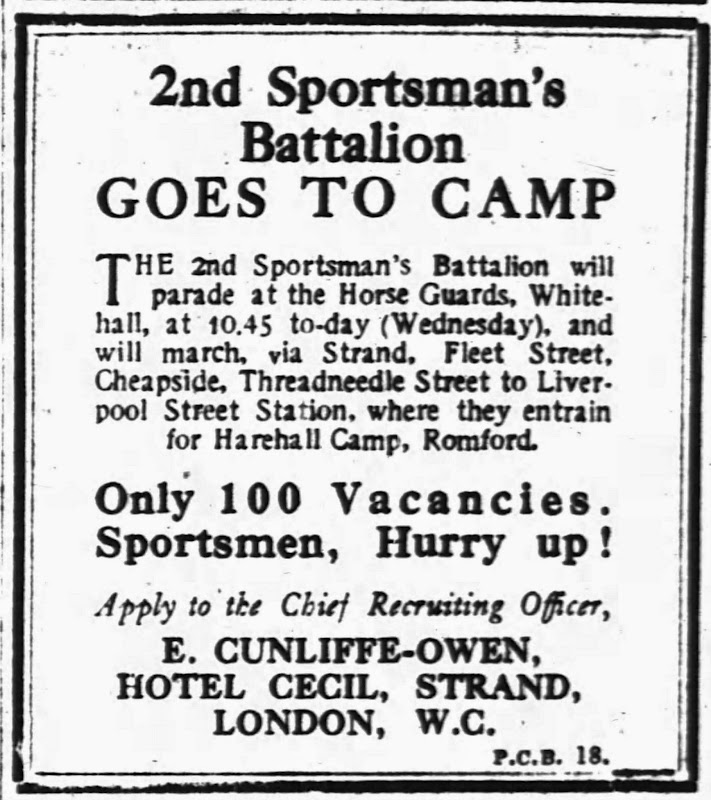

 BASKET BALL.
  SPORTSMAN’S NEW CAMP.

 RICH; DRAWS ALLOWANCE


