A record of the Sportsman's Battalions during the First World War, including a database of soldiers who enlisted in - or served with - the 23rd, 24th and 30th Royal Fusiliers, originally raised by Mrs. Emma Cunliffe-Owen in September 1914. If you have any questions or comments, please send to fmsketches@macbrem.com, thanks!
Showing posts with label Newspaper. Show all posts

April 30, 1915

Chelmsford Chronicle

ESSEX ART AT THE ROYAL ACADEMY.

Frank Heath, whose address is the 2nd Sportsman’s Battalion Royal Fusiliers, Romford, may therefore be counted as an Essex man for the present. He has an oil painting, “Amateur Gardeners,” on the line – a pair of charming little girls watering a wealth of flowers. The whole is broad and direct in treatment, and entirely successful.

April 29, 1915

Western Times

2nd Sportsman’s Battalion at Football

The first Rugby football match for the Championship of the 2nd Sportsman’s Battalion was played at the Camp, Romford, on Tuesday evening, between “A” and “B” Companies, the latter winning by 8 points to nil. Company Sergeant-Major Finch acted as referee. The game caused intense enthusiasm, the whole of the officer of the Regiment being present, and over 700 rank and file. The next round is between “C” Company (the West Country Company) and “D” Company, the winners of each round to play for the final. Great credit is due to “B” Company players for the excellent play they showed, considering they left camp at 7 a.m. in the morning for trenching work and returned at 5:45 p.m. kicking off a quarter-of-an-hour later.

April 28, 1915

Exeter and Plymouth Gazette

The writer of an article in one of the monthly magazines remarks, in the course of some references to the Sportsman’s Battalions, that “A sergeant in the 2st Sportsman’s Battalion, at Romford, was heard correcting a private for his method of swabbing a floor. “Let him alone,” said someone standing by, “he’s only a K.C.; he doesn’t know any better.” As a matter of fact, a member of this corps, who has since been given a commission, served in the ranks for three months as an ordinary soldier, formerly sat in the House of Commons and been Mayor of Norwich. It has occurred to me that the writer may have had in his mind Capt. A. E.Dunn, who entered the corps as a private, and has since been given a commission and promoted. He sat in the House of Commons for the Camborne Division of Cornwall, and was Mayor of Exeter – not Norwich – in 1901 and 1902.

The Gazette

A London solicitor who had joined the First Sportsman’s battalion, Royal Fusiliers, had received the following congratulatory telegram from an old client: “Accept my congratulations on your gallantry in joining the Sportsman’s battalion. Anyway, you know how to charge.”

April 27, 1915

Birmingham Gazette

DELANEY AND FARRELL

AOTOR PUTS UP A GOOD SHOW BUT IS BEATEN

ON POINTS

By Our Boxing Expert.

At the National Sporting Club, last night, Private Jerry Delaney, of the Sportsman’s Battalion of the Royal Fusiliers, beat Willie Farrell, of Southwark, on points in a 20-rounds contest.

There was a lot of interest in the match, which was a return contest, by the way. The two men had met in Birmingham last year, when Farrell lost in the second round, the match being stopped by the referee to save him unnecessary punishment.

AT 9ST. 11LB.

On that occasion Farrell was suffering from a sprained ankle, but last night he took the ring splendidly fit, as was his rival. The articles stipulated a weight of 9st. 11lb., which is a couple of pounds over the championship limit. At the weighing-in at 2 o’clock the Bradford man went 9st. 9lb., and Farrell a pound heavier.

The former had trained at Brighton, while his rival did his preparation at Wembly.

Before the big contest of the evening Sans Keller, the Aldgate fly-weight, had met and beaten George Matthews, of Hanley, in a 15-rounds match for £100. Matthews Nearly dropped his man with a terrific right in the third round, but did not follow up his advantage, and a rather open defence cost him the match on points, but it was a spirited affair, and both men were heartily cheered at the close.

NOTHING DOING.

It was just after ten o’clock when Farrell and Delaney took the ring before a packed house and it may be mentioned that the opinion of the experts as to the chances was reflected in odds of 3 to 1 on the soldier. Farrell certainly looked the heavier man, at the start there was more feeling for distance than anything else, although both men got in a quick stabbing left while Delaney was responsible for a wild miss with the right.

The second round saw the same eager feinting, with nothing much doing, and it was evident that the two men had much respect for each other. Delaney managed to jar his opponent with a pretty upper cut in holds, but it was not until midway through the third round that a real exchange of punches was noted, both being impelled to this action by the receipt of an irritating left in the face.

Delaney was, if anything, the quicker man, especially with regard to the left, but Farrell was very agile and his footwork notably good.

The actor had rarely got a chance to mix things, for Delaney had a habit of suddenly sending up a swift right upper-cut by the way of relying on his excellent left.

GOOD EXCHANGES.

The third and fourth rounds saw Delaney lead on points, and yet he seemed to disguise this superiority somehow. In the fifth round a hard rally at close quarters saw Farrell do the postman’s knock with both hands to the body, but Delaney wound up with a nasty right just over the ear that sent the Southwardk lad staggering. Farrell was inclined to force matters now, but he usually got the worst of the in-fighting, and his face began to get rather flushed in the sixth round, the result of the attentions he had receive.

Farrell was making a brave show, but one could not resist the impression that he was being outclassed by a man who cunningly refused to display his skill to the fullest advantage.

Delaney’s defence was perfect, and in his ducking and retreating there was the economy of effort that marks the class boxer. Farrell gave no outward sign of recognizing his own subordination. He kept trying with splendid spirit to penetrate a faultless defence and at the same time to cope with an attack which was dazzlingly versatile.

DELANEY COMFORTABLY AHEAD.

When Farrell, taking advantage of a bad miss with the right, landed a pretty left on Delaney’s nose, the crowd cheered him in sympathy, but the Bradford man soon evened up matters before the bell with a few lefts. The ninth round produced some spirited boxing by both, each landing in turn, but when the half distance had been reached Delaney was comfortably ahead on points.

In the twelfth round Delaney’s nose was bleeding and Farrell’s left eye showed signs of trouble, but it was a great round for fierce work, in which Delaney had just a shade the better.

The 13th went to Farrell, who landed several lefts, and was hereabouts boxing with splendid judgment and precision and making excellent use of the ring. After this, however, Farrell fell off a bit, and seemed slower, so that Delaney scored frequently with the left, and at close quarters always held the master hand.

The last half-dozen rounds were comfortably held by Delaney, whose continual left against a very tired opponent kept forcing him further ahead. In the 19th round Delaney sent in a smashing left that would have put most men out, but Farrell survived this and two others of the same kidney.

Altogether Jerry won his fight quite handsomely without ever suggesting that the odds laid on him at the start were quite justified, Farrell’s share in the proceedings did him great personal credit.

April 24, 1915

Evening Despatch

ALL SORTS OF SPORT.

INTERESTING ITEMS FROM ALL PARTS.

Mr. D. M. Gant’s Lawn Dance, by Common – Zarabanda, has foaled a colt by Lomoud.

Hitch, the Surrey fast bowler, who joined the Sportsmen’s Battalion, has been invalided out of the army.

April 20, 1915

Berwickshire News and General Advertiser

Lady Maitland’s Silver Wedding.

WE give a photo of Viscountess Maitland at Thirlestane Castle, who has just celebrated her silver wedding.

Viscount Maitland is the eldest son of the Earl and Countess of Lauderdale who how resides in the South of England. He and Lady Maitland, (who is a daughter of the late Judge Vaughan Williamson) have been living at Thirlestane Castle for the past 3 years and are very popular in the district, both having taken a preeminent part in good work in Lauderdale. Since the outbreak of War, Lord Maitland has been with Military Services as Colonel of the Sportsman’s Battalion


Manchester Courier and Lancashire General Advertiser

BARON DE REUTER DEAD.

HUSBAND’S GRIEF AT THE LOSS OF HIS WIFE.

Baron Herbert de Reuter, managing director of Reuter’s Telegraph Company, has been found lying dead at his residence near Reigate. A revolver which had been discharged was found, and there appears to be little reason to doubt that the baron fell by his own hand.

The deceased was greatly overwrought by the sudden death of his wife, to whom he was warmly attached, on Thursday last, and whose funeral had been fixed for yesterday. The baron’s body was found in a summer-house in the grounds. On a table there were two letters. One was addressed to Mr. Flint, the gardener, who found the deceased and the other “To the spirit of my dear wife Edith.”

The funeral of Baroness de Reuter was postponed, and it is understood that she will now be buried in the same grave as her husband. They leave two children. Their son, Hubert, is serving in the Sportsman’s Battalion, and their daughter married, in 1901, Mr. James Douglas, of Tilquhillie, Scotland.

Baron de Reuter was 64 years of age. Until last week he was in constant attendance at the offices of the new agency, of which his father, the late Baron Julius de Reuter, was the founder and with which he had been associated ever since 1875, the year before his marriage.

In his younger days Baron de Reuter contemplated a musical career. After passing from Harrow to Balliel College, Oxford, he declined to remain at the university long enough to take his degree, in spite of the remonstrances of Dr. Joewit (then Master of Balliol), and went to Paris. But after a your or more he returned to London and decided to comply with his father’s wish that he should enter the services of Reuter’s Agency, of which he soon rose to be managing director. Under his guidance its scope grew, until at present there is hardly a part of the civilized world with which the agency is not in communication.

April 4, 1915

Sunday Mirror

SOLDIERS AT RUGBY.

The Artists won the match against the Sportsman’s Battalion on Richmond Athletic ground yesterday by three goals (one dropped) and two tries to two tries – 20 points to 6. Vaccination and other things prevented the Sportsman’s from mustering its best side; but for all that it was a great game and it was only in the last few minutes, when the Artists put on a couple of goals, that they took a commanding lead.

Quinn dropped a superb goal to begin with, and then followed tries by Padbury and Edlmann – two old Richmond men, who were the Artists’ halves. Tries by Clementson and Curwen for the Sportsman’s left it anybody’s match. But in the last few minutes Fox placed two goals from tries by Quinn and Padbury, for the Artists. The Sportsman’s scrimmage worked very hard, but the side missed the help of its brilliant half backs, Henri and Taylor.

Sunday Mirror

Only 100 Vacancies now left in the

2nd SPORTSMAN’S BATTALLION

(ROYAL FUSILIERS)

In addition to Special Reserve of 500 for 1st and 2nd Battalions.

Colonel-in-Chief – THE KING.

The only Battalion accepting recruits up to 45 years of age.

Age 19 to 45.

Height 5 ft. 6 in. and upwards. Pay and Separation Allowances at Army Rates.

Apply to the Chief Recruiting Officer E. CUNLIFFE OWEN.

HOTEL CECIL, STRAND, LONDON, W.C.

April 3, 1915

Whitstable Times and Herne Bay Herald

DISAPPEARANCE OF HERNE BAY COUNCIL OFFICIAL.

JOINS THE ARMY AND DESERTS.

REWARD OFFERED FOR INFORMATION.

Since the recent disappearance of Mr. Harold Midgley Metcalfe, accountant to the Herne Bay Council, the books have been examined and a warrant has been issued for the missing man’s arrest. Mr. Metcalfe left Herne Bay in September to join the Army. He was enrolled in the Sportsman’s Battalion. His general smartness soon won a corporal’s stripes, but about a month ago he deserted and has not since been seen.

A reward of £20 is offered for particulars of his whereabouts.

March 24, 1915

Hull Daily Mail

SPORTSMAN’S BATTALION.

MR & MRS T. R. FERENS AT THE PARADE.

Mr T. R. Ferens and Mrs Ferens, also Alderman Taylor and Mrs Tayor, of Hull, were present on the Horse Guards’ Palace Whitehall, as the 2nd Sportsman’s Battalion marched past. The Hull men in the 2nd Sportsman’s Battalion are Lieutenant Frank Edwards of Brunswick Chapel, and Corporal H. Matthews, of Cottingham, Hull.

The 2nd Sportsman’s Battalion of the New Army have left London for their new quarters at Hare Hall, Essex, and they made a brave show as they marched through the Strand and the City to entrain at Liverpool-street.

The 1st Battalion is already in camp near Romford, and the 2nd Battalion’s headquarters have been at the Hotel Cecil. From the hotel they marched to the Horse Guards Parade to be inspected by Brigadier-General Kellet, commanding the brigade to which the Sportsmen are attached.

Drawn up on the lower side of the Parade, the Battalion presented a fine martial appearance, with every man at attention.

CHEERS FOR THE FOUNDERS.

The Brigadier-General evidently thought so, for he addressed the men in terms of high praise.

“I am very proud to have the honour to command such a battalion,” he said, “and, please God, I shall be able to lead you against the enemy in a very short time.”

“I know very well,” he remarked, “the great sacrifices which a large number of you must have made, sacrifices in property and position, to answer your country’s call, and we all thank you. The nation thanks you.

“I am proud to see the makings of such a fine battalion before me. There is much hard work before you – to train the body and brain. The spirit is already trained.”

When the Brigadier-General referred to the splendid work done by Mr and Mrs Cunliffe Owen in raising the battalion, the men’s enthusiasm broke out in a general cheer from all ranks.

March 23, 1915

Dominion

The Sportsmen’s Battalion – Raised by a Lady.

A very interesting account is given in the “British Australasian” just to hand of the raising of the Sportsmen’s Battalion in England by Mrs. E. Cunliffe-Owen. Like so many of the important things of life, it all apparently happened by chance. The lady in question was walking down Bond Street with her son when she met two well-known big game hunters of her acquaintance and gently rallied them upon not being at the front. They told her they had volunteered but had been rejected because of the age limit. Half-humorously, half-seriously, the suggestion was made that Mrs. Cunliffe-Owen should raise a corps of sportsmen without giving undue prominence to their birth certificates. The lady communicated with Lord Kitchener and, to shorten the story, the Secretary of War gave permission for a battalion of 1600 to be formed.

The duties of recruiting officer were performed by Mrs. Cunliffe-Owen herself, with headquarters at the Hotel Cecil, and so efficiently did she discharge them that on the full strength of the first battalion having been enrolled the War Office requested that a second battalion, also 1600 strong, should be formed, and to this second voluntary task the lady, with the assistance of a competent staff, is now devoting herself. The second battalion is under the command of Colonel a. de V. B. Paget, and both battalions enjoy the distinction of having the King as their honorary colonel. Mrs. Cunliffe Owen is therefore the first lady to raise a regiment since the beautiful and famous Duchess of Gordon “raised the Gay Gordons with a kiss” a century or so ago. A further interesting feature of this battalion is the fact that a very large number of Australians and New Zealanders figure among the commissioned and non-commissioned officers as well as among the ranks. Colonel Viscount Maitland is in command of the first battalion.

Western Times

Sportsman’s Battalion

Although the 2nd Sportsman’s Battalion are now in camp, E Company has still its headquarters at the Hotel Cecil, London, awaiting completion of the extra huts , which, owing to the difficulty of getting supplies of wood, etc., has been delayed. Recruiting is still going on at the Hotel Cecil as before for men up to 4t years of age, and all applicants are greatly welcomed.

E Company is under the command of Capt. A. E. Dunn, who raised an entire West of England company for the Sportsman’s Battalion in the Exeter District. Capt. Dunn served three months in the ranks of the 1st Sportsman’s Battalion. The character of the battalion has attracted recruits quite as much as the extension made by the War Office in the Age limit.

March 19, 1915

Chelmsford Chronicle

NEW SPORTSMAN’S BATTALION AT ROMFORD.

On Wednesday the 2nd Sportsman’s Battalion moved from London to their new headquarters at Hare Hall, Romford, near Gidea Park station. The first Battalion is in Quarters at Grey Towers, Hornchurch, two miles away.

The Battalion came by train to Romford. In London they had been inspected before leaving by Brigadier-General Kellett. Cheers were given for the founders of the Battalion, Mr. and Mrs. Cunliffe Owen. On reaching Romford the Battalion formed up under the command of Col. A. de B.V. Paget, with the Adjutant, Major H. H. Enderby, and the Major Percy Elwell. Numbering well over 1,000 men, the Battalion presented a fine appearance. Marching by the main road to Hare Hall, they entered upon the occupation of what are believed to be the most up-to-date field barracks yet erected. It embodies all the improvements that the experience of the War Office in the last six months can suggest. There are a couple of dozen cubicle shower baths, with hot and cold water laid on; the thirty beds in each dormitory hut, though made of wood, owing to the scarcity of iron bedsteads, turn into the wall in the day time, over lapping each other to form seats and occupying the minimum of space; each hut is lit by electric light; the bootmaker’s, the post-office, the tailor’s, and the barber’s stand in a row, and the wet and dry canteens are spacious and comfortable.

In the hall itself the bedrooms have been neatly and simply furnished to accommodate 36 officers. The subalterns sleep four in a room. The colonel has one of the smallest rooms, looking out over the camp, and as simply fitted as the rest. The canteens and store-rooms are fully stocked with every possible requirement. A hospital with 24 beds had been provided; the drugs were ready in the doctor’s surgery, and sergeant and five men of the R.A.M.C. from Colchester will form the nursing staff.

It is understood that four Companies of 270 men each will be going to the Front in June, or thereabouts, and 5h and 6th depot companies will have to be formed to keep the camp going and fill any gaps that may occur in the other Companies.

March 18, 1915

Birmingham Gazette

THE 2nd SPORTSMEN’S BATTALION ON THE MOVE.

The 2nd Sportsmen’s Battalion marching across Trafalgar-square on their way to Liverpool-street to entrain for Harehall Camp near Romford.

Daily Mirror

The 2nd Sportsman’s Battalion marching through the City yesterday. They have gone into camp at Romford, Essex.

GOING INTO CAMP.

This dog has “enlisted” in the 2nd Sportsman’s Battalion as its mascot, and marched with the men through the city yesterday. He is glad to be going into camp. He much prefers the country to the town.
Exeter and Plymouth Gazette

IN CAMP

2nd SPORTSMAN’S BATT.

WEST-COUNTRY BAND

There are few smarter battalions among the New Army than the Second Sportsman’s, which left London yesterday for its new quarters at Hare Hall, Essex. The assembly on the Horse Guards Parade was witnessed by a large crowd of spectators, many of whom had relatives or friends in the ranks. The men, alert and soldierly in their bearing, looked as hard as nails and fit to endure any hardship they may have to encounter. Colonel A. de B. V. Paget, the officer-commanding, congratulated the men on their smart turn-out, their discipline, and zeal. He knew their heart was in the work, and he hoped they would speedily become efficient and ready to go out with the Brigade to help to thrash the Germans. He was sure no battalion would do better than theirs when the opportunity came. Many of them, the Colonel added, had made great sacrifices of property and position, and in other ways, to respond to their country’s call, and the nation thanked them. There was hard work in front of them, and he hoped that in a short time he should be able to lead them against the enemy. He acknowledged the debt of gratitude they owed Mr. and Mrs. Cunliffe-Owen, who had spent time, trouble, and money in the nation’s cause.

The battalion arched to Liverpool street by way of Trafalgar Square, the Strand, Fleet-street, Cheapside, and Old Broad-street. The full band, consisting of 35 instruments, which have been presented by a member who desires to remain anonymous, led the way, and the drum, fife, and bugle section and the Brass Band of C Company, which has been enrolled at Exeter, also accompanied the battalion.

March 17, 1915

Devon Exeter Gazette

Au Revoir!

Yesterday the West of England Company of the Sportsman’s Battalion Royal Fusiliers left Exeter, under the Command of Captain A. e. Dunn, after a lengthened period of training.

Devon Exeter Gazette

SPORTSMAN’S BATT.

EXETER DEPARTURE.

The “C” (West-Country) Company of the 24th Service Battalion Royal Fusiliers (2nd Sportsman’s), left Exeter yesterday morning tor camp. The men, numbering 323, assembled at the dinking fountain, in Sidwell-street just before 8 o’clock. Under the command of Captain A.E.Dunn, with Lieuts. Enderby, W. G. Perkins, and F. Templeman and headed by the band of 20, the men marched by way of High-street and Queen-street to S. David’s Station. En route the band, under Sergt. Brock, rendered in spirited fashion the marches “Soldiers of the King” and “Sons of Our Empire.” Despite the comparatively early hour, the streets were thronged with people, and the men were cheered enthusiastically. A special train awaited the men, who responded with a thunderous “No!” to the cry of “Are we downhearted?” Although the railway officials made some attempt to keep the crowds of civilians from thronging the platforms, the station was quickly filled with the friends of the “Tommies.” Cheers were given for the officers and Exonians, and the train, from the windows of which miniature flags were freely displayed, steamed out amid much enthusiasm.

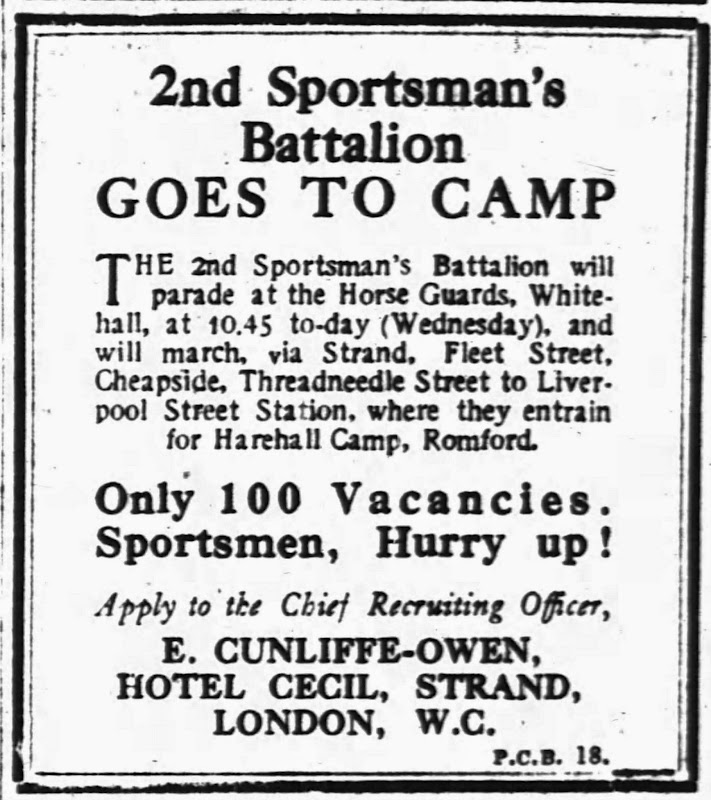
The Times

2nd Sportsman’s Battalion

GOES TO CAMP

The 2nd Sportsman’s battalion will parade at the Horse Guards, Whitehall, at 10.45 to-day (Wednesday), and will march, via Strand, Fleet Street, Cheapside, Threadneedle Street to Liverpool Street Station, where they entrain for Harehall Camp, Romford.

Only 100 Vacancies. Sportsmen, Hurry up!

Apply to the Chief Recruiting Officer,

E. CUNLIFFE-OWEN, HOTEL CECIL, STRAND, LONDON, W. C.

Western Times

A GOOD SEND OFF

Departure of the 2nd Sportsman’s Battalion

FROM EXETER

The 2nd Sportsman’s Battalion, which has been raised in the West-country through the instrumentality of Capt A. E. Dunn, and which has since its formation had its headquarters in Exeter, left the City yesterday to go into camp to complete their training for whatever service is before them. The send-off was as encouraging and enthusiastic as could well be, and the cheering crowds that thronged the streets were tribute to the popularity of the Battalion and to a fine body of men.

No won who saw the Battalion – fresh, smart, athletic, and fit as the men are – march through the City with that litheness and swing which betokens perfect physical fitness and vigour, could help congratulating Capt. Dunn on having the proud command of such a splendid body of men. In the best of spirits and keen for service, the men responded cheerily to the ready outbursts of the citizens, the waving of hats and handkerchiefs, and good wishes which were evident on every side. They were not downhearted: they said so themselves many times as they swung through the street between unbroken lines of civilians.

The “fall in” was at 8 o’clock at the top of St. Sidwell’s, and the Battalion mastered promptly and in full force. It numbers 323 of all ranks, and, besides the O.C., the officers are Lieuts Enderby, W.G. Perkins and F. Templeman, with Co. Sergt.-Major C. T. W. Finch.

The Battalion Band, under Sergt. Brock, was there to lead the way with martial music. The band itself, like the Battalion, has made splendid progress and now numbers 20. The played lively and patriotic airs, with “Soldiers of the King” and “Sons of Our Empire” among the numbers rendered.

The route take was through Sidwell-street, High-street, and Queen-street, passing the statue of Devon’s hero, General Buller, and then on to St. David’s Station, where a special train was in waiting. Numbers of friends managed to get on to the platform and there was much hand-shaking and exchange of wishes for good luck. To secure this latter for his battalion on stalwart member had been decorated with an old horseshoe tied with ribbon in the colours of the Allies, which, notwithstanding its hug dimensions, he bravely ad proudly wore upon his breast. The men were soon comfortably aboard the train, which, amid a perfect hurricane of cheering, steamed away on the stroke of 9 on its journey east.

London Standard

BASKET BALL.

An interesting match has been arranged between some members o f the Sportsman’s Battalion of the Royal Fusiliers, commanded by Lord Maitland, and a London basket-ball team. The military side will include Hayes and Hitch, the well-known Surrey cricketers, and amongst their opponents will be J. G. Lee, who has taken an important part in the work of organizing Y.M.CA. recreation tents in various military centres, and Dr. Robert le Cron, the well-known ice-hockey player. No charge will be made to witness the game, which will take place at the Central Y.M.C.A. Tottenham Court-road, on Saturday, at 7.45 p.m.

March 16, 1915

London Standard

SPORTSMAN’S NEW CAMP.

COMFORT FOR THE SECOND BATTALION.

When the 2nd Sportsman’s Battalion (24th Royal Fusiliers) removes its headquarters tomorrow from London to Romford it will enter into the occupation of the most commodious, up-to-date field barracks ever constructed. The new camp in the grounds of Hare Hall, near Gidea Park station on the Great Eastern Railway, has accommodation for the 900 men already enlisted in this battalion, and there is ample room for the erection of many more huts when they are required.

Lieutenant and Quartermaster Stuart, formerly of the 16th Lancers and the Buffs, showed one of our representatives over the officers’ quarters in Hare Hall and the camp in the grounds yesterday.

The only reason why the Hare Hall camp is the best of its kind yet constructed is that it embodies all the very latest improvements that the experience of War Office experts during the past six months could suggest. There are, for instance, a couple of dozen cubicle shower baths, with hot and cold water laid on; the thirty beds in each dormitory hut, though made of wood, owing to the scarcity of iron bedsteads, turn into the wall in the day time, overlapping each other to form seats, and occupying the minimum of space; each hut is lit by electric light; the bookmaker’s, the post office, the tailor’s, and the barber’s stand in a row, and the wet and dry canteens are spacious and extremely comfortable.

In the hall itself the bedrooms have been neatly and simply furnished to accommodate 36 officers. The subalterns sleep four in a room. The colonel has one of the smallest rooms, looking out over the camp, and as simply fitted as the rest. The canteens and store-rooms yesterday were fully stocked with every possible requirement. A hospital with 24 beds had been provided; the drugs were ready in the doctor’s surgery, and sergeant and five men of the R.A.M.C. from Colchester will form the nursing staff.

Already there is a talk of a 3rd Sportsman’s Battalion being formed, but there are still places to be filled in the 2nd. Four companies of 270 men each will be going to the front in June or thereabouts, and 5th and 6gh depot companies will have to be formed to keep the camp going and fill any gaps that may occur in the other companies.

March 14, 1915

Daily Mirror

VICTORY FOR SPORTSMAN’S BATTALION: 9 POINTS TOO GOOD FOR H.A.C.

“Fall on it.”               The arrival of the grand stand, borne by three “Tommies”               Stand in use.

Though all of the Rugby clubs abandoned their fixtures when war broke out, there have been a number of good Service games which, if not scientifically equal to a Blackheath-Rosslyn Park match, have been at least exciting. On Saturday the H.A.C. played the Sportsman’s Battalion, who won 9 points to nil.

March 12, 1915

Western Times

The 24th Royal Fusiliers (Sportsman’s Battalion) visited Crediton on Wednesday on a route march. About 300 men took part in the march, under Capt. A. E. Dunn and Lieuts. Enderby, Perkins, and Templeman. At the station they were joined by their band, who had come by train. From the station the men marched to High-street, where they were dismissed for three quarters of an hour. On their way to the town they were greeted by the children attending the Haywards Schools. Refreshments were provided at the Liberal Club. The battalion presented a very smart appearance, and greatly impressed the inhabitants.

Western Times

Wishing God Speed to West Country Sportsmen.

Captain A. E. Dunn is justly proud of the West-country men he has recruited at Exeter for the Sportsman’s Battalion. They paraded 280 strong, with their band, this week, and were inspected by the Mayor (Mr. J. G. Owen), who wished them “God-speed, great glory, and a safe return” before they leave for their training quarters in Essex. Our photos show the Mayor, with Captain Dunn and the councillors, inspecting the lines.

March 9, 1915

Dundee Courier

BAND OF FIRST SPORTSMEN’S BATTALION

The 23d (Service) Battalion of the Royal Fusiliers, more familiarly known as the “First Sportsmen’s Battalion,” contains a very fine class of men. In its ranks are men famous in various branches of sport, such as Association football, Rugby football, cricket, etc., and in this battalion are included no fewer than eighty men from Dundee and district. This photograph, taken at the training camp at Hornchurch, shows the members of the band. Fourth from the right in the back row is Bandsman Moncur, 32 Bell Street, Dundee. In the front row, fourth from the right is a Montrose man, while second from the left in the front row is a Glasgow man who was formerly a member of the Dunfermline Trust Band. The First Sportsmen’s Battalion Band has Englishmen, Scotchmen, Irishmen, and Welshmen amongst its members. The Marquis of Maitland, Colonel of the battalion, is in the front row, with Adjutant Inglis on his right, and Captain Church on his left.

Exeter and Plymouth Gazette

Sportsmen’s Batt.

WEST-COUNTRY CO.

INSPECTED AT EXETER.

The “C” (West-country) Company of the 24th Service Battalion Royal Fusiliers (2nd Sportsmen’s) which has been stationed at Exeter for some time past, and is shortly leaving to join the Battalion, was inspected by the Mayor of Exeter (Mr. J. G. Owen), who was accompanied by several members of the City Council, at Bury Meadow, yesterday. The Company, which was under the command of Captain a. E. Dunn, assembled in the Castle Yard, where the men were inspected by Colonel Western (officer commanding No. 8 District). About 280 men were on parade, and presented a smart appearance. The officers, in addition to Captain Dunn, were Lieutenants Perkins and Templeman, while Company-Sergeant-Major Finch was also present. Headed by is band, the company marched to Bury Meadow via High-street and Queen-street. After closely inspecting the men the Mayor, in the course of a speech, said how pleased he was at their appearance. Although not a military man, he was able to distinguish between a mere slouch or ragged parade and a real regular one. He was struck by the great improvement in bearing and drill. The latte day recruit drilled with his brain as well as his body, and the two acting in union gave an excellent result. He understood they were soon to join their Battalion, and he hoped they would give their superior officers as good an impression as they provided at Exeter, and that the Battalion would be proud of the men of Devon and Cornwall. He hoped that whatever befall them, they would remember the tow mottos of Devon and Cornwall and would be “Ever Faithful,” and they “one and all” would do their utmost to support and maintain the integrity of the Empire. On behalf of the citizens he wished them God-speed, great glory, and a safe return. (Applause.)

Three cheers were heartily given for the Mayor and Mayoress on the call of Sergeant-Major Finch.

Captain Dunn, in thanking the Mayor for his reviewing the Company, said he would like to take the opportunity of expressing sincere thanks for the great kindnesses extended by the inhabitants of the dear old city. The men would go nowhere where they could be more happy and contented.

March 6, 1915

Corsicana Daily Sun

NOTED SCULLER JOINS ARMY

William Albany Now Member British Sportsmen’s Battalion.

William Albany, the world famous professional sculler, who has rowed three great races against Ernest Barry winning on two occasions, is one of the members of the First Sportsman’s Battalion, attached to the Royal Fusiliers, known as “Hard as Nails,” which is quartered at Hornchurch, Essex, England.

Big game hunters, horse breeders, gamekeepers, professional athletes and one or two Fleet street sporting men are also included in the ranks.

March 5, 1915

Aberdeen Weekly Journal

WELL-KNOWN FOOTBALLERS IN THE SPORTSMAN’S BATTALION.

Lewis R. Lewis (on reader’s left), the Army International footballer, is a corporal in the 2nd Sportmen’s Battalion, and has been appointed captain of the football club of the battalion. With him in the picture is Sergt. Adams, of the same battalion, who played for Fulham this year, and was formerly captain of Southend United.
The Cincinnati Enquirer

HOTEL CECIL, LONDON.

Our attention having been called to the fact that there is an impression in America that this hotel has been taken over by the Red Cross Society, we would take the earliest opportunity to inform you that such is not the case.

The hotel is open to receive visitors as usual. Beyond the fact that certain of the public banqueting rooms are being used for the purpose of recruiting for the Sportsman’s Battalion, there is no interference with the usual course of business.

     Yours faithfully,
          F. M. Hornsby, Manager.

March 3, 1915

London Evening News

“A DRUM! A DRUM!”
          --Macbeth.

The Temple, its cloisters, and its musty old chambers are reverberating with the beat of the drum, and the peace-loving occupants of the fine old rooms in Kings Bench-walk are shutting their windows and “sporting their oaks” in vain.

The sanctity of the various courts is violated by the sound of marching soldiers, hoarse cries of officers, and – the constant beating of a drum.

For some days the 2nd Sportsman’s Battalion has been in possession of Kings Bench-walk and Crown Office-row, owing to the exceedingly “heavy going” at Hyde Park, which ahs made marching a somewhat difficult task.

Crown Office-row is the spot preferred by the men of the battalion because it is on the level, but King’s Bench-walk is the ground more favoured by the officers, for, although it is on the incline, there is more space for manoeuvring.

The Sportsman’s Battalion is a fine body of men, but since their training-ground has been King’s Bench-walk their footsteps show signs of lagging. The “left, right,” of their officers met with slow response from the feet of the men, and so a drum, whose beat should synchronise with the movement of the feet, has been requisitioned.

“It is not the fault of the men,” said an officer to an Evening News representative, “but merely the rise and fall of the parade ground. Our fellows are jolly good on the level, but rather like the ‘bargain motor’ when we tackle King’s Bench-walk. Go well down hill, but a bit slow in climbing and might be relegated to that class styled ‘also ran.’ And the drum is expected to bring about a uniformity of pace.”

In the meanwhile the occupants of the surrounding chambers are begging hospitality from their legal friends who have rooms in more remote corners of the Temple.

And the thousands of birds that usually crowd the score of trees in King’s Bench-walk have migrated to Pump Court, where the branches of the only two trees are bent with their weight.

The Brooklyn Daily Eagle

WAR ECHOES

We strongly deprecate the attempt to introduce snobbery into the New Army by the creation of “class battalions,” and we are by no means surprised that, as in the case of the Sportsman’s Battalions, the attempt has led to criticism and controversy. – London Express