A record of the Sportsman's Battalions during the First World War, including a database of soldiers who enlisted in - or served with - the 23rd, 24th and 30th Royal Fusiliers, originally raised by Mrs. Emma Cunliffe-Owen in September 1914. If you have any questions or comments, please send to fmsketches@macbrem.com, thanks!
Showing posts with label Rugby Football. Show all posts

April 29, 1915

Western Times

2nd Sportsman’s Battalion at Football

The first Rugby football match for the Championship of the 2nd Sportsman’s Battalion was played at the Camp, Romford, on Tuesday evening, between “A” and “B” Companies, the latter winning by 8 points to nil. Company Sergeant-Major Finch acted as referee. The game caused intense enthusiasm, the whole of the officer of the Regiment being present, and over 700 rank and file. The next round is between “C” Company (the West Country Company) and “D” Company, the winners of each round to play for the final. Great credit is due to “B” Company players for the excellent play they showed, considering they left camp at 7 a.m. in the morning for trenching work and returned at 5:45 p.m. kicking off a quarter-of-an-hour later.

April 4, 1915

Sunday Mirror

SOLDIERS AT RUGBY.

The Artists won the match against the Sportsman’s Battalion on Richmond Athletic ground yesterday by three goals (one dropped) and two tries to two tries – 20 points to 6. Vaccination and other things prevented the Sportsman’s from mustering its best side; but for all that it was a great game and it was only in the last few minutes, when the Artists put on a couple of goals, that they took a commanding lead.

Quinn dropped a superb goal to begin with, and then followed tries by Padbury and Edlmann – two old Richmond men, who were the Artists’ halves. Tries by Clementson and Curwen for the Sportsman’s left it anybody’s match. But in the last few minutes Fox placed two goals from tries by Quinn and Padbury, for the Artists. The Sportsman’s scrimmage worked very hard, but the side missed the help of its brilliant half backs, Henri and Taylor.

Sunday Mirror

Only 100 Vacancies now left in the

2nd SPORTSMAN’S BATTALLION

(ROYAL FUSILIERS)

In addition to Special Reserve of 500 for 1st and 2nd Battalions.

Colonel-in-Chief – THE KING.

The only Battalion accepting recruits up to 45 years of age.

Age 19 to 45.

Height 5 ft. 6 in. and upwards. Pay and Separation Allowances at Army Rates.

Apply to the Chief Recruiting Officer E. CUNLIFFE OWEN.

HOTEL CECIL, STRAND, LONDON, W.C.

March 14, 1915

Daily Mirror

VICTORY FOR SPORTSMAN’S BATTALION: 9 POINTS TOO GOOD FOR H.A.C.

“Fall on it.”               The arrival of the grand stand, borne by three “Tommies”               Stand in use.

Though all of the Rugby clubs abandoned their fixtures when war broke out, there have been a number of good Service games which, if not scientifically equal to a Blackheath-Rosslyn Park match, have been at least exciting. On Saturday the H.A.C. played the Sportsman’s Battalion, who won 9 points to nil.

The First Sportsman’s Gazette – No. 12

EDITORIAL

When one has the leisure to look back upon the happenings of the past few months, the thing which stands out with greatest prominence is the contrast between our present state of mind and the heroic resolves which stimulated our pulse beats and brought us all hot foot to the Recruiting Office.

What strange coma has descended like an all-enveloping mantle on those who were once so keen?

We had heard of Belgium’s wrongs; we were full of noble pride when we remembered that our country had not hesitated to go to war to uphold her honour; we felt capable of any sacrifice, and yet all the ginger seems to have gone out of us, and we worry ourselves to death about little things which are as nothing at all when we remember the dangers and difficulties which our boys are facing in France.

I do not wish you to think for a moment that I put myself in a different class from the rest. Not a bit of it. This is an entirely impersonal Editorial, in which I am endeavouring to find the reason for a curious psychological condition.

“Why was Jones made a Lance-Corporal instead of myself?”—“I wonder if I shall get a week-end pass?” these are questions which agitate the brains of most of us at one time and another.

Men of all classes, men from all lands, drawn together by a common bond-—submitting to discomfort, and lacking, maybe, those many little niceties which go to make this life endurable-—living together in a great camp; taking orders from their N.C.O’s.—not commanding as hitherto; hard at it day in and day out drilling, trenching or on fatigue. Is it to be wondered that in time the mind descends to the paltry? I think not.

We are splendid material, and all we need is a little imagination—something to fire us with the zeal which was ours before.

The drudgery of our training is almost at an end, and shortly we enter upon a new era, when each day will bring its novelty and we shall feel proud to think we had the courage to endure. You cannot turn untrained men into soldiers in a week or a month, and it is a certain fact that it takes the man of culture far longer to pack his brain with the cells which enable him to automatically obey the command of his instructor than the “swaddy” who has neither breeding nor education.

Perhaps the reason is here? The finer clay is more difficult to mould, but once fired I am convinced you will have the finest Battalion of Infantrymen Great Britain has ever seen.

Good luck to the First Sportsman’s Battalion! May it prove to the Germans that the British sportsman knows how to play the game of war.

THE EDITOR.

BATTALION NOTES.

The noteworthy item in the week’s programme has been the field exercises which have been enjoyed by all.

All ranks are warned against communicating information respecting the strength and disposition of H.M. Forces by Telephone, unless the recipient has sure information regarding the identity of the enquirer—a precautionary measure, the wisdom of which will be apparent to all.

There has been an extremely interesting schedule of Musketry Instruction during the week, and in connection with this it is pleasing to note that 2nd Lieut. Cragg has qualified at Hythe as 1st Class Instructor of Musketry.

Quite a large number of recruits have been added to the Battalion Roll since our last issue.

L.-Corp. J. A. Turnbull has been appointed Acting Corporal, and Pte. A. Gaddis has been appointed Lance-Corporal.

The health of the Camp is splendid, and the ban on visitors was removed on Saturday, March 6th.

ST. PATRICK’S BALL.

The Privates of the 1st Sportsman’s Battalion are giving a Subscription Dance at the Drill Hall, Hornchurch, on Wednesday the 17th inst. at 8 p.m. By kind permission of the Colonel Commanding, Viscount Maitland, extension of time to 2 a.m has been granted. It is the intention to ask 15 members of each Company to become subscribers. The cost of a subscribers ticket is 5s., which will entitle the holder to a ticket for himself and two complimentary tickets for a lady and gentleman or two ladies. These tickets will include light refreshments. A special bar for wine and sandwiches will be provided.

The Regimental Band, under Sergeant Almond, will be in attendance. All information respecting the dance can be obtained from the Hon Sec, Pte. F. G. Harris, Hut 13,

A WORD WITH FREEMASONS.

A meeting of a few of the brethren was held on Wednesday evening last, under the Chairmanship of Bro. the Rev. A. J. Parry; it was then decided to summon a mass meeting of the brethren in the Battalion for the purpose of deciding whether or not it is desirable to hold a Craft Re-union Dinner at an early date.

The meeting will be held at 8.30 p.m. on Thursday next at the Drill Hall and the presence of every brother is earnestly requested.

The further business of the meeting, should a dinner be decided upon, will be to elect an Organising Committee and Secretary and brethren outside the Battalion are cordially invited.

Those intending to come are invited to communicate with Pte. G. Vernell, Hut 35, who is acting as temporary secretary.

OUR REVIEW.

We have received from the Oxford University Press a copy of “What every Soldier ought to Know,” price Twopence, which contains a great many hints to the soldiers in the field.

We have also received from Messrs. E. Marlborough & Co., copies of the English-German “Soldiers Language Manual,” price Threepence, and “A Simple French Song and Play Book,” price Threepence.

The February Number of “Health and Vim” contains several interesting photographs of the First Sportsman’s Battalion.

THE REGIMENTAL BAND

Nothing in the Battalion has improved so much as the Regimental Band. Extravagant praise, perhaps, but there is not one amongst us who would not subscribe to the sentiment.

Started in a small way the advance has been so marked that the band can now almost vie with the best.

This result, is in no small measure due to the Bandmaster, Sergeant G. L. Almond. Experienced in military discipline with an excellent knowledge of music, Sergeant Almond possesses in a rare degree the faculty of getting the best out of his men.

Time, tone and articulation have all received attention, while the excellence of the attack or decision is most marked, and the general effect is good.

Sergeant Almond studied for Kneller Hall, and later was with the Royal Artillery mounted band as principal cornet player and one of the first violinists.

His other experience was gained while for 12 years with the Prince Albert Somerset Light Infantry Regiment.

His work is backed wholeheartedly by the Band President, Major Richey, the Band Secretary, Captain Church, and we believe by every member of the Battalion.

Comprising at present thirty members it is expected shortly to get up to the full complement of thirty-five. The aim is to combine classical with popular music and no standard work is beyond the scope of the players. Their usual programme comprises something like the following:

(1) March—“A la Militaire.”
(2) Overture—“Rosamonde.”
(3) Waltz—“Le Sang Roumain.”
(4) Selection—“Chocolate Soldier.”
(5) Serenade—“La Polonia.”
(6) Patrol—“Irish.”

while combined with the bugles the best-known item is the Allies march “Somme and Meuse.”

The items are of course varied as circumstances demand, but the whole gives one some idea of the versatility of the performers.

The repertoire is constantly being enlarged and it is hoped shortly to give concerts both in the evenings and Saturday and Sunday afternoons.

There are no Star Performers in the crowd, but each and every member gives of his best.

Herein lies the success of the band.

FOOTBALL NOTES.

RUGBY.

SPORTSMAN v. 2nd BATT. 6th LONDON RIFLES. SPORTSMEN STILL WIN.

On Saturday last our team after varied checks arrived at Bullock Hill to play the London Rifles. There were a few changes in the team as Stretton was playing again, and two members of the side missed their connection at London Bridge. Dalrymple filled one of the vacancies. It is a pleasure to note that our forwards scrummed so much better this week, and throughout the game got possession. Micky Reynolds gave a great deal of confidence to his other men, and although in following through he was not always properly supported, the crowd as a whole showed much better combination. The ball is still sticking in the back line of the scrum, and if we want to win to-morrow when we play the H.A.C. we must pack better and get the ball well out.

The first half was in our favour and forward rushes headed by Reynolds, Clemetson, Gilmour and Thompson led to two tries being scored by Williams and Wadham.

The combination of the three-quarters deserved a better fate even than two tries, for throughout the game the backs were all across the field and every run gained ground. Wadham was found to be a good handful to tackle for on his fast runs lie used his weight well, drawing the opposition, and giving William good openings, which were always well used to advantage.

Dalrymple played well at half, and as usual Henri was always to the fore. We had the best of the line outs and Clemetson and Gilmour used their height and weight in gaining possession supported well by Stretton, Thompson, and the other forwards, and almost invariably making ground for us.

We had a strong wind to play against during the first half and the fitness of our team proved itself all through the game. The elements being more favourable of course helped us considerably in the second half. Shortly after commencing, from good forward play Henri got the ball from Dalrymple and passed to Wadham, who passed it to Williams to cut his way through the opponents and score a fine try. An attempt at kicking was not successful. Shortly after this, again getting possession of the ball, Wadham ploughed his way through the opposing team and scored the try of the match, which was converted by Clemetson. The Rifles attacked well, but were rarely dangerous except in the first few minutes. Their full-back played well for his kicking was hard and well judged. Farr, who played at full-back for us instead of Scott was good both in ing and fielding the ball and saved his team by excellent touch finding. Unfortunately Scott- Tucker shortly after half-time had to retire thus leaving us with only six forwards. Still Ave played well together and pressed hard and were unfortunate in not getting over once or twice when suddenly Brace, the Rifles left wing man kicked the ball from midfield, followed it up, picked it up rather luckily and crossed the line for the home team, amidst great jubilation. The goal was just missed, and after a few minutes pressure from the Battalion side, time was called leaving us victors by 16 points (2 goals, 2 tries) to 3 points (one try). Forward we hold the advantage, although Roller, Norris, and Bert Smith played a good game for the Rifles. At half we had the pull, the homesters finding it hard to cope with our pair, especially with Henri’s tricky tactics.

We are greatly indebted to Lieut, and Quartermaster Howell for his excellent judgment as referee and other kind attentions.

We were entertained at dinner after the match and did ample justice to the good fair. We hope to be able to show our full appreciation later when the London Rifles come to Hornchurch as our guests.

Teams:

London Rifles—Full Back: Capt. Tucker; Threes: Rfm. Austen, Cpl. Knight, L.-Cpl. Woodcock, and L.-Cpl. Brace; Half Backs: Rfm. Dimmore and Rfm. Parker; Forwards: Lieut. Ford, Bert Smith, Lashbury, Keller, and C. F. Keller, L.-Cpl. Norris Cpl. Dyce and Rfm. Norman.

First Sportsman’s Batt. F.R.—Full Back: Farr; Threes: Salvesen, Wadham, Williams, and Spurway; Half Backs: Henri and Dalrymple; Forwards: Reynolds, Clemetson, Gilmour, Thompson, Stretton, Scott Tucker, and Whitlock.

The game on the Battalion ground on Saturday is against the H.A.C., and -with our opponents anxious to wipe out the previous defeat a very stern struggle should be witnessed. The fact that Coverdale and K. Horan the Blackheath halves figure in the side should be an attraction to all rugby enthusiasts.

The kick-off is timed for 3.15 and visitors will be welcomed.

“FULL BACK.”

ASSOCIATION.

DISAPPOINTING GAME WITH HAMPSTEAD.

The Battalion Football score, at least, as far as the Association Code is concerned, was very low on Saturday.

Her we lost to the R.A.M.C. from Brentwood, in a game which beggars description, by 8 goals to 3, while at Hampstead the margin against us was 3 goals to nil.

This is the second time that Hampstead have taken toll of us with, a side which man for man is not our equal.

On Saturday in a bustling game we were beaten for pace, our attack lacked sting and we never really settled down to give of our best.

The fact that the two newcomers to the side did not come up to sample may have caused the remainder to lose confidence, the ground, which from the touchline appeared to be in good order, developed on close inspection a series of small holes, which caused the ball to come off at unexpected angles, the ball itself was misshapen and the official controlling the game showed a lack of the finer points which caused irritation to some of the players.

Any one of these reasons may have contributed to the non-success or perhaps it was a mixture of the lot.

Read the story and judge for yourself.

Hampstead were aggressive from the start, Littlewort, Ewing, Rawling and Higgins all being called upon before the ball was eventually cleared and a move started towards the other end, where the Hampstead goalie was forced to rush out and save. Ewing, playing at left half, started off in great style but quickly tired and the Hampstead right wing were not slow to take advantage of the fact.

Always dangerous, it was from this wing that the first goal came, Pike the outside man raced away and sent the ball across to Christie at outside left. Christie’s shot was only partially cleared by Kirton and Pike rushing in scored from the rebound.

From the restart Sandham made ground on the right. He was weakly supported by his inside man and his final pass was charged down, Littlewort being called upon to check Humphreys. The elder Hendren got away on the left and Owers was unfortunate in being a shade too late to receive the centre. The Hampstead side took up the running again, Gooding sending behind and Christie trying another dropping shot, this time without effect. It was during this period of the Hampstead attack that a penalty was awarded against Higgins for a reason which was not very clear. Kirton, however, saved in great style and the situation was relieved. It must not be thought, however, that the game was entirely one way, for after Hooper and Horbury had found the two Hendrens a tough handful the Hampstead goalie was forced to run out and save from Sandham. Littlewort started a movement in which J. Hendren, Owers and E. H. Hendren all took part; in spite of many brilliant solo efforts this was the first really combined move of our forward line. Offside against Pat Hendren spoiled the finish. He was in evidence a moment later with a centre to Owers who struck the crossbar with a great shot. That it did not score was distinctly hard lines for the Battalion side, as the Hampstead goalie was well beaten. Hereabouts, too, a goal would have steadied the side and changed the whole aspect of the game. Things, however, were running badly for the Battalion and a little later Gooding put Hampstead further ahead with a surprise shot after a period of uninteresting play.

Generally our forward work was patchy but another combined effort just before half time left Harry Littlewort in possession. The centre half was badly fouled just outside the penalty area and from the free kick the ball was sent behind. A case in which the punishment did not properly fit the crime.

Owers was early prominent in the second half, heading the ball just past the post. Hampstead retaliated and forced a corner off Lewis. This was saved at the expense of another which was safely dealt with. E. H. Hendren, with a splendid run forced a corner at the other end and Jonas, the Hampstead centre half relieved. Lewis was forced to save from Christie by sending into touch. Fraser performing the same office for Sandham at the other end. Hopkins at inside right was still weak, and Pat Hendren, Owers and Littlewort continued to get the lions share of the work, Littlewort sending just over the bar with a terrific drive land Owers shooting behind from a move initiated by Hendren.

This was the signal for a fresh Hampstead attacking and Christie forced a corner, and the latter shot badly when well placed. Kirton saved brilliantly from Humphreys and then a breezy war between Referee and players delayed the game for a moment. Followed, a livener from the elder Hendren, the Hampstead goal-keeper only just saving his shot for Sandham to send behind on the return. Hendren himself just missed the mark with another shot.

There was always an amount of promise about the Battalion work which was never quite realised, and Humphreys properly put the lid on thing’s by scoring number three for Hampstead after a single handed run.

Littlewort, Owers and Hendren gained a corner and Hendren just failed to get home with one of his “specials.” Owers made a sort of despairing solo effort towards the end which almost brought about a score, but the work generally was not of convincing style which we are wont to expect of the Battalion side.

An improvement is looked for in the match next Saturday against Maidstone United at Maidstone.

The game is for the benefit of the widow of the late groundsman and trainer, and the kick off is timed for 3.15.

The sides last Saturday were: —

Hampstead Town—Goal: Winyard; Backs: Hooper and Horbury; Halves: Pollock, Jonas and Fraser; Forwards: Pike, Gooding, Humphreys, King and Christie.

Sportsman’s Battalion—Goal: Kirton; Backs: Higgins and Rawling; Halves: Lewis, Littlewort, and Ewing; Forwards: Sandham, Hopkins, Owes, Hendren and E. H. Hendren.

“PITCHER.”

PRIVATE CHARLIE DILLON.

The incomparable dame of many pantomimes.

Everyone in the Battalion knows Charlie, whose picture reproduced on this page shows a very different Charlie from the cheerful old lady who has appeared in Great Britain’s greatest pantomimes during the past 17 years.

Charlie has toured Australia three times, has visited Canada and has appeared in nearly every one of the principal Music HaIls throughout the world, besides going the rounds of the Moss and Stoll tour no fewer than eleven times.

That Charlie is a man of resource is proved by an incident which occurred at a well-known West Coast resort. I will relate the story in Charlie’s own words.

“Everything was all right; the play had been well boomed, and the house was crowded to suffocation. I had seen nothing of the guv’nor all the afternoon, but had heard he had accidentally come across an old school chum. Just as I was about to ring the Curtain up, to my astonishment the boss and his pal both walked on the stage—one loaded with bottles of Champagne, the other with a tray of oysters in his hand—the pair followed by several ladies of the company. I at once pointed out that we were already four minutes late in ringing up the Curtain and that the audience was becoming impatient. No notice was taken and putting the good things on a little table they commenced to open oysters and draw corks. A further protest, still no notice, at last losing patience I cried ‘ look here gentlemen, if you don’t clear out at once I shall ring up the Curtain!’ ‘All-right, me boysh, ring up the housh, if you (hic) lik’sh.’ All this time the audience were whistling and banging as hard as they could go. Seeing that all persuasion was useless, I rang up the Curtain. The effect was marvellous. One sat sucking oysters, another drinking Champagne from the bottle and still another pouring it out into glasses. You should have seen the scramble to get to the wings. There they were falling over one another, some tripping up over property, and the audience fairly shrieking with laughter. It was the funniest thing I have ever seen.” Charlie, whose name and faint brogue betoken him a native of Erin is a keen cricketer, and has proved himself a very useful bat. Now he is learning the art of war and seems to be making splendid progress. Good luck to him.

WEEK-ENDER.

THE LONG AND THE SHORT OF IT.
Sergeants Waterman, West and Whitehead.

FAMOUS CRICKETERS IN THE BATTALION.
(Series continued).

A. SANDHAM (Surrey).

One of the most promising young cricketers in the Battalion is A. Sandham of Surrey, now a private in “B” Company.

Sandham comes from Mitcham, a famous cricket nursery which has already given us Tom Richardson, Strudwick of Surrey and Bale of Worcester. Sandham is no mean addition to the trio although he has not yet had an opportunity to show his qualities to the full.

Surrey has been so full of talent during this last few years that Sandham has good reason to be proud of the progress he has already made and when the time comes he should develop into one of the mainstays of the eleven.

Joining the Oval staff four years ago he served a short apprenticeship in the second eleven and was given a chance with the premier side in his first season. In his first important match he got 50 against Cambridge and followed up with 60 against Lancashire in his maiden county effort.

During this season he was remarkably successful with the bat, scoring a total of 3,000 runs, including nine centuries. True these were not all obtained in county cricket but a man who can get a century in any class of cricket is always a good man to have on your side. Four of the centuries were made on four consecutive days, two for the Club and Ground, one for the Surrey Second eleven and one for his old club Mitcham.

Sandham’s highest effort was 196 against Sussex in 1913, when he was associated with a partnership of 290 for the fifth wicket.

In club cricket, too, he was responsible, with Jack Hobbs, for putting on 312 for the first wicket against Godstone.

In cricket as in other walks of life kings sometimes run in grooves, and for a while last season Sandham was unable to avoid the L.B.W. decision. Five times in six innings he was out in this way before he could break the spell.

A safe long field and a bat of the steady order Sandham promises to be an able follower of previous Surrey giants. Certainly he is a worthy addition to the Hayes and Hitch combination which the champion county has already given us.

Better known as “Cheerful Charlie” he carries the virtue of steadiness almost to the extent of gloominess. He seems to take life as seriously as his cricket and should his success be proportion, Sandham is in for a real good time.

FRANK WINCHCOMBE.

Mainly About People.

Notes concerning members of the Sportsman's Battalion.

Harris, F.G. (Private).—Born St. John’s Lewisham. Educated Deptford Grammar School. Principal largest Science, Art and Commercial School under London County Council, and afterwards Inspector of Schools. At one time music master at the Roan School, Greenwich. Captain and Secretary of Football, Swimming, Rowing, Boxing and Golf Clubs. He is at present the popular Secretary of the Regimental Rugby Club besides being the organiser of many other social events in connection with the Battalion.

Harrison, Jack (Private).—Well-known boxer, was in Grenadier Guards, 1907-10. As soon as he discovered he could box he took it up seriously, and his series of minor successes culminated in his winning the Lonsdale belt for the middleweight championship at the N.S.C. in 1912; he beat his opponent, Sergt. McEnroi (Irish Guards) on points. While with his regiment he won the heavy-weight championship of the Brigade of Guards (1909), after the previous year winning a middle-weight open competition at Windsor. His engagements at the N.S.C. have included victories over Dai Thomas (knock-out in eighth round); George Beckett (on points), fifteen rounds; and Rutherford, of South Africa. In 1913 Harrison went to America, and while in a weakened condition he met Eddie McGooty, whho knocked him out in the first round, fracturing his jaw, and he was thus prevented from defending his claim to the Lonsdale belt that year. Two other fights in America were won—Jammie Smith and another reputable pugilist; in each case there was no decision.

Wharton, Alfred Burden (Corporal).— Originally in Legal Profession. Well-known London entertainer. Been connected with all sorts of theatrical work. Manager of touring shows for last 10 years, including Paul Mills’ “Courtiers,” also member of “The Brownies.” Makes a specialty of curate studies. Member of one of the old volunteer forces (5th Middlesex). Football enthusiast. Other hobbies chess and snooker.

Wilson, Ralph (Private).— Educated Barton Schoojl, Wisbech. Played for his school cricket and football (Association) teams. Later assisted occasionally Wisbech St. Augustine’s in Camb. Senior League, Hinchingbrooke Cup, Peterborough League, and King’s Lynn League, and more frequently Wisbech Wednesdays in King’s Lynn (Wednesday) League. Interested in sport generally. Journalist by profession, having been connected with “Isle of Ely and Wisbech Advertiser,” “Kentish Gazette and Canterbury Press,” and “East Kent Times,’’ and “Thanet Times” (Margate).

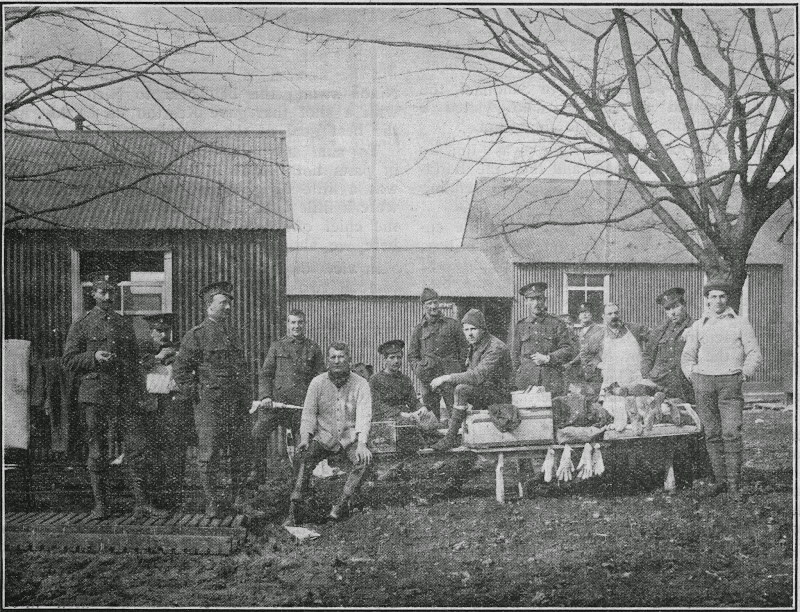
THE GILLIES & GAMEKEEPERS OF THE BATTALION.

The above photograph does not, unfortunately, include the whole of the Gillies and Gamekeepers of the Battalion, but it conveys some indication of the spirit which has emulated these hardy Northeners, who are always amongst the first to flock to the Colours when the war drum beats, and the pipes begin their wild skirling. There’s something in the fierce Highland blood which responds at once when there’s fighting to be done, and here we have a representative collection of men, lovers of the open air life, who have left home and country to serve H.M. the King. To these splendid fellows

a soldier’s life comes naturally, and as many have followed their Master’s lead in taking the King’s Shilling we find displayed a fine patriotism which might well be copied by those in our big cities, who still hesitate. It is impossible in this small space to comment on any particular individual, but we cannot refrain from mentioning Piper Sergt. Robertson, who has served with the 5th Battalion Royal Highlanders, and of whom we shall have something to say in a later issue, and Sergt. Schofield, who is the only figure in the group born south of the Tweed.

B COMPANY’S FIRST ANNUAL DINNER.

A Flashlight Impression of “B” Company’s Annual Dinner.

The excellence of any function arranged by “B” Company must be a foregone conclusion if the Dinner which was held at the White Hart Hotel, Romford, last Friday evening can be taken as any criterion.

Everything went off splendidly, the dinner itself was excellent, the speeches fitted the occasion, the entertainment was excellent and the Committee and the chief organiser, Private F. G. Harris, are to be heartily congratulated upon the result.

Lieutenant P. Suckling occupied the Chair, supported by all the officers of the Company, while the visitors included Colonel Lord Maitland, Lt.-Ool. Gibbons, Doctor Hill, Captain Inglis and 2nd Lieuts. B. E. York, C. P. Roberts, Sydney Smith, R. O. Jourdain, and Regimental Sergeant-Major Merrick.

Lt.-Col. Gibbon struck the right note when he said that at present we should be more than ever proud of our Army and finished by voicing the opinion that the Sportsman’s Battalion, when it gels the opportunity, will do its best and succeed in adding fresh laurels to the honour of the Army and the Old Country.

Sergeant Marsden in proposing “The Allies” was perhaps the turn of the evening. His most amusing speech really deserved a place on the entertainment platform. Second Lieut. Eimen, in reply, gave us some idea of the Belgium "feeling towards England as that of the Little to the Big Brother, and his allusion to some of the atrocities perpetrated in that little country made one more than ever anxious to get into the firing dine and help to make amends.

The toast of the 1st Sportsman’s Battalion was given in a typical speech by Regimental Sergeant- Major Merrick, and Lord Maitland in reply emphazised the fact that we had one goal and that was to fight the Germans. Among the new Battalions it was a scamper to get out first, and only by steadily progressing with our training would we get considered in advance of others. Second Lieut. Taylor toasted the visitors including Doctor Hill in a racy speech and paid tribute to the fact that the Doctor had come well through a trying period, while the Doctor expressed himself as grateful to everyone for their co-operation. The toast of the Chairman and Officers was well treated by Sergeant Major Webb, and in Lieutenant Suckling’s response it transpired that the Dinner was to be repeated annually on March 5th, wherever B Company might

be and under whatever condition. Second Lieut. Hillcoat was also associated in the reply.

Sergeant Wainwright presided at the piano and the entertainers included Lieut. P. Suckling, Privates Kilpatrick, Larner, Lindsay, Hamilton, Sullivan and Williams.

The whole of the above are members of the Company while there still remained a reserve upon which time made it impossible to call.

And now as Sergeant Marsden said in his very witty speech “Like .Lady Godiva I am drawing near my “close.”

Remains to be said that the evening was a tremendous success and everyone is looking forward to its repetition. Members of the Committee not previously mentioned were Messrs. Q.-M. Sergeant Cole L.-Corp. Barr, and Privates Cooper, Fulljames, Mansfield and Thomas.

THE PASSING SHOW.

By the Week-Ender.

Despite the war, great preparations are being made for the theatrical season in town, and I suppose that in discussing these preparations we must include the West End variety shows, for have we not Rejane at the Coliseum, and are not other great stars promised before the summer comes?

Sir Herbert Tree is following “David Copperfield” at His Majesty’s with an adaptation of M. Pierre Froudale’s drama “The Right to Kill,” and I learn that Sir Herbert will himself play the part of the avenger in this intensely human play.

On Wednesday last “Madame Butterfly” was produced at the Shaftesbury in English, with Miss Rosina Buchman in the name part.

“The Girl in the Taxi” moves to the New Theatre where we shall see a charming Russian actress—Mlle. Lyuba Liskoff—in the part of the jolly jolie parfumeuse in place of Mlle. Yvonne Arnaud.

Monday last brought the 100th performance of “The man who stayed at home” at the Royalty.

Madame Rejane appears at the Coliseum in a sketch “The Bet,” which, in racy fashion, reproduces a very probable incident of the war with the fraternising of British and French officers, giving a truly practical demonstration of the entente cordials.

At the Palace on Tuesday night, precisely at 8.30 p.m., the Curtain rose on “The Passing Show of 1915.” I have not as yet had opportunity to see this revival, but the critics have received it with enthusiasm, so I feel sure that the management will once again have excelled themselves.

There is a jolly ripping programme at the Alhambra, and a new revue is promised shortly.

Leslie Stiles’ new piece, “Stage Struck,” is a great success at the Empire, and1 I wish I had space to amply describe it.

The new revue at the Palladium, “Passing Events,” with the backing of a fine bill is well worth seeing, as also is “Go to Jericho” at the Oxford.

Sportsmen visiting town this week-end have a fine choice. Next week I hope to tell you a little about what’s on at the Restaurants.

HORNCHURCH CINEMA.

Next week’s programme includes a particularly dramatic Ruffle’s Production entitled, “Wreckers of Lives,” together with that charming historic comedy “Davy Garrick,” specially staged by Sir Charles Wyndham.

The Hornchurch Cinema is a comfortable resort for wet evenings, and its appointments are equal to those found in the high class West End Houses. Sportsmen need never be at a loss for a night’s amusement.

March 5, 1915

Aberdeen Weekly Journal

WELL-KNOWN FOOTBALLERS IN THE SPORTSMAN’S BATTALION.

Lewis R. Lewis (on reader’s left), the Army International footballer, is a corporal in the 2nd Sportmen’s Battalion, and has been appointed captain of the football club of the battalion. With him in the picture is Sergt. Adams, of the same battalion, who played for Fulham this year, and was formerly captain of Southend United.
The Cincinnati Enquirer

HOTEL CECIL, LONDON.

Our attention having been called to the fact that there is an impression in America that this hotel has been taken over by the Red Cross Society, we would take the earliest opportunity to inform you that such is not the case.

The hotel is open to receive visitors as usual. Beyond the fact that certain of the public banqueting rooms are being used for the purpose of recruiting for the Sportsman’s Battalion, there is no interference with the usual course of business.

     Yours faithfully,
          F. M. Hornsby, Manager.

The First Sportsman’s Gazette – No. 11

EDITORIAL.

An old campaigner, and a good soldier in every sense of the word, recently gave it as his opinion that never had he seen a more capable body of men than those which make up the 23rd (Service) Battalion, Royal Fusiliers, and he also expressed the view that when fighting was afoot these men, drawn together from the four quarters of the globe by a common bond, would render splendid account of themselves.

Few of us would wish for better compliment.

Those two words—“Sportsman’s Battalion”—have a ring about them which attracts the right kind of individual. They suggest “playing the game,” and everything that means to the Britisher. They make a real appeal to the individual who loves an outdoor life—the man who is used to pitting his skill, his judgment and his endurance against long odds, the prophets who, at the inception of the idea for forming a Sportsman’s Battalion, said that men of this class would take to soldering as a duck takes to water have had ample justification.

Many have been the setbacks, great have been the difficulties, but these things only serve to give a zest to the game, and now the most arduous part of the task is over, and there has come into being during the four darkest months of the year a battalion of which each individual member is as efficient a soldier as the two years’ man in times of peace. It might also be safely said that had the equipment come to hand more quickly even greater things might have been accomplished.

The future is in the lap of the Gods, but now that Spring is almost here, and there is some possibility of rifles being served out to us at an early date, it may not be long before we are ready and fit to take up our posts in the trenches alongside those other splendid units of Lord Kitchener’s Army, which Great Britain has trained in such record time.

THE EDITOR.

BATTALION NOTES.

Trenching has been continued during the week as usual, with the exception of last Saturday, when the heavy rain caused the trip to Benfleet to be abandoned.

The “Dismiss” Bugle was a welcome sound to those anxious to get away for the week-end.

Chief interest for the moment centres on the bayonet drill, in which all companies are making good progress under the instruction of Sergeant-Major Smith. The recruits, too, are coming along splendidly under Sergeants Cummings and Whiteside.

Fresh recruits are being accepted every day.

It is pleasing to note that the general health of the Camp is improving, the epidemic of influenza and sore throats having been almost entirely stamped out.

In this connection it is pleasing to note the return of Sergeant Bucknall. The whole regiment heard of his illness with the deepest regret, and we are glad to welcome his return and that of the remaining members of his hut.

APPOINTMENTS.

The following extract from the “London Gazette” of 25th February has interest for the Battalion :—”Temporary 2nd Lieutenants to be Temporary Lieutenants—R. N. Bealey and the Hon. A. E. F. Yorke (22nd February).”

And the whole Battalion will welcome the appointment of Sergeant R. O. Jourdain as Temporary 2nd Lieutenant.

Also from the “London Gazette” 1st March : — Temporary 2nd Lieutenants to be Temporary Lieutenants—2nd Lieut. Pirie; 2nd Lieut. Cross. (22nd Feb., 1915).

Temporary 2nd Lieut. P. A. X. Thompson is appointed 2nd Lieut. 3rd Inniskilling Fusiliers (Special Reserve).

The appointment of Sergeant R. T. Williams, Right Flank Company, as a musketry instructor, is also announced.

CHANGES.

Privates J. Wilson and C. Johnstone have been transferred from “B” to “L.F.” Company.

SOCIAL.

“B” Company are holding a dinner at the White Hart Hotel, Romford, to-night (Friday), with Lieutenant P. C. Suckling in the chair.

AN APPRECIATION OF THE MESSING COMMITTEE.

One of the songs sung by Kitchener’s Army to the tune of the Soldiers’ Chorus from Faust, runs something like this : —

“All soldiers live on bread and jam,
All soldiers eat it instead of ham,
Every morn we hear our Colonel say
“Eyes front, form fours, jam for dinner to-day,”

which in good humorous vein gives some hint that there might be just the slightest chance of monotony occurring in the feeding of England’s Legions.

Stew yesterday, roast to-day, stew to-morrow— stew before, stew after, in one continuous procession until the palate cloys;

Not that the meat is not excellent, not but that it is thoroughly cooked. Rather is it that the taste becomes accustomed to every subtlety of the flavour, and thus having explored every possibility, there being nothing left to put a zest on the appetite, one eats mechanically without enjoyment for the sole purpose of feeding the human machine.

An Escoffier would make a food poem with the materials our cooks are furnished with, but we cannot expect an epic from the Army Cook.

He does his best under difficult circumstances, and he is improving mightily, thanks to the hard work of the Messing Committee. Boiled beef and carrots is a truly admirable dish, Lobscouse, and Boiled suet pudding and Jam are just a few of the items which have served to add the spice of novelty to our daily dinner menu.

Chops for breakfast are very much appreciated by the trenchermen, and it is pretty evident that when this Committee gets well into its stride great things may be expected.

Dinner on the Drive, in sunny February,

EVERYBODY’S DOIN’ IT.

Specially contributed to the “First Sportsman’s Gazette,” by John Hassall, the well-known Poster Artist, whose designs are seen on every hoarding. On the back of the drawing are the words, “Sorry, couldn’t find time for anything before. Am rushed off the earth,” Many thanks, Mr. Hassall!

LECTURE BY SERGEANT R. T. NOYES.

Sergeant R. T. Noyes, better known as “Canada,” gave a most interesting lecture on Friday evening last at the Congregational Church in the village on the expedition to Khartoum to relieve General Gordon. The march to Khartoum and the arrival just one day too late to save the ill-fated Gordon is one of the most dramatic, and at the same time, most pathetic incidents in English history, and when described by one who actually took part in it the story becomes intensely interesting.

Sergeant Noyes went with the expedition in a civilian capacity, being one of the 385 Voyageurs or Canadian river men who served as experts, and he traces the journey from the moment of leaving Canada until within sight of Khartoum.

At one moment pathetic with the nearness of death, the next broadly humorous with a description of the mending of his clothes with a piece of tin and finding it too hot to sit down, Sergeant Noyes held his audience from beginning to end.

I should like to pick you out a plum or two from such an interesting store of experiences, but Sergeant Noyes has promised to repeat the story in full through the medium of the Gazette at a very early date.
SPRING CLEANING.

FOOTBALL NOTES.

ASSOCIATION.

EXCITING GAME WITH DULWICH.

The return match with Dulwich at Champion Hill on Saturday had every promise of an exciting struggle, and a record crowd turned out to see the fun.

With the Hamlet anxious to wipe out the defeat of a few weeks back, a ding-dong game was seen, with quite a cup-tie flavour about it.

Full of incident, with the issue in doubt until the finish, a draw of 2 goals each was the only result possible on the day’s play.

Science at times was at a discount, and the efforts on both sides were spasmodic rather than continuous. The sticky nature of the ground had something to do with this, although overkeenness was probably the chief factor.

For Dulwich Clegg stood down to let in W. J. Davies, who has recently joined the colours, and on the Battalion side Lewis at half deputised for Lieut. Hayes.

The Battalion side was the first to be aggressive, and a shot from Clunas went just wide of the mark. It was not long before Higgins at the other end was forced to send into touch from Hayward, the Hamlet outside left.

Higgins, who has not been in the field since Christmas, played a masterly game at back, and his tackling and placing of the ball were as sure as ever.

Lewis contrived to get the ball to Sandham, the outside right centred to Clunas, who waited a shade too long before taking the final shot.

Nixon, the Dulwich outside right, was quickly forcing a corner the other end, and then the Battalion took up the running again, Sandham sending to Owers, who shot behind.

There was always a certain spice about the encounters between Rawlings, the old Dulwich boy, and Nixon, the newcomer, and it must be confessed that the Battalion man did not always get the best of it. Nixon and Nicol on the Dulwich right were always spelling danger. Clarkson, their centre man, raced past J. Hendren and Lewis, but offside against Nicol spoiled the resultant move.

The see-saw work continued, Higgins got the measure of Hayward, and immediately had to race across and check Nixon and Nicol.

Owers was slow at the other end, and Sweeting, the dashing left back, cleared for Dulwich. A pretty move between Owers, the elder Hendren and Sandham, was finished with a weak shot, and in a flash Higgins was forced to concede a corner. This was well cleared by Littlewort, but the Hamlet forwards were not to be denied, and after Kearton had made a great save from Nicol, Newstead scored from a melee in front of the goal, with Kearton still on the ground. In some ways it was a lucky goal, for it seemed as if the goalie should have hung on a little longer before trying to clear. It came, however, after a period of pressure by the Hamlet forwards, and no- one begrudged them their success.

E. H. Hendren raced away from the re-start and gave Vernon of Dulwich a very warm handful, which the goalie did well to save. The ball was only partially cleared, but the return shot from the younger Hendren was cleverly tipped over the bar.

The Battalion forwards for the most part lacked go, although they came again towards the end of the half, when pretty work between Atkinson, Clunas, and Hendren carried the ball into the enemy quarters.

The Battalion side went off with a rush in the second half, and it was not long before they got the equaliser. Rawling was really the initiator of the movement. Receiving back from Pat Hendren he booted up to Owers, the centre man sent out to Hendren, who passed inside for Clunas to score from an awkward angle. This was the signal for a general siege of the Dulwich goal, and after Littlewort, Rawling, and Clunas had all tried long shots with effect, Owers with a ladylike movement turned a centre from Hendren to account. Owers, who had not been playing with his usual vim, atoned for many previous omissions by this effort, and lie almost repeated the dose a second later from a pass by Clunas.

It was not long before the Hamlet side were again in the picture, and with the visitors hesitating for the fraction of a second on an offside appeal, Nixon swung the ball over to Nicol, who scored with a shot that gave Kearton no earthly. Easily the best goal of the match.

To sum up, both sides played good football, in parts both made mistakes. The result perhaps was a little disappointing to the Battalion, but we were a little slow in the forward line, Owers being the chief offender. With a little more “ginger” here we should have gained the verdict.

In view of the increasing interest in the Battalion football two matches have been arranged for Saturday, the one against Hampstead Town at Hampstead, and the other against the R.A.M.C. from Brentwood, here. Both are timed to start at 3.15

“PITCHER.”

THE SPORTSMAN’S RUGGER TEAM.

Top Row (left)—Harris (secretary), Thomson, Williams, Gilmour, Franey, Spurway, Trott, Whittock, Clemetson.

Bottom Row (left)—Salvesen, Pearce, Lieut. Taylor, (the Referee), Capt. de Bourbel, Wadham (capt), Henri, Stratton.

RUGBY.

ST. THOMAS’ HOSPITAL v. 1st SPORTSMAN’S.

The Rugby team played St. Thomas’ Hospital Saturday at Chiswick Park, with a change of two forwards, Capt. de Bourbel and Pte. Stratton being unable to play. Their places were taken by Reynolds and Scott-Tucker (the former making his first debut with the team).

The ground was in perfect condition, but the Sports are used to heavier going, and it was not conducive for their good play. The wind was favourable for the home team in the first half, and they made full use of it, and tried to wear down the visiting forwards. The first score was obtained by the Medicos, for, from a free kick, Coverdale the international, dropped a beautiful goal. Immediately after this the Sports pressed hard and had twice in succession five yards scrum in the home line, but on each occasion, owing to their forwards being unable to get possession, lost the chances and ground gained. A fine piece of passing by Coverdale to Owen, the celebrated Blackheath player, a second score was obtained. This was unconverted, and at half-time the Medicos were leading by 6 points to nil.

The Sports forwards after half-time seemed to wake up, and many excellent forward rushes were lead by Clemetson, Gilmour and Thompson, but suddenly Owen and Coverdale made a splendid passing movement, and Owen got over and made the home team 9 points up (owing to the strong wind this try was unconverted).

The Sportsmen after this seemed to get a new life into them, the forwards got the ball out, and after a good forward rush led by Clemetson and Spurway, supported by Taylor, Pearce crossed the line most cleverly, and Williams converted the try by a well-judged kick.

A great task at this time lay before the visitors, for with only 15 minutes to play they had to obtain five more points to be victors.

This was managed by another grand rush by Clemetson and his forwards, and Henri being on the spot picked up very smartly, passed to Wadham, who immediately transferred the ball to Salveson. He got a splendid try on the line midway from the goal posts. This made no difference to Williams in his kick against the cross wind, for the converted two points were obtained, making the Sportsmen one point ahead.

They continued pressing, and when the whistle blew they were on the opponents’ line.

Coverdale gave a tine exhibition, and with the support of Owen, were very nearly the means of beating our team.

The Hospital were very unlucky to lose Gimlette during the early part of the second half, and thus having to play with seven forwards, but the judgment of their full-back, Cardell, in his fielding the ball and round kicking, saved them a great deal of pressure in the latter part of the game.. All our three-quarters played a very good saving game, especially Wadham, and with the help of our halves we have to thank them for our victory. It was unfortunate that Scott’s leg troubled him because, though tackling well, he was unable to kick as well as he has previously.

The forwards are greatly lacking in combination in the scrum, and before we can win further matches we must have scrum practice. Each seemed to wait for a certain place; this is folly because the first to get the shove on very often is the first to get the ball out.

The game was most admirably refereed by Mr. E. T. Andrews, to whom our thanks are due, and we hope to have the pleasure of having him refereeing for us soon again.

St. Thomas’ Hospital—J. D. M. Cardell; G. R. C. Willson, W. Owen, R. W. Procter, and F. Molina; H. Coverdale and L. M. Davies; J. S. Sloper, S. A. T. Ware, G. T. Gimlette, J. W. Wayte, F. C. Gladstone, R. E. Rampling, E. J. S. Bennett, and A. Pappenfus.

1st Sportsman’s Battalion—H. Scott; L. Williams, R. Pearce, H. F. Wadham (capt), and S. A. Salvesen; Lieut. H. A. Taylor and P. Henri; G. V. Spurway, J. M. Gilmour, D. L. Clemetson, S. Thompson, G. T. Franey, A. Whitlock, H. Scott-Tucker, and S. Reynolds.

This Saturday we are meeting the London Rifles at Brighton, and on the following Saturday we play the return match at home against the H.A.C., who only once have been beaten, and that was by us, so this match will be keenly looked forward to by all our Rugby supporters.

FREEMASONRY.

The Editor has heard that the suggestion of a Craft Re-union Dinner has met with approval in the Camp. Replies have even been received from brethren outside the Battalion. A meeting of Freemasons is therefore called for Wednesday evening next, at 6.30 p.m. Those desirous of attending are requested to send their names at once to the Editor. The place of meeting will, of course, depend on the number signifying their intention of being present.

CORRESPONDENCE.

Copy of a letter addressed to Mrs. Cunliffe-Owen. The article referred to is “Broncho Lou,” which has quite a characteristic Western flavour.

     Riverside Hotel,
          Reno, Nevada,
               Feb. 3rd, 1915.

Mrs. Cunliffe-Owen,
     Dear Madam,
          Were I in a position to do so, I would much like to send you a check for £1,000 to purchase comforts for the men at the front, Sportsman’s Battalion. As it is, however, I see no way at present except to contribute a few original stories, based on fact, and if the same were worthy of publication, I should like all the proceeds to go to the men of the above Battalion.
     This Story is original. If you think the same would be acceptable to the boys, if nothing else, I shall be glad to send you more.
     I should, as you know, like to be with them, sharing their hard knocks, as well as their comradeship,-and I believe I could help liven things up, as former life as a soldier in the trenches, has taught me what goes best with the fellows.
     Sincerely and respectfully,
          (Sgd.) H. BARR CHILD.

JOURNALISM AND SOLDIERING.

Dear Freer,
     I understand that the changes which have been made recently on the Staff of the Gazette have been misunderstood in some quarters of the Camp, and misrepresented in others, and I think that a brief statement from me may possibly help to clear the air a little. In the first place I wish to place on record the generous and courteous manner in which the Commanding Officer and all the other officers concerned carried through these changes. My own resignation was rendered necessary by the fact that in the eighth issue I allowed my instincts as a journalist to outrun my duty as a soldier. My plea is that the position was rather an unusual one, and that at times I scarcely knew whether I was acting in my capacity as soldier or as Editor of the Battalion journal. In any case I recognise the essential justice of the attitude taken up by the Regimental authorities in this matter, and I am perfectly satisfied, not only with their decision, but also with, their way of carrying it into effect. I may perhaps be permitted to add that the resignation of my colleagues on the Responsible Committee, although inspired by friendliness to myself, does not necessarily imply responsibility for the sentiments expressed in my article.
     I wish the Gazette—in which I shall always retain the deepest personal interest—a long and successful career under your able guidance.
          Very sincerely Yours,
               WILLIAM J. HARVEY.

FAMOUS CRICKETERS IN THE BATTALION.
(Series continued).

E. H. HENDREN (Middlesex).

Looking every inch a cricketer, E. H. Hendren, now a Private in “B” Company, has been playing in first-class cricket, in fact first-class football too, since the early age of 18.

On the ground staff at Lords he quickly earned recognition from the country. 1907 was the date of his first important match, and, curiously enough, it was against Lancashire when a more than usually inquisitive crowd so spoiled the wicket by prodding it with sticks and umbrellas, that the game had to be abandoned after lunch.

It is, I believe, the only case of this sort on record in first-class cricket, certainly the only case at Lords,

Robbed of the chance of distinction in his opening game, Hendren has since won his spurs in many fields, although Lords has always been his happy hunting ground.

It was here he made his first big score, that of 134 not out against Sussex. He has oftentimes topped the century since, but this still remains his highest effort.

Perhaps his best performance, also at Lords, was in the second match with Surrey last year.

Hayes, now his comrade in arms, would remember this too.

Hendren had just reached double figures when Hayes bowled him with a ball which hit the wicket without removing the bails. Hendren playing in masterly fashion afterwards showed such appreciation of his good luck that he totalled 124 before being finally dismissed.

Cricket appears to be a family gift, for both his brothers have distinguished themselves in the same sphere of sport.

Patriotism runs in the same groove too. Dennis Hendren, originally with Middlesex, and now associated with Durham, is at present training with the Durham Light Infantry, and of his younger brother most of us have a more intimate knowledge.

The subject of this sketch has never been out of England, although he has played in one of the trial games at headquarters.

He is perhaps the safest long field in the country, and his bag usually averages between 30 and 40 victims a year.

He was a member of the side which, playing at Gloucester, scored one of the quickest victories ever known in county cricket. The match started at 12 o’clock and finished at 6 o’clock on the same day, Middlesex winning by an innings, and Frank Tarrant taking 4 wickets with 4 successive balls.

Although essentially a cricket article, we cannot entirely overlook the football side of the picture.

“Pat,” as he is known to his familiars, first came into prominence with the Manchester City side, and later migrated to Coventry City. While there the City gave Preston North End the surprise of their lives, beating them in the first round of the English Cup, Hendren scoring the winning goal. Coventry eventually got into the fourth round before being knocked out.

For the last four seasons he has played at outside left for Brentford, in which position he has been a most prolific goal scorer.

Still young in his profession, Hendren has shown that he is made of the right stuff, and should he attain further honours, we of the Sportsman’s Battalion who have met him, will be amongst the first to welcome his success.

J. HENDREN (Durham).

J. Hendren, also associated with “B” Company, seems destined to follow in his brother’s footsteps.

Spending four seasons at Lords, he has for the past two years been qualifying for Durham, playing friendly matches for this county in the meantime.

While playing for the Middlesex second string he often found Sergeant Marsden in the opposition, and Marsden bears testimony to his prowess.

Sergeant Marsden was a member of the Hampstead Club, and Hampstead has always been a name to conjure with in the cricket world.

In the ordinary course Hendren would have figured in Durham Senior League Cricket this season, for he had promised to assist South Shields, where Frank Harvey, the old Lancashire player, is the professional.

Jack is a worthy member of a sporting family, and has the making of a good cricketer, footballer, boxer, and soldier too.

FRANK WINCHCOMBE.

Mainly About People.

Notes concerning members of the Sportsman's Battalion.

Freer Cyril C. (Private).—Educated at Archbishop Holgate’s Grammar School, Malton, Yorks. Devoted business life to organising and advertising. Was on Staff of “Daily Mail” and is now Advertising Manager to Roneo, Ltd. Lecturer on Business Methods, at Regent Street Polytechnic. Keen golfer. Represented school in rugby, fond of shooting. Founded the Malton Rifle Club in 1901, and acted as Secretary to the Volunteer Augmentation Society, which had for its object the strengthening of the local Volunteer Company. Has taken a prominent part in Freemasonry, being in the Chair of his Lodge, Camalodunum 660 in 1906, its Jubilee year, is also P.M. Fitzwilliam Marie Lodge 277, P.P.G.A.D.C. North East Yorks, P.Z. King Edwin Chapter 660 and P.P.G. Asst.-Soj. North East Yorks.

Leith, Edward (Lance-Corporal).— In theatrical business. Manager for Marie Studholm. Five years as Stage Manager with Seymour Hicks. Song writer, including in his efforts “My Daffodil Girl,” for Marie Ash, and “The Call,” chorus of which appears in this number of the Gazette.

Marwood, G. (Sergeant).—Born in Taunton. Educated Emmanuel College, Wandsworth Common. Civil servant. All round sportsman including Tennis, boating, motoring, cycling and walking in his hobbies. Five years P.W.O. Civil Service Rifles.

Thomas, Clement (Private).—Educated Marylebone Higher Grade School. Motor Engineer. In the industry from its infancy and had the satisfaction of placing first English motor cab on the streets of London. Hobbies, hunting—is the winner of many steeplechases—fishing and yachting. Generally known as “Tommy.”

Toogood, A. H. (Private).—Professional golfer Champion Midland Counties. Fourth in Open Championship at Sandwich. Second in “News of the World” in 1906. Represented England against Scotland, 1904-5-6-7. Won London Professional Foursomes with Rowland Jones in 1907 Beat open Champion of Ireland.

BOXING PERSONALITIES IN THE BATTALION.

W. HOOPER (Welter-weight).

You may catch your boxer but the difficulty is to make him talk, and this perhaps accounts for the fact that outside the actual fraternity we of the Battalion have heard little or nothing of the powers of Private W. Hooper.

Hooper, who fights under the name of Dick Brown, is a splendid example of the hereditary genius. His grandfather was well known in the ring, his father besides being useful in “the art” was a first-class runner (an ominous combination), while both his brothers have made a name for themselves in the boxing world.

Harry gave us an opportunity of witnessing his abilities near home, when he drew with Stanley in a ten-rounds contest at Romford, and the younger brother did well in the army and navy championships before going to the front with his regiment, the 16th Lancers.

William, who is the eldest of the trio, was well in the running 18 months ago for the welter-weight Lonsdale belt, when he had the misfortune to break his hand. This and the war have put him back a bit, but he is now doing his best to re-establish himself.

It would be meaningless to some of us to quote a list of the names of the boxers he has conquered, the remainder of us know. Perhaps a better idea of his quality can be gathered from the fact that in one year he had 33 victories to his credit, in fact until the accident to his hand he had never been beaten. Most of his wins, too, were gained in the first round. Recently he easily got the better of Bill Sutton at The Ring, while he was the runner-up in a welter-weight competition at the National Sporting Club on the night of Delaney’s big fight.

Modest,- a fearless fighter and hard hitter, Hooper who is a Private in No. 4 Company, goes about his training in the most unostentatious way possible.

Jerry Delaney, light weight, and W. Hooper (Dick Brown) welter weight, would be a good Battalion double for the Lonsdale belt competition.

Any offers !

THE “SUB.”

PRIVATE JERRY DELANEY (on the left) who defeated Jack Denny last week at the N.S.C., and his trainer, Private Joe Jagger.
THE HUT ORDERLY.

By The Recruit.

I decided I was a Sportsman before I thought of being a soldier, and I do really think that if I had not been so sure of that one thing I should never have joined the army; but I was always keen on reading football reports and I oft would venture my bob on a gee.

Well, my pal Fred, joined the Battalion in November, and when he came home at Christmas he was so full up of pride with being a Lance-Corporal, that I made up my mind to throw up my job as hot cross bun maker and enlist.

I haven’t been a soldier long, but I’ve learned many things during the short period I’ve lived in Hornchurch.

For instance, I’ve never washed up before in my life, but by jove I know how to do it now, and I can give any new chap who comes along a few tips about getting rid of the grease with the least amount of trouble.

Don’t you worry. It’s foolish to bother about drying mugs and plates, souse ’em well in hot water, then stand ’em up and let ’em drain. In less than an hour they will be all right without a single touch of the teacloth.

The fellows may grumble a bit, but if you smile hard and crack a joke, you’ll get through easy enough.

There’s one thing, though, that I kick about., I’m the only recruit in my Hut, and the other inmates have a rule to the effect that recruits must fetch early morning coffee and biscuits for the runners from the cook house and serve it to them in bed. It’s a hit too thick, I think, because it means lighting two fires first. We’ve a vacant bed, and I 'hear another recruit is coming in. Heaven help him, he’ll get this particular job as a permanency directly he arrives.

No other fellow in the Hut has been appointed permanently as Sunday orderly. I felt a bit proud of that at first, but now I realise that it is simply another of those burdens the young soldier has to bear.

The tea buckets, too, are a bit of a bug-bear. The other fellows boil water in them, and it takes me about two hours of hard scrubbing with Monkey Soap—which I have to buy myself—to get the grime off the bottom.

Why on earth so many meals are needed I cannot imagine. There’s Coffee and Biscuits for the runners, Breakfast for the trenchers, Breakfast for the runners, an “al fresco” semi-lunch for those on parade at 11 o’clock, dinner at 12.45, tea at 4.30, dinner for the trenchers at 4.45, and lastly a wallopin’ great supper of sorts about 9.

Our chaps bought a double set of plates, and they manage to dirty the lot at each meal, so you can jolly well understand that if I don’t know anything about washing up nobody does.

That blessed bugle, too, seems always on the blow. First its “cook house,” then its “rations,” then its “cook house,” and when our chaps started me regular as letter carrier, I’ve got to keep my ears skimmed for “Lively Lou.”

At the beginning I washed all the chaps’ kit boxes—I washed the windows, and was beginning to wonder I was not told off to touch up the tin roof plates. Lately I’ve made progress as a slacker, and when that other blessed Rookie comes on the scene I’ll be as artful as they make ’em.

I used to tell myself that soldiering was a grand life, and I jeered at Gerty, that little kitchenmaid I walked out, but now I know she was a bloomin’ Hero, ’cos as I’ve tried to convey, I’ve had some myself.

The other morning—the day after I’d been orderly—I was called over the coals by the Sergeant for not taking—and now I’m hoping I’ll be a defaulter for a month or two, for I’m sick to death of this washing up games.

The First Sportsman’s Gazette – No. 10

EDITORIAL

It is a curious fact that many of us—keen though we were on “getting a smack” at our friend the enemy in those feverish days which preceded enlistment, are now losing touch with the issues at stake in this world conflict.

The reason is not far to seek, for are we not putting our energies into, becoming efficient soldiers?

Our new mode of life scarcely permits of much reading or speculation as to what is happening abroad, and what is more, except on those rare occasions when our Navy gets busy, there is a terrible monotony in the news served up to us by the London papers—-trench fighting, does not permit of rapid progress—so, after a hurried glance at the headlines, our erstwhile favourite journal is tossed on one side.

I firmly believe that if we have each week in the “First Sportsman’s Gazette.” an article on the doings of our boys at the front, written by some member of the Battalion,, in whose soul burns the fire of literary genius, it will serve to keep our minds on the game we are learning to play.

You will remember our eagerness after hearing the news of Scarborough, and the thrill we experienced when we were told of that big fight off the Falkland Islands, and it just comes to this, I want someone to write an inspiriting weekly “leader” on the war, which, by chronicling the deeds of brave men, and telling of Britain’s greatness, shall re-invigorate us, and make us all the more determined to go in and win.

It’s rather nice to think that you and I are not like the man who ought to go and does not. We have left comfortable homes, and have made sacrifices of which we alone can know, in order to serve our country in our country’s need, and afterwards, when we come back—if we do—we shall be proud to say we did not shirk.

We have to rough it a little now—we shall have to rough it still more, but what of it? It is a grand and manly life, and we are doing something.

I know one man, a relative of General Paris, the defender of Antwerp, who almost cried when age precluded him from joining the army. He would say, “If only I could do something. Sitting on an East Coast rock with a gun in my hands would be loafing, but loafing with a difference, for I should feel that I was helping.” That man left for France on Saturday last as a Red Cross orderly, and when he told me the news he was overjoyed.

Thanks to a special concession, we older men in the First Sportsman’s should consider ourselves fortunate indeed.

Some there are amongst us who at the beginning of things took badly to saluting. Most of us regard it differently now, and it was only the other day that I found out why. I was going along the High Street when the strains of martial music told me that the boys were returning from trench digging. I stepped to the edge of the pavement sprang smartly to “attention,” and it was with a keen pleasure that I saluted Lord Maitland, and the officers who marched past at the head of their Companies; for in a flash it came to me that I was paying my respects to the might of Britain in the person of those who hold the commissions of His Majesty King George the Fifth. I may not have yet succeeded in mastering the subtle niceties of saluting, but I intend to do so, for it behoves us all so long as we are soldiers to cultivate that smartness which stamps the good soldier wherever you may see him.

The appointment of Sub-Editor, Financial Manager and Secretary, and Advertising Manager, has not been definitely settled, and the Editor will be pleased to receive further applications.

A Cartoonist, someone used to sporting journalism to report the Battalion Soccer matches and a “Things we want to know” reporter for most of the Huts are still urgently needed.

If improvements are to be effected in this our Battalion journal, volunteers should come forward without delay.

Contributions of interest are cordially invited, and it is pointed out that to facilitate early publication of the “Gazette” these should reach the Editor not later than 6 p.m. each Monday for publication in the next issue.

THE GREAT FIGHT AT THE N.S.C.

Private Jerry Delaney—our Jerry—easily defeats Jack Denny of New Orleans.

When first I saw Delaney I never imagined that I was looking at a truly tine boxer, who had studied the art, and fitted himself by strict training to more than hold his own at that Mecca of “the fancy,” the National Sporting Club.

Thanks to the concession to members of the 23rd, secured through the good offices of Mr. Bettinson, a large number of the boys booked seats, and being granted special leave, proceeded to town in time to enjoy a good dinner before occupying their seats at the Club.

My first impression of the ring was peculiar, it called up recollections of pictures I have seen showing the Roman populace in the amphitheatre awaiting some great contest of skill; but whilst in those bad old days cruelty was the thing most loudly applauded, now all brutality has gone and only science remains.

There were no villainous faces, as one has read of in books written by the early Victorian authors— just a gathering of well-bred gentlemen who love sport for its own sake, and have the courage to follow their inclinations.

The auditorium was almost full, and khaki strongly mingled with the black and white garb of peace.

I noticed more than one Staff Officer, whilst amongst those were several from our own Battalion,

After a little waiting the Gladiators entered the arena for the first bout. After two somewhat uninteresting bouts for the semi-finals of welter-weight novices, and a six-round contest in which Joe Conn of Bow beat Harry Moyes of New Cross in one round, there came the twenty-round contest between Young Fox of Leeds and Alec Lafferty of Glasgow, in which the former had an easy win on points.

Then came the great contest of the evening.

Jerry Delaney we all know, so there is no need to say much about him here. He's a good plucked ’un,” and a true “sport,” so all of us are glad to think he proved himself the better man.

Jack Denny is game enough too, but he was out-boxed by one who is cleverer than he, and he knew it before the first round was over. When they stripped I somehow felt that our man had a tough job in front of him, for the American seemed to be better developed; however, as the fight progressed, it was easy to see that Jerry’s wiry frame represented hard training and genuine fitness.

I do not pretend in this article to minutely describe the various phases of the right—you have already read of it in the pages of the sporting papers, but I will instead record the impressions of an eye-witness for the benefit of those who were not present.

In the very first round Jerry’s superiority showed, and although Denny kept up to it, Jerry put in some clever two-handed work, which began to have real effect.

In the third round Jerry quickly scored, and the bell only just saved Denny, as was the case in many of the succeeding rounds.

There was a good deal more holding on in the fourth round, in which Jerry’s right fist made constant acquaintance with the American’s jaw.

Delaney seemed to do just what he liked with the American in the two next rounds, and I firmly believe that had he pressed his advantage the contest would have ended with the sixth round.

Denny “came up to it” a little in the seventh round, but Jerry’s lightning left became very busy, and the American was very badly punished. All through those left-hand jabs of Jerry had a nasty habit of finding their mark, and Denny knew about it, for as the fight progressed he showed signs of the severe gruelling he was experiencing, and the audience expressed no wonder when after the fourteenth round his seconds announced that he had “given in.”

All honour to “our” Jerry, and may he find just as easy a victory when he meets Freddy Welsh.

There can be no doubt that Jerry owes a good deal to his trainer, Private Joe Jagger, whose solicitude and care during the last few weeks have been most marked. Some mention must be made of Private Hooper, who recently defeated Kid Vinton of Gateshead at St. James’ Hall, Newcastle-on-Tyne. Hooper has been one of Jerry’s sparring partners, and I hope to reproduce a photograph of the trio in my next issue.

Jerry is back in camp again, still wearing the smile which worried Denny so much; and he said when I asked him to put his impressions on paper that he’d much sooner fight a round than write a single line—so as “A nod is as good as a wink to a blind horse,” I pleaded urgent business at the Editorial sanctum and cleared.

GENTLEMEN, THE KING.

In the report of “C” Company’s dinner which appeared in our last issue, the Chairman was reported to have stated that it was the first occasion on which the health of His Majesty the King had been drunk by the 23rd Royal Fusiliers.

“Ichabod” points out that this toast was proposed by our Colonel at the Burns’ Anniversary Dinner on January 23rd last, and loyally drunk by the Scottish contingent of the Regiment.

FOOTBALL NOTES.

RUGBY

THE FIRST SPORTSMAN’S versus THE 17th (SERVICE) BATTALION R.F.

A fortnight ago the Sportsman’s Battalion, quartered at Hornchurch, sustained its first defeat at the hands of the 17th (Service) Battalion R.F. at Whyteleafe. The conditions were shocking, but the play was excellent, and neither side deserved to lose. The visitors, just when they seemed all over the 17th, were beaten on the post by the only try scored in the game, and they naturally looked forward eagerly to the return. Meanwhile, on Saturday week, at Walton-on-Thames, they beat the undefeated H.A.C. The latter had such a big reputation that the Sportsman’s had some misgivings as to the result, but right away from the kick-off a scrum was formed on the H.A.C. line, and Henri nipped over. Henri is an old Shirburnian, and should he be given a fair trial is sure to make a great name for himself. Only a few minutes had elapsed when Wadham, the old U.C.S. boy, who played for Middlesex in 1903 and 1904 (not in the “nineties,” as given by a slip of the pen in these notes last week), added to the visitors’ lead. They continued to force the pace. Wadham on one occasion running over the line with three men hanging to him, but being adjudged “held up.” There was no further score, the Sportsman’s winning a fine game on their merits.

They were naturally elated by this, and as the side, reconstituted in the three-quarter line, where Pearce has immensely strengthened the attack, is improving every week, they fully expected to get their own back against the 17th on Saturday. Farr, the Christ’s Hospital boy, who played—and played well— at full back, has been replaced by R. G. Scott, who represented Queensland, and is one of the cleverest and safest full backs in the country. The ground was in excellent condition except for one bad spot in the centre, and the Sportsman’s had the satisfaction of reversing the verdict. Henri was again very conspicuous, and shortly after the start he scored a typical try—dropping over very cleverly. Then after Williams had converted from a wide angle a really brilliant try was gained. The Shirburnian set his line going, Wadham passing to Pearce, who gave to Henri, the latter returning the compliment, and Pearce scored. In the second half Pearce ran in again after good combination, and Cook, the Black- heathen, kicking a very fine goal from a penalty for the visitors, the Sportsman’s won by 11 points to 3.

The Rugby Club on Saturday the 27th inst. play St. Thomas’s Hospital at Chiswick. The team and supporters will meet on the Drive at 9.15 a.m.

THE SPORTSMAN’S RUGBY CLUB.

“NIPPY” HALF-BACK.

Lieut. H. A. Taylor was educated at the Royal High School, Edinburgh. In 1908-9 he obtained his football colours as a full back, but later on, secured the position of scrum half. Judging from his play for the Sportsman’s Club, this is his correct place as the skill he has displayed during the season has been highly commendable. Since leaving school he played regularly for Edinburgh Dental Hospital. He has always been associated with good class football and both the captain and vice-captain of his school during the time he was in residence obtained their caps for Scotland, viz., J. Hume (scrum half) and A. D. Laing (forward).

ASSOCIATION.

BROMLEY VERSUS THE BATTALION.

The 1st Sportsman’s Battalion are rapidly making themselves acquainted with the cream of London’s amateur clubs. Their opponents last week-end were Bromley, whom they succeeded in defeating, after a capitally contested game, by live goals to two. Both sides were well represented, Bromley, save for the continued absence of McWhirter, being at full strength. They made the running in the first half, and scored two excellent goals (through the agency of James and Harkness) to one by the Battalion (Littlewort).

The visitors showed to excellent advantage from the time Owers headed an equalising goal for them a quarter of an hour from the restart. Yet, although the subsequent goals scored by Owers, Clunas, and Hendren were all well worked for, they never deserved to win by a three-goal margin. E. Hendren was the most prominent player on the ground, his touch-line runs and centres betraying the master mind. Littlewort was predominant in defence, and held up the Bromley forwards time after time.

SHOOTING.

Will twelve members of the First Sportsman’s Battalion who are good shots on the Miniature Range send in their names and hut number to Sergt.-Major Williams (Musketry Instructor), as it is intended to arrange a match with the members of the Gidea Park Riile Club at an early date.

POSTAL INFORMATION.

Letters are despatched daily at 10 a.m., 12.45, 6.30 and 8 p.m. from Camp Post Office. All registered letters and packages should be applied for daily between 9 a.m. and 12.45 p.m., also between 4 p.m. and 7 p.m. The Office is open on Sundays from 5.30 to 6.15 p.m., and letters are despatched at 6.30 p.m. Telegrams are despatched about every half-hour during the hours the Post Office is open, but the Sergeant in charge is in no way responsible for delay in transmission after handing them to the Government authorities.

FAMOUS CRICKETERS IN THE BATTALION.

ERNEST G. HAYES (SURREY).

An Impression.

The Battalion boasts many celebrities, but none is more famous, perhaps, than Ernest G. Hayes, the well-known Surrey County and All England cricketer, now a private in “B” Company.

Upon first acquaintance Hayes does not exactly fill the imagination as a performer of doughty deeds, the dear-cut lace and square jaw which. usually betokens the successful athlete are missing, but the quick eye is there, and somehow the sense of his thoroughness grows upon you. The workmanlike manner in which he applies himself to his present training gives some little indication of the qualities which have made his name a household word in the held of sport.

First into prominence with the Honour Oak Club where he had a habit of scoring a century every week, he was invited to join the Surrey Club Start in 1895. He quickly proved his worth by scoring 130 against Northampton in his first 2nd XI match. Promoted to the senior side in the following season, his first match for the County was against a very strong Australian combination. For a man with the century habit this presented no terrors, and he totalled the excellent score of 60 before being' dismissed. It is almost unnecessary to add that he has been in the side ever since with credit both to the County and himself.

His first trip abroad was made in 1898, when he went as a coach to the Craddock Cricket Club in Cape Colony.

His experiences since have been as varied as they have been interesting, for he has represented England with Lord Brackley’s team in the West Indies, Mr. P. F. Warner’s team in South Africa, and Mr. A. O. Jones’ team in Australia, besides figuring prominently against Australia and the South Africans at Home.

Hayes for several years has been an early choice for the Players in the representative matches against the Gentlemen, and last year he captained the professional side.

He has distributed his favours equally, his highest score of 2/6 being made against Hampshire, while his best bowling performance of 7 wickets for 25 runs was registered against Middlesex. His best all-round performance was perhaps the scoring of 120 runs, followed by 8 wickets for 13 and 5 wickets for 40 at the expense of Somerset. Truly Hayes’ day out.

When Surrey last season gained championship honours after being in the wilderness for so long, Hayes and the veteran Tom Hayward were the only members of the championship side of 15 years ago. He did his share in the revival too, scoring 1,300 runs, with an average of 38, and taking a fair proportion of wickets. This record might have been even better, but illness kept him out of the side for a month.

There would appear to be some connection between the bat and the shovel, for Hayes on ,his showing at Benfleet can wield one equally as well as the other.

Amongst his other hobbies he has the habit of occasionally conceiving the hut to be a menagerie, and while his descriptions of the inmates of the various cages can hardly be described as things of beauty, they are certainly to those fortunate enough to hear them, a joy for ever.

A thorough sportsman and a true friend, Hayes possesses in an exceptional degree that steadiness which is demanded of all of us when on parade.

It is doubtful whether the Battalion, “B” Company, or hut 14, are the more proud of him as a member.

THE VICTORIA COTTAGE HOSPITAL, ROMFORD.

An institution which has been of service to the Battalion, and for which subscriptions were recently invited by a “ Private Patient” in the pages of this journal.

HORNCHURCH.

The Village, Hornchurch.

There are many in our Battalion whose relatives and friends Will welcome some particulars of this wonderful Essex village in which we are quartered, so I have persuaded the Editor to grant me some space for the reproduction of pictorial representations of the Parish Church and the High Street.

The village is pleasantly placed on the main road between Romford and Upminster, and is bounded on east and west by the rivers Ingrebourne and Rom.

The Church of Saint Andrew is a relic of past ages, intimately connected with the days of knightly chivalry. The curious carving of the Bull’s head with horns is a feature that is unique, and savants interested in archaeology make pilgrimages to view it.

The old village in the days of Edward the Confessor, was of greater importance than Romford, and many are the Royal personages famed in history who have visited the neighbourhood.

Mayhap in those early days of Britain’s history this delightful and well-wooded countryside was the haven to which the Vikings steered after effecting a landing on the coast of this fair county.

Perhaps some local gentleman blessed with a better knowledge of the neighbourhood may now be induced to contribute an article which contains a fuller account of our present home to a future number of the “Gazette.”

Lastly, I would just venture a word on another matter. We must think of those at home who are naturally anxious to see pictures of the camp in which we live, so I have asked the Editor to reproduce pictures of the Cook House, Institute, &c., and he has promised to comply with my wishes.

Hornchurch Parish Church.

CORRESPONDENCE.

WAR AND BUSINESS.

February 23rd, 1915.

Dear Mr. Freer,
     I hasten to answer your letter of Feb. 2'2nd, and while I should like very much to do exactly as you say, I am, as you quite understand, extremely busy and to take the necessary hour or two or three to prepare properly an article for your paper is really something (as much as I regret it) I am unable to do.
     If there is anything in the following lines, however, which you. can use, you are welcome to: —
     If War was always taking place as it was in the Middle Ages—if we were, as a Nation, always either trying to take something from someone else, or were trying to protect, from some encroaching hand, that which we have, then there would be but one career open to the men of red blood and energy, viz., that of a soldier or sailor. Fortunately, however, War has become only an occasional catastrophe and the life of a soldier as full of excitement and of credit and of glory as it is, at this moment, cannot continue indefinitely in the opportunity to do the brave or glorious things.
     Next in the list of opportunities seems to me to stand the great game of Commerce, which holds its arms out to the whole world and says, “Come into my sphere, there is room and to spare for all.”
     A day’s business may be as exciting, as interesting, as full of novelty and of charm as any day’s work can be and the whole thing can be considered a great, splendid game and played with the same energy, aggressiveness and goodwill as is a game of football or cricket.
     I hope, when the War is over, that those men who have proved their worth and courage in the defence of their country, will find themselves drawn toward that great sphere of activity, “ Commerce,” second only to that of a soldier, and by their everlasting energy help win and hold for Great Britain always the leading place in the world’s Commerce.
     Yours faithfully
          H. GORDON SELFRIDGE.

February 22nd.

Dear Mr. Editor,
     May I offer a word of congratulation to you and the other very “Sporty” Sportsmen who have decided to “carry on” with the Gazette, notwithstanding innumerable difficulties.
     I like your leading article, it is manly and tolerant. Long may you occupy the Editorial Chair, and may the ink flow from your pen Freer and Freer. (Excuse me). . !
     This is the sincere wish of,
           ONE OF THE SPORTSMEN’S WIVES.
     (Or rather)
          WIFE OF ONE OF THE SPORTSMEN.

To the Editor, “ First Sportsman’s Gazette.”
     I have thought out a great scheme to end the war, if it can be worked. It suggested itself whilst looking back on many happy days of fishing on the Gulf, and of which I hope to write you later. If at first sight it should appear treasonable I must explain that I have been out of England for the past 25 years; and the prevailing climate “ makes me tired”; for whilst I gave up everything and came over 3,000 miles to try and do my bit, the climate and malaria knocked me out of the “ Sportsman’s/’ and as the authorities will not recognise my many extraordinary qualities, I am “ frozen out.” Therefore, if I cannot win a V.C.—and V.H.C. at Cruft’s seems to be as near as I can get to it—I don’t see why I should not try for an iron Cross ! Do you ? eh ! what ! This scheme would be far more effective than the present German blockade and must 'bring England to her “ marrow bones,” and give her 11 cold feet.” It is so simple that I wonder they have not threatened us with it before. My only uncertainty is as to whether to offer it to the Kaiser or to Messrs. Haldane, McKenna & Co. I thought of L.G., but he would want to tax me on “ unearned increment” or something*. If you or any of your readers can advise me as to this ! shall be glad to let you in on the Iron Cross business. Any of you who know the _game of “freeze out” should be able to advise.
     This scheme would find employment to the hyphenated—-a long word with a short meaning— Americans. Sorry I forgot, I have not told you yet what it is. Simply divert the course of the Gulf Stream from these shores, and there you are ! So-long and good luck
     Yours, MALARIA,
         “Brookroyd,” Ilkley, Yorks.
P.S.—None of your readers have told me where I can get some Rack pointers yet !

FREEMASONRY.

The Editor would like to hear from Freemasons in the Battalion as to whether a re-union dinner of all Members of the Craft is desirable.