A record of the Sportsman's Battalions during the First World War, including a database of soldiers who enlisted in - or served with - the 23rd, 24th and 30th Royal Fusiliers, originally raised by Mrs. Emma Cunliffe-Owen in September 1914. If you have any questions or comments, please send to fmsketches@macbrem.com, thanks!
Showing posts with label Hard As Nails. Show all posts

March 6, 1915

Corsicana Daily Sun

NOTED SCULLER JOINS ARMY

William Albany Now Member British Sportsmen’s Battalion.

William Albany, the world famous professional sculler, who has rowed three great races against Ernest Barry winning on two occasions, is one of the members of the First Sportsman’s Battalion, attached to the Royal Fusiliers, known as “Hard as Nails,” which is quartered at Hornchurch, Essex, England.

Big game hunters, horse breeders, gamekeepers, professional athletes and one or two Fleet street sporting men are also included in the ranks.

The First Sportsman’s Gazette – No. 4

THE SPORTSMAN’S ALPHABET.

A is our Adjutant; how he can ride!
B’s our Battalion, his worry and pride.
C the Canteens; when you’re dry, try the wet,
D is our Doctor; good man and good “vet.”
E is our Empire; for her we must fight,
F’s for “Form Fours”; can we yet do it right?
G is the Guard Room; beware of its cell,
H is for Hornchurch, the place where we dwell.
I is the Institute; I call it draughty;
J are the Jim Jams; O shun them, ye crafty!
K’s for the Kaiser; we’ll fair give him sox,
L is for London; we liked the “Coal Box.”
M is John Merrick, of merit he’s full
N’s Private Neville, who saw a sick bull.
O’s Mrs. Owen; we owe her our thanks,
P is for Pitsea, where we’ve trenched and made banks
Q’s the Query if soon to the war we’re away,
R the Rifles we’re hoping to handle some day.
S are the Sportsmen; who said “hard as nails”?
T (ea) the mixture (plus extras) they give us in pails
U, I hope, are each doing your bit, every one,
V’s the Viscount, our Colonel, we’ve proved him A1.
W is the War; at tis end we shall cheer,
X with a minus, the strength of our beer.
Y’s is the man who takes things as they come,
Z is the Zeppelin, pride of the Hun !

I. F. W.

THE SECOND BATTALION.

Our representative visited the Hotel Cecil last Saturday. Recruiting is proceeding at a satisfactory rate, and Capt. Enderby, the Adjutant, expressed the opinion that in three weeks time the 2nd Battalion might be expected to arrive at its new Headquarters, Hare Hall, near Gidea Park, Romford. Many famous sportsmen have joined during the last few weeks. Among others there are C. P. McGahey, ex-captain of the Essex County cricket eleven; Mclvor Jackson, the Surrey cricketer; Harry Packer, Welsh Rugby forward; Lewis R. Lewis, Welsh International player; Robert M. Miles, late captain of Pembroke College Cricket and Football teams; Jack Cartmell, Brentford footballer, and E. Henderson, Middlesex cricketer. Other recruits include W. Burlton Stuart, a well-known pig-sticker and polo player; Reginald Cooper, big game hunter; P. G. Sadd, Captain of the Burton Rugby Football team and twice middleweight champion of the Midland Counties; William H. Denton, a skater, runner, and champion swimmer; Rev. Frank Edwards, of Brunswick Church, Hull; and finally, a young son of Charley Mitchell, the boxer.

CORRESPONDENCE.

“KISSING-CUP’S RACE.”

To the Editor, “First Sportsman’s Gazette.”

Sir,

Since the appearance in a recent issue of the “Daily Express” of an article dealing with the above perhaps too popular sporting ballad some of my gallant brothers-in-arms of our honoured Battalion inform me that a good deal of discussion— of a more or less heated character, as it would be in so electric an atmosphere—has been going on as to whom the guilt was to be attached of having given to the world, in its every habitable part, the irrepressible “ Kissing-Cup’s Race.” Well, naturally, being a “Sportsman,” I am undesirous that the blame of so heinous a literary crime should fall on innocent shoulders, and I herewith hasten to own that I alone did it. But let me also hasten to add that it was, after all, a very youthful indiscretion—as you may believe when 1 tell you it was thrown off at a single sitting in a fit of red-hot sporting enthusiasm after, as a mere lad, having seen my first Derby; moreover, it was one of the grandest struggles ever witnessed for the much- coveted “Blue Riband,” in which that greatest of all jockeys in a tight finish, Fred Archer, on the Duke of Westminster’s Bend ’Or beat Rossiter on Messrs. Brewster & Blanton’s Robert the Devil by a short head. The year? Perhaps I don’t—or won’t—remember that. It will amuse some of my mellower comrades of “Ours” to look it up for themselves. But I should like to say here that the story of the ballad in question is purely an imaginary one, though many have thought they could trace in it the life-romance of one or another of the then reckless young “sports” of the peerage, the notorious Marquis of Hastings of that time for instance. But this is not so; and if I may be allowed to say so, I think the fact of the “plot ” of the piece being such a characteristically familiar one to all those knowing anything of sporting life is what made it from the first a favourite recitation in all classes of Society; to strike the human note, that is the great thing in all dramatic pieces.

“ Kissing-Cup’s Race ” first appeared in the “ Sporting Times,” better known as the “Pink ’Un,” then owned and edited by my dear old friend John Corlett, and to whose spicy pages I afterwards became a fairly regular contributor; the piece was then published in book form with many of my other ballads of a like nature, by the well-known publishers, Messrs. Samuel French, Ltd., and It was then that it became so widely popular as to prove rather a nuisance to myself as I am sure it must have done to many others. The late Duke of Westminster called one of his racing fillies Kissing-Cup after it; she won the New Stakes at Ascot, by the way, and became the dam of many good winners; and then—to crown all—“The Follies” did a burlesque on it, and now it’s on the “Pictures,” and if that doesn’t kill it nothing will—except a full-blown play I have prepared on the subject, and which, had it not been for the war, would have been duly produced.

As I say, I’m sorry I did it; though it is some consolation to me to think that, out of the twenty or so novels, thirty plays and sketches, and several battalions of pieces for recitation that bear my name, “ Kissing-Cup ” is the only one for which I have felt called upon to apologise.

And now, assuring you, sir, that I would not have ventured to so far trespass on your valuable space save to decide a question on which I have been informed many of your gallant readers are good enough to feel interested.

I am,
          Yours in sackcloth and khaki,
                    C. CAMPBELL RAE-BROWN,
                    (Private) Sportsman’s Battalion.

CORRECTION.

Dear Sir,

I had no idea that I was such a devil of a fellow until I saw it all in your last number. I hasten, however, to correct your correspondent in one detail. I do not hold the world’s record with the M.H. rifle as that is obviously a mistake. I believe I do hold the record at 600 yards with the M.H. carbine. Trusting that you will oblige me by making this correction.

I am, Sir,
         Yours faithfully,
                    NORMAN COCKELL, Lieut.

MAINLY About PEOPLE.

Notes concerning members of the Sportsman’s Battalion.

Aston, Wm, Francis (Private).—Actor and Stage Manager Professionally known as Wallace Aston. Educated at Dulwich Grammar School and travelled extensively in U.S.A. and Canada, and United Kingdom, mostly with that celebrated actress, Mrs. Patrick Campbell; playing the character parts in “ The Second Mrs. Tanqueray,” “ Notorious Mrs. Ebbsmith,” “ Magda,” “ Electra,” and “ Flower of Yamatoo.” Was for several years Stage Manager with Wilson Barrett’s renowned play “The Silver King.” Has also been associated with Lady Tree, Ben Webster, and the late Laurence Irving in numerous West-end successes. Private Aston is no stranger to the Music Hall—having produced and played in his own dramatic sketches at most of the principal Halls in London and provinces. His favourite pastimes—hockey, walking and shooting.

Cooper, V. A. (Private).—Left home when he was 16 and went to South Africa. Has been in turn civil servant, farmer, locomotive engineer, brewer, cook, steward, store-keeper, purser, and soldier. Was in the Cape Civil Service for some time; then farmed in partnership with a Boer at Tulbaagh. Went to sea as a cook’s boy; first journey was a voyage of 10 months from Barry (Wales) to New Zealand and Australia via the United States. Was a store-keeper on a cable ship in Pacific (’Frisco Manilla cable). Worked his way to a pursership and on his last trip had charge of 600 passengers. Has made 18 trips to Australia, an average of 3 a year. His steamer arrived at Antwerp on the night the Belgian army mobilised, but did not drop anchor, escaping under cover of darkness. Private Cooper speaks Dutch and Spanish.

Gibson, C. S. (Private).—Artist, chiefly in landscape painting and reproduction. Useful at military sketching. His sports are tennis and cricket, and his principal hobby is competition motor cycling. Private Gibson is anxious to see a corps of dispatch riders attached to the Battalion, and to join them when they are formed! Is a good shot and oarsman.

Jourdain, Raymond Oliver (Sergeant).—Descended from an old Huguenot family. Born near Manchester and educated at Derby School. Open classical scholar of Magdalene College, Cambridge. Took Classical Tripos. Has travelled in West Indies and parts of South America. One of his brothers commands the 47th Loyal North Lancashire Regt., and another the 5th (Service) Battalion, Connaught Rangers. Sergt. Jourdain is a successful breeder of pedigree cattle (British Holsteins). He has taken a leading part in politics in the West of England, being an Imperialist and a Tariff Reformer.

Kendall, J. M. (Private).—Antiquary; interested in architecture and kindred subjects. A Fellow of the Society of Archaeologists. Has written considerably on archaeological subjects, and done much expert work in that direction for the Government. Spent ten years ranching in California. Educated at University College School and the University of California.

Leigh, H. E. (Sergeant).—Educated at Dulwich College. For some time farmer in Africa, and was for three years in the Natal Carbineers. Was on active service in Zululand when Dinizula was taken prisoner. His hobby is motoring, and his sports include tennis and football. Was in his college fifteen at Rugger.

AMUSING EXPERIENCE OF THE REV. FRANK EDWARDS.

(2nd Sportsman’s Battalion).

During the South African War Mr. Edwards acted as chaplain with the South Wales Borderers, and was promoted to the rank of Captain on the battlefield by Lord Roberts for an act of bravery in carrying despatches. In the Zand River fight he had the lower part of his face badly damaged by a Boer shell, and in consequence was in hospital for some weeks. The next bed was occupied by an old cavalry major of the “Blue” school who generally expressed himself in very sultry superlatives. The major and Mr. Edwards soon became “pals,” and one day the former called out, “Padre, I’ve been thinking.”

“What about, Major,” Mr. Edwards asked.
“What d— good shots those-- Boers are! ”
“Why, Major.”
“Well, they not only hit us fellows, but they jolly well hit us on our strong points. I’m a cavalry man; they’ve got me in the knee and spoiled my saddle grip. You’re a parson; and they’ve got you in the jaw.”

EDITORIAL NOTE.

The committee of the Gazette are more than gratified at the cordial reception given to their first three issues. The circulation reveals a steady improvement, more particularly outside the camp. We now have regular subscribers in all parts of the Kingdom, and there is little doubt that no other regimental journal has been more widely distributed. It only remains for those responsible for its production to maintain the standard which has been set, and for the readers to continue their support, both financially and by way of literary contributions, helpful criticism, and the suggestion of new features. The committee confidently leave these and all kindred matters in connection with the Gazette in the hands of men who are not only soldiers but also sportsmen.

KEY TO OFFICERS’ FOOTBALL TEAM.

Back Row (Left to Right)—Lieut. Williams, Dr. Hill, Lieuts. Hillcoat, Suckling, Murray, Thompson and Taylor. Sitting (Left to Right)—Major Richey, Capt. Inglis, Lord Maitland, Lieuts. Hayes and Foy.

SPORTSMAN’S BATTALION ASSOCIATION FOOTBALL CLUB.

The Battalion played the London Caledonians on Saturday, January 2nd, and suffered their first defeat by 5 goals to 1. Our team was a weak one, Clunas, Littlewort, E. H. Hendren, Lewis, and Bates all being away recruiting. The Callies had a strong team out to meet our boys. We held out till two minutes from half-time before the first goal was scored. The second half our team went to pieces rather more than we expected. Higgins, however, played like a Trojan—but without avail, our opponents improving, and eventually won as stated.

The Battalion eleven paid a visit on Saturday, January 9th, to Dulwich, and played the well-known amateur team Dulwich Hamlet, both teams being well represented, and, as expected, a fine game was witnessed by a considerable number of spectators. Owing to indisposition Lieut. Hayes was unable to play, and Pte. Higgins captained the team.

The game was started at a very fast rate, the ground being in good condition, if somewhat wet. The Sportsman’s, however, played with determination and a combination that had not hitherto been seen in any other match, and which was noticeable particularly among the forwards. After twelve minutes’ play Hendren, with a fine shot, scored the first goal; Owers scored the second, and Hendren the third. This finished the scoring in the first half. Upon changing ends the Hamlet played up and made some spirited attacks, but the defence of Higgins, Rawlings, and Littlewort was superb, time after time robbing the Dulwich forwards and breaking up their combination.

KEY TO B COMPANY’S FOOTBALL TEAM.

Back Row (Left to Right)—Stillwell, Sandham, Parkes, Lee, Atkinson, Lient. Foy, Sawden, Sgt.-Major Merrick.
Sitting (Left to Right)—Williams, Hendren, Sergt. Skewes, Baillon.

Towards the finish, after a combined run of the forwards from the Sportsman’s goal to the half-way line, the ball was passed to Clunas, who worked his way through the Hamlet backs and, after being charged off the ball on three occasions, with a marvellous shot scored the fourth and last goal.

Result—Sportsman’s, 4; Dulwich Hamlet, 0.

The Dulwich officials were much impressed by the play of the Battalion team, being quite certain that it was the best football played at Dulwich this year, and were anxious to arrange a return match, on February 27th, which date was accepted conditionally by the Battalion Secretary.

On Sunday, January 10th, the 2nd Battalion Football Club paid a visit to the camp in order to play the 1st Battalion Club. Notwithstanding heavy rain Lord Maitland, Mrs. Cunliffe Owen, and the officers of both Battalions were present.

Much to the disappointment of the many spectators and the 1st Battalion players, the visitors were poorly represented, and two substitutes had to be found, Sergt. Williams and Private Moffat ably assisting them. The game needs little description. At half-time the 1st Battalion led by six goals to none. The game eventually resulted as follows:—1st Battalion, 8 goals. 2nd Battalion, 2 goals. The ground towards the finish was in a dreadful condition and prevented accurate play.

On Saturday the 1st Battalion Eleven play one of the strongest amateur teams in the London District, e.g., Leytonstone.

The railway fare is sevenpence provided a certain number travel, and 45 minutes from Hornchurch is the utmost time taken. The Leytonstone ground adjoins the Midland Station. The kick-off is at 2.45 p.m.

THE CONNING TOWER.

ITEMS OF NOTES AND NEWS.

We think the following paragraph, quoted from Mr. Solomon Eagle’s notes on current literature in The New Statesman, worthy of still wider circulation:—

That vivacious periodical, the Book Lover, of Sydney, has just printed what it regards as the real Australian national anthem. It’s author’s name is given as “ Den,” and, although it is cryptic, it is immeasurably superior to most national anthems, and especially to the Canadian song,“The Maple Leaf,” of which both the words and the music are vapid to the last degree. The i Australaise ’ is too long to be quoted in full, but here is a typical verse and its chorus: —

Fellers of Australia,
Blokes an’ coves an’ coots,
Shift yer — carcases,
Move yer — boots,
Gird yer — loins up,
Get yer — gun,
Set the — enemy,
An’ watch the — run.

          Chorus—
          Get a — move on,
          Have some — sense ;
          Learn the — art of
          Self de — fence.

I cannot for the life of me fill in the missing words, but probably most of my readers will be quicker- witted than I. Mr. Shaw might, perhaps, be able to suggest something.”

One of our correspondents writes: Why, oh why did you call the Gazette by its present title which means nothing to anyone outside the Camp? Had it a more general title it might have been worked into a good general sporting newspaper property. And how could it be the “First Sportsman’s Gazette” ? Surely the first sportsman by a very long chalk is not a member of the present battalion? Why not “The Sportsman’s Battalion Gazette ? ” But I think a good chance of securing a future good press property has been lost in not calling it something like “The Sporting and Military Gazette,” being the Organ of the Sportsman’s Battalions. Trusting my remarks may not appear presumptuous, C. C. R-B.

The Hon. Secretary of the Sportsman’s Battalion Football Club desires us to acknowledge the kindness of the following:—F. H. Wall, Esq., Football Association, for the gift of two new balls; The Daily Express, gift of two new balls and one pair of boxing gloves. The Secretary is anxious also to hear from the Company secretaries regarding subscriptions. He may be found in Hut 37.

The formation of a Rink Hockey Club has been suggested. Those desirous of joining are requested to communicate with the Editor.

The Scotch pipers have approached us on what is to them a very important matter. There are eight of them, and they are extremely anxious to wear the kilts (Lord Maitland’s clan). Not a bad idea!

Will any B.P. warrant scoutmasters now serving in the Sportsman’s Battalion kindly send in their names to Quartermaster-Sergeant Cole, together with the troops they represent. This information is required at the Scouts’ Headquarters.

THE LOOK-OUT MAN.

THE CULT OF THE NON-ESSENTIAL.

Why must the Soldier wear a Moustache ?

it is a fair assumption that the men forming the Sportsman's battalion are animated by a common desire to do their part in upholding the honour of British arms and in overthrowing the power which seeks to dominate not only Europe but the world.

Now, nobody with any sense joined for the fun of the thing, or (expected to have a rosy time.

The period or training was regarded as a necessary but unpleasant prelude to the active service abroad which, we take it, is the goal of every man’s ambition, and the determination is keen so to work as to make this period as short as possible. Always keeping in sight the object for which we joined, every duty is weighed, consciously or unconsciously, by the test of its utility for the end in view. Thus, the cook-house fatigue is not one which is in any way sought after by reason of its inherent attractiveness, but its necessity is so obvious for the achievement of our purpose that it is accepted cheerfully and performed, we think, efficiently. It requires but a small effort of imagination to see in every onion peeled a potential nail in the. Kaiser’s coffin. We are prepared to believe that there may be a definite connection between our reiterated attempts to achieve “a steady ’alt, bringing the right foot up to the left,” or the ability to do the “three distinct motions in the erect slope” and the smashing of Prussian militarism. This, too, is accepted cheerfully, and performed, we trust, efficiently.

But it passes the wit of man to discover any possible connection between the reason for which we joined and the army regulation which compels us all to submit to the disfigurement of a moustache. Many of us have attained maturity cherishing a clean upper lip as a woman cherishes her virtue, and now every morning beholding our unnatural face in a glass, we are constrained to register silently or otherwise, another item to the Kaiser’s account.

It would be interesting to know when and by whom this order was promulgated. It certainly has no great force of tradition behind it. We know that the Duke of Wellington did not wear a moustache, and he died little more than sixty years ago. Nor does the practise seem to have been obligatory in the Crimean days, so the custom is of quite recent growth, and open, we think, to criticism on many grounds. It cannot be enforced for reason of cleanliness, nor for the sake of uniformity. A glance down the ranks on any parade ground would show that uniformity could be achieved only by a ruthless sacrifice of all the fantastic excrescences which their owners dignify by the name of moustaches.

Why then is this rule enforced? It has been suggested that it is to prevent the intrusion of adventurous females into the ranks, several authentic cases of which are on record.

(Incidentally we venture the assertion that any enterprising lady who could worm her way into the ranks of the Sportsman’s Battalion would have the time of her life—but this is by the way).

Perhaps somebody with knowledge of this regulation will enlighten us as to its inner meaning. We do not mind doing things, but we do like to know why we do them. J. I. H.

January 7, 1915

Newcastle Daily Journal

SPORTSMEN’S BATTALIONS.

Mr A. E. Keys-Wells, 28, Church Street, Durham, writes:- Mr E. Cunliffe-Owen, Chief Recruiting Officer for Sportsmen’s Battalions, has asked me to urge men up to 45 years of age, of the upper and middle classes, to join at once. I want to obtain 30 men in the counties of Yorkshire, Durham, etc. Thirty joining together will share the same hut, and will form a small “pals” corps. Application forms and particulars can be had on receipt of a post-card.

North Devon Journal

SPORTSMAN’S BATTALION ROYAL FUSILIERS

DEAR SIR, - In consequence of the letter as to age limits of recruits, which you kindly published the other day, I have received a large number of enquiries.

These have convinced me that a great deal of misapprehension and uncertainty still exists in the public mind as to the status of, and conditions of enlisting in, the Sportsman’s Battalions.

May I therefore once more crave your indulgence to set out the following facts:-

  1. The Sportsman’s Battalions are properly recognised units of the Regular Army, and their status is precisely the same as that of any other Regiment in His Majesty’s Forces.
  2. No one enlisting in the Sportsman’s Battalion is required to make any subscription or donation to the funds. He is supplied with a full kit, including a complete khaki uniform, which he receives within a week of enlistment.
  3. Being regular soldiers of the King, the “Sportsmen” receive the same pay, and their wives and dependents the same separation allowances, as other soldiers.
  4. While the Sportsman’s Battalions are the only British Regiments recruiting up to 45 years of age, the minimum is still 19, so that all fit men between 19 and 45 can join.
  5. Men wearing spectacles are eligible, provided that with their glasses they can pass the sight tests.

Yours Faithfully,

A. EDWARD DUNN, Lieut.
Recruiting and Enquiry Office, Castle House, Exeter, January 1st, 1915.

Daily Mail

HULL MINISTER WITH THE COLOURS.

A letter has been received by the “Mail” from the Rev Frank Edwards, who is now in London. He says: I have duly joined the Sportsmen’s Battalion, and am delighted with the comradeship of the men, and their keenness. They are drawn from all spheres of life, and comprise all types and professions. I met a clergyman of the Anglican Church, who told me that I was directly responsible for his joining, for he had seen the report in the Press that I had done so, and he at once decided to the same. I think I can transfer some of that credit on to your shoulders. Anyway, it shows how in various ways the Press assists in recruiting. No man can possibly do better than join the Sportsmen’s Battalion. It is a wonderfully fine body of men on the whole; all as hard as nails and keen as mustard. Another told me he had read my “farewell sermon” in a Hull paper sent him. I told him I had not seen it, and thought he was mistaken. Was any such report published? If so, kindly send me two or three copies. Please accept my sincere thanks for all the kind and most efficient help you rendered me in all my work in Jull by your courteous, unfailing, and most able services.”

Yorkshire Evening Post

THE JOURNALIST-RECRUIT.

Mr. C. E. Montague, of the “Manchester Guardian,” one of the ablest journalists of the day, has joined the Sportsmen’s Battalion for service at the front. Mr. Montague is not what would be called a “sportsman” in the usual sense, but he is a first rate climber, familiar with most of the Swiss snow-peaks and with the Westmorland and North Wales rock climbs, and keeps himself fit at home by tennis, cricket, and cycling. He is close on, if not already over, the age limit for service, but his physical activity is that of a much younger man. He was already in the Manchester special constables. Mrs. Montague is the only daughter of Mr. C. P. Scott.

December 12, 1914

London Evening News

Sportsman’s Battalion Marching through London.

British Sportsmen

Here is a chance for Varsity Men, Old Public School Boys, and all British Sportsmen up to 45 years of age, to serve their King and Country with their brother Sporting-men. Join the

Sportsman’s Battalion

Royal Fusiliers

Colonel-in-Chief – THE KING

The War Office has now called for a second battalion of this splendid corps. There are hundreds of Sportsmen fit and ready to serve – able men who have fitted themselves for the hard life of a soldier by vigorous pursuit of sport.

How to Join.

A special increase of 500 men per Battalion over and above the usual 1,100, having been asked for by the War Office, there are now vacancies for this number in the 1st Battalion. For 1st Battalion apply C.O., Hornchurch Camp, Essex. Other candidates apply in person or in writing to Chief Recruiting Officer, Indian Room, Hotel Cecil, London for Enrolment Form.

Sportsmen from 19 to 45 Years of Age – Join To-Day.

Pay at Army Rates.     Financial obligation optional.

Show the King’s enemies what British Sportsmen are.

The Glasgow Herald

THE SPORTSMAN’S BATTALION.

A further opportunity is being afforded in Glasgow for enlistment in the Sportsman’s Battalion Royal Fusiliers. The battalion is one of the most attractive units which are being raised for active service, and it has already obtained a large number of men of a very fine type, which are now undergoing training in the South of England. Only men of a high standard of physique are eligible, and the class who are specially invited to join are sportsmen and others who have been accustomed to an out-of-door life, such as gamekeepers and ghillies. The 1st Battalion attained full strength some time ago, but since then instructions have been received from the War Office to secure an additional 300 men and an entire 2nd Battalion. Lord Maitland, son of the Earl of Lauderdale, is in command of the 1st Battalion, and the commander of the 2nd Battalion is Colonel Paget. Captain C. G. Westhead, who is in charge of the recruiting, was recently in Glasgow, and on that occasion he was successful in making a large number of enrolments. He has now returned to the city, and from to-day will be in attendance at his office in the Central Station Hotel for the purpose of interviewing men who are desirous of enlisting. His visit will probably be limited to a few days, and it is therefore hoped that all who wish to avail themselves of the present opportunity will do so without delay. The minimum height is 5ft. 6in., the chest measurement 36in., and the age limit from 19 to 45 years. In addition to men for the ranks Captain Westhead is endeavouring to obtain a pipe-major and six pipers.

The Bellman

The Sportsman’s Battalion has recently gone into training, receiving a rousing send-off as it marched through London on its way to entrain for its quarters in Essex. As its name implies, the corps is composed of men familiar with all kinds of outdoor sports. Fox hunters and cricketers, boxing experts and football players are soldiering shoulder to shoulder with Canadian baseball players and gentlemen jockeys. This “hard-as-nails” battalion. as it has been called, ought to give a good account of itself in active service.
Photograph of Pte. Sidney Smith with Brothers

From the book ‘Frederick Edwin, Earl of Birkenhead: the First Phase' by his son, Frederick Winston Furneaux Smith. The book was published in 1933. The photograph was probably taken on December 12th, 1914, as the Sportsman’s Gazette reported later that month:

“We learn with interest that the Rt. Hon. F. E. Smith, M.P., visited the camp on Saturday, December 12th, accompanied by his brother, Mr. Harold Smith, M.P. They were shown over the camp by another brother, Private Sydney Smith, who is a member of our own battalion.”

December 7, 1914

Aberdeen Journal

The Sportsman’s Battalions.

Sir. – Great confusion has been caused by unauthorised persons writing to the press in connection with the 1st and 2nd Sportsman’s Battalions.

Will you kindly make the fact clear in your paper that the Hotel Cecil, Strand, London, is the only officially recognised office for both battalions.

I have sent an official representative to Edinburgh and Exeter, but all applications for enrolment for either battalion must be made in person or in writing to the head recruiting office here. – Yours, etc,

G. CUNLIFFE OWEN.
Chief Recruiting Officer.
Hotel Cecil, Strand, London
December 5, 1914

Devon Exeter Gazette

Sportsmen Wanted

FROM THE WEST

TO JOIN NEW CORPS.

Devonians pride themselves on being sportsmen, and over and over again they have proved themselves adepts in every branch of sport, but now the call is made to them to lend a hand in a sterner game, that of joining hands with our brave fellows who are busy on the Continent smashing the might of Prussian militarism, so that never again shall the Kaiser and his War Lords threaten the peace of the world. Away up at Hornchurch, the “Hard-as-nails” Battalion is busily training in order to be fit to take the field with the other units of the new armies when Lord Kitchener considers the opportune moment has arrived. To those who may not have heard of the “Hard-as-nails” Corps, we may mention that this is the nickname given to the Sportsman’s Battalion, a force which will prove its worth when it takes its place on the battlefield. Within its ranks are sportsmen of all classes between the ages of 19 and 45, and its members include authors, actors, doctors, ministers, merchants, farmers, architects, engineers, students, clerks, and shop assistants. Everyone is keen on his work, and animated with but one desire – that of serving his King and country. The Battalion is affiliated to the Royal Fusiliers, and is as much a unit of the Regular Army as any regiment of the line. The appeal to sportsmen to to join the corps has been so successful that the first battalion, under Colonel Viscount Maitland, is complete, and a start is now being made with a second battalion, under the command of Colonel Paget. Among the officers of this battalion is Lieut. Dunn, better known, perhaps, as A. E. Dunn. His love for the West Country naturally led Lieut. Dunn to hope that among the members of the 2nd Battalion will be found many of the sportsmen of Devon and Cornwall, and, in order to bring the matter prominently before the two counties, he is holding a recruiting campaign in the West. In appealing to Devon and Cornish sportsmen to form a special Western Company of the 2nd Battalion, Lieut. Dunn is not asking them to join a force about which he knows little, for he joined the 1st Battalion in the early days of the movement as a private, and for two months did his drills and fatigues like any other Tommy, and remarks that feels all the better for his experience.

Well, who is going to be the first to enlist as a result as a result of the new appeal! Sportsmen, from the very nature of their calling, are so trained as to understand the meaning of sacrifice and playing the game, and the present opportunity gives them the chance of proving to the world that sport makes a man of anyone. The fact that friends joining together, and, when the right time comes, will fight together, is sufficient to prove that congenial comradeship will be found in the corps, while those who have relatives – wives, children, mothers, fathers, or other kith and kin – dependent upon them can rest assured that their dear ones will be well looked after while they are away serving their country. But the appeal which is now addressed to West-Country sportsmen is made upon the highest grounds of all – “When duty calls or labour, be never wanting there.” All down the ages the men of the West have always sprung forward as one man at their country’s call to do or die in her cause, and we are confident that the sportsmen, to whom this appeal is addressed, will, in their imagination hear the stirring roll of Drake’s drum calling them to their post of duty, and come forward in a solid mass to swell the army which is gathering from all parts of the Empire, in response to the call of the Motherland in her hour of need.

Naturally, many men who are eager and willing to join will answer, “I am quite willing. I recognise my duty, but there are many details of business to which I am bound to attend before I don the khaki, and while I am doing this the Battalion may be full.” This difficulty has been fully recognised by headquarters, and Lieut. Dunn has been authorised to state that, in order to meet cases of this description, recruits may undergo their preliminary training for the first few days or a fortnight locally before proceeding to headquarters. This will naturally give business men ample opportunity of settling their affairs before joining the Battalion. At Hornchurch they will find that every provision has been made for their comfort, and they will have the satisfaction which comes to anyone when he realises the fact that he has done his duty. For the next fortnight recruiting offices will be opened at Castle House, Castle-street, Exeter, and Lieut. Dunn will be pleased to give any information to those who may be interested. A prompt response should be made, however, as already 300 or 400 members have joined the second Battalion, and if the West is to be well represented there must be no delay.

Evening Telegraph

Cricketer and Footballer Enlists.

E. Hendren, the Brentford outside left and Middlesex County cricketer, has joined the Sportsman’s Battalion and gone into camp at Hornchurch. No objection to his joining the forces was raised by the club, although they will receive a severe blow if he is unable to play for them. It is expected, however, that he will be available for Brentford whilst stationed at Hornchurch.

Exeter Plymouth Gazette

OBEY YOUR KING AND COUNTRY’S CALL

TO-DAY.

Shall Drake’s Drum beat in Vain?

MEN OF DEVON

Do Your Duty and Do It Now.

YOU are not too old. The Sportsman’s Battalion if the Royal Fusiliers welcome all fit men from 19 to 45 years of age. YOUR Comrades will be Congenial. Serving in the ranks of the Sportsman’s Battalion are Authors, Actors, Doctors, Lawyers, Ministers, Merchants, Farmers, Architects, Engineers, Students, Clerks, and Shop Assistants.

THOSE you leave at Home will be Provided For. In addition to pay, Separation Allowances are made, not only to Wives and Children, but to Fathers, Mothers, and the dependants of the soldiers.

YOU Will Not Be Lonely. Friends joining together will be kept together.

All particulars can be obtained at the Local Headquarters of the Sportsman’s Battalion, CASTLE HOUSE, CASTLE STREET, EXETER. Open from 9 a.m. to 10 p.m. Seeking information commits you to nothing.

Western Times

A SPORTSMAN’S BATTALION

Efforts to Interest Devon and Cornwall

During the next month a special effort is to be made to arouse interest in the Sportsman’s Battalion recently inaugurated in London, and which is recognised by the War Office, and is, in fact, a regiment of Regulars. In the Metropolis the scheme has met with such pronounced success that the first battalion, under Colonel Viscount Maitland, has been established, and a start made with the second battalion under Colonel Paget. It is for this second battalion that the special Western effort is now being made. Already three or four hundred members have joined, so that there is no time for delay if the West-country is to be adequately represented.

Among those who early joined the battalion is Mr. A. E. Dunn, who is so well-known in Exeter and the West, besides having a big connection in London. Mr. Dunn joined in the rank of a private, and for a couple of months took his part in the daily routine – rising at 6 for drill and march – after which he was pressed to take a commission. This he did, and hopes thereby to be even more useful in strengthening the battalion. In Mr. Dunn’s able hands has been placed the work of recruiting in Devon and Cornwall, and in order to make the objects and possibilities of the battalion known he is arranging a series of meetings in town and country, of which more anon.

Meanwhile Mr. Dunn has granted us an interview, in the course of which he pointed out that it his ambition to get a West-country Company. He recognizes the love of county, and believes that when they know that they will be able to work together, with West-county officers who would be thoroughly alive to local traditions, sportsmen of all kinds and degrees will be eager to register. Sportsmen of every kind are eligible up to 45, and everyone who takes an interest in sport.

At present the 1st Battalion is encamped at Hornchurch, Essex, where barracks were specially built. They are the last word in building science, and everything has been done to secure comfort and to add to the efficiency of the troops. A short distance away huts are being constructed for the 2nd Battalion now being formed, and all the latest scientific developments in the sanitary science are being applied. Mr. Dunn has been given a very free hand with regard to the West-country Company. It is recognised that while in some instances the recruit will be able to have the preliminary drills locally for, say, ten days or a fortnight, and then proceed to London, whence in a body they will proceed to camp. The attestation can be carried through immediately on enlistment. The headquarters in London are at the Hotel Cecil, while for the Western recruiting an office has been opened at the Castle House, Castle-street, Exeter, continuing open for a month. It is hoped and believed that sportsmen will rally to the flag now that they are sure of sympathetic treatment, but Mr. Dunn hopes, naturally, that there will be an early response. Full particulars of the terms of service can be obtained from Castle House, Exeter. By-the-bye, Mr. Dunn expressed indebtedness to Mrs. Cunliffe Owen, who had financed and made the business arrangements for the Sportsman’s Battalion.

Daily Telegraph

Men of the 1st SPORTSMAN’S BATTALION at Hornchurch, Essex. All are Sportsmen.

A Chance for British Sportsmen

Hunting-men, Golfers, Cricketers – in fact every line of Sport is represented in the first Corps of the

Sportsman’s Battalion

Royal Fusiliers

Colonel-in-Chief – THE KING

The War Office has now called for a 2nd Battalion. As the 1st attained its full strength in three weeks – all Varisty men, Old Public School Boys – men who are hardened to the soldier’s life by strenuous pursuit of sport should enlist at once in this splendid corps.

Sportsmen from 19 to 45 Years of Age – Join To-Day.

Candidates should in the first instance apply in person or in writing to the Chief Recruiting Officer, Indian Room, Hotel Cecil, London, for Enrolment Form, which, when duly approved at Headquarters, can be presented at the nearest Recruiting Office, when candidate will be immediately examined and attested.

Pay at Amy Rates. Financial obligation optional.

Show the King’s enemies what British Sportsmen are.

November 21, 1914

The War Illustrated

Sportsmen of Peace for the Grim Game of War

After an inspection in Hyde Park, London, by their colonel, Lord Maitland, the Sportsman’s Battalion marches out to entrain for their camp. Many noted sportsmen and athletes have joined its ranks.

A RESPONSIBLE German Paper recently complained that the British carried the spirit of sport everywhere, and looked at everything from a sporting point of view. She has found that our fighting men are sportsmen, and she will that our sportsmen are warriors – equal to, and better, than the disciples of culture.

The Sportsman’s Battalion of Lord Kitchener’s army owed its inception to the efforts of Mrs. Cunliffe-Owen, and there was a rush of recruiting that speedily filled up its ranks. Its camp is as Hornchurch, in Essex, where it is getting the necessary initiation in drill, discipline, and the practice of arms.

The battalion is attached to the Royal Fusiliers, and it consists of picked men and trained athletes, many of them at championship rank. Two of the companies consist solely of giants over six feet tall. They have already been nicknamed the “Hard-as-Nails,” and we may expect them to justify this sobriquet.

Officers of the Sportsman’s Battalion. On the left, Viscount Maitland; in the centre, Captain H. J. J. Inglis, adjutant; and on the right, Lieutenant Enderby, quartermaster.

With the men of the Sportsman’s Battalion in camp at Hornchurch. A professional cricketer, a professional singer, an angler, and a City merchant assist in gathering firewood. In the upper picture on the right a Cambridge University Blue carries a log in performing the same necessary task.

Unknown

Then and Now

MEMBERS OF THE SPORTSMAN’S BATTALION

The above cartoon, which is reproduced in “The men of Great St Mary's Cambridge in the Great War”, is a fictional reworking of the photograph in the War Illustrated newspaper of November 21st. In the cartoon, each of the recruits is shown in the typical garb of his civilian profession or calling. From left to right, they are: W.E. Bates, SPTS/919 (professional cricketer); unidentified, possibly A.B. Wharton, SPTS/6 (professional singer); C. Armstrong, (angler) SPTS/936; unidentified (City merchant).

Whitstable Times

WHAT WE HEAR

[…]

THAT Mr. Weekes, of the firm of Messrs. Strachan and Weekes, the engineer responsible for the Whitstable sewage scheme, has joined the Sportsman’s Battalion of the new Army and has been appointed a pioneer sergeant.

November 14, 1914

LOCAL RESIDENT IN THE SPORTS BATTALION.

Mr. R. Sargood Williams has sent us the following interesting insight to the Sportsman’s Battalion which he has just joined.

Mr Sargood Williams lived in Hastings for 13 years, and made a great many friends in walks of life, and he will be long remembered for his energetic connection with the Hastings and St. Leonards Cycling Club.

He is now soldiering, and local people will wish him the best of luck. In his letter he says: –

“The Battalion was formed about the beginning of October, and until last Wednesday the Headquarters and most of the Battalion were in London. Daily marches were made to various parts of London to harden the men whilst the camp at Hornchurch was being prepared. Anyone who has not seen what an enormous amount of work is required to complete a Battalion in every detail can have no conception what a tremendous task it is.

Last Wednesday, 4th November, as reported in the daily papers, we marched 1,300 strong, from headquarters, the Cecil Hotel, to Hyde Park, where we were reviewed, and then marched through the City to Liverpool station, and entrained to Romford. Grey Towers Camp is well situated on a gentle slope. The huts are built of corrugated iron, lined with match boarding, and are very comfortable. Each hut holds 30 men, 15 beds on a side, and a long table down the centre. There is a large institute or concert hall, hospital, and all of the usual offices connected with a camp. The whole place is lighted with electricity, generated in the camp. The morning Reveille sounds at six o’clock. The fall in for Swedish drill and exercises from 7 to 8, 8 to 9 breakfast, 9 to 12.30 roll call, inspection, and drill, 12.30 to 2.30 dinner, 2.30 to 4.30 drill or march out, 4.30 to 5.30 tea and on fine nights a route march of one or two hours, so you can see our time is well occupied.

In the Battalion are many of the leading sportsmen and athletes in the kingdom, and “The Hard as Nails” Battalion as a nickname is well earned. All the men are very keen at their drill, and are making wonderful progress. The commanding Officer and other Officers are doing their very best for our comfort and proficiency, and we hope to be a credit for to their training. The Sportsman’s Battalion has been incorporated in the Regular Army with the Royal Fusiliers.

“I should also be very glad to receive and distribute any presents of tobacco, cigars, and cigarettes, etc, which any kind friends are willing to send for the Privates in the Battalion.

“Our great ambition is to be able to enter Berlin with the rest of the troops when the German menace is crushed, as it surely will be.”

Mr. Sargood Williams’ friends will be interested to hear that his address is: Hut 29, Sportsman’s Battalion, Royal Fusiliers, Grey Towers Camp, Hornchurch, Essex.

Leaving London for Hornchurch: Perspectives

Hard As Nails
Michael Foley, 2007

Before leaving for Hornchurch, the Battalion was inspected by the commanding officer Viscount Maitland.

They then marched from Hyde Park, opposite Knightsbridge Barracks, where they had been drilling, to the city through streets lined with crowds of cheering people.

The route took them past Buckingham Palace, Wellington Barracks and the Houses of Parliament onto the embankment. They were then addressed by at the Mansion House by the Lord Mayor.

The 23rd (Service) Battalion Royal Fusiliers (First Sportsman's)
Fred W. Ward, 1920

All things come to those who wait, however. We were to move to Hornchurch—the first step to active service. We had our uniforms, we even had white gloves, and at last we fell in, by the Hotel Cecil, with a band at our head, and off we went. Funnily enough, some of us felt this break with London more than we felt anything afterwards. It was really our first introduction to "the Great Unknown."

Had the Guards been marching away they could not have had a greater and a more enthusiastic send-off. The streets of the City were packed; it was a struggle to get through. At Liverpool Street we were reduced to a two-deep formation, and even then it became a case of shouldering your way through those who had gathered to wish us "God speed." But we were entrained at last; we detrained at Romford, and we marched to Hornchurch. We were in the camp.

Hornchurch During the Great War
Charles Thomas Perfect, 1920

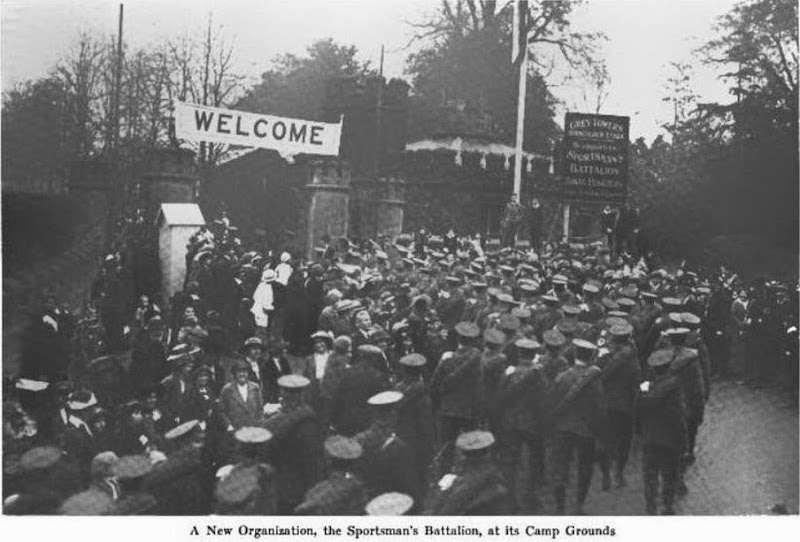
After a march through London, from Hyde Park to the City, past the Mansion House – where the Lord Mayor (with whom was Mrs. Cunliffe-Owen) delivered an address of welcome to the men – and on to Liverpool Street Station, where they entrained, the Battalion arrived on the afternoon of November 4 at the Camp. Their reception in London was of a most enthusiastic character, crowds of cheering citizens lining the streets, and according them a splendid welcome.

It fell to [the Cottage Homes Band] to lead the Sportsman's Battalion to their Camp at Grey Towers. The band, under the direction of Mr. H.W. Alden (bandmaster), met the battalion on its arrival at Romford Station, with a letter to Col. Lord Maitland, offering the service of the lads, which was gladly accepted. To see those little chaps, whose stride was only half the length of that of the men of the battalion, stepping it out, was distinctly inspiring, although one cannot help feeling that the men found short stepping some what trying.

Hornchurch folk extended a similar greeting to them, as, headed by the Cottage Homes Band, they marched in magnificent order through Grey Towers gates for the first time.

The following verses were written to commemorate the arrival of the Battalion:

WELCOME TO THE SPORTSMAN’S BATTALION
November 4th, 1914.

We’ve waited for you – “Hard as Nails” – and now at last you’ve come,
   We saw you march through London Town, we heard the fife and drum,
We heard the tramp of martial feet, we saw the bunting fly,
   We heard the Lord Mayor’s greeting as your ranks went swinging by,
We saw the throng of cheering folk, we heard their mighty shout,
   And then we heard your answering cry : – “We won’t be be bothered about!”

And now Our Village welcomes you, yes, every mother’s son,
   From the buck “officially” forty-five to the lad not twenty-one.
We love you, and we’re proud of you, for answering the Call
   Of King and Home and Country – Soldiers and Sportsmen all,
And well we know you’ll play the game when guns and cannon roar,
   And, like true Sportsmen, do your bit to make a winning score.

Fame you have won in times of peace on many a playing field,
   Where mimic battles bravely fought but barren victories yield,
But now a sterner fight is yours, where you will show your grit,
   And prove what manly sport can do to make a nation fit,
And when you make your final stand against the German Huns,
   Just keep your wickets up, lads, while they make all the “runs.”

CHAS. THOS. PERFECT

September 26, 1914

Grantham Journal

The Recruiting Boom.

The boom in recruiting in London still continues. […] The Sportsmen Battalion (appropriately nicknamed the “Hard-as-Nails Corps”) is recruiting briskly at the Hotel Cecil. Every morning’s post brings hundreds of written applications, and there are, of course, large numbers of applicants who make personal enquiries at the hotel. Indeed, so heavy are the applications that difficulty is experienced in dealing with the recruits.

A well-known K.C.M.G. was amongst those who offered their services on Tuesday. He was willing to enlist as an ordinary private. He has had considerable experience, having commanded or served in numerous expeditions in Africa, and is the possessor of three medals and five clasps. Other well-known sportsmen and explorers of high social distinction have presented themselves. The post bag contained a letter from a young Belgian nobleman, a hunter, asking to be allowed to join, as he cannot, he said, serve in his own country, because he cannot obtain equipment there. A good many retired officers have offered their services, and the question is asked why their services are not accepted by the War Office. It is worth noting that a doctor who has visited many recruiting stations has declared that the men already in the Sportsmen’s Battalion are from the finest stamp of men he has seen. The Battalion is private and self-supporting, and was approved by the War Office before it was embodied. Mr. Cunliffe-Owen is the chief recruiting officer. Sir William Plender, it was announced, has consented to act as hon. treasurer.

Manchester Courier

THE SPORTSMAN’S BATTALION

Being the only corps in England in which the age limit has been extended to forty-five, the Sportsman’s Battalion now recruiting at the Hotel Cecil in London has attracted an immense number of applications of the highest type of men. At the same time the organisers will gladly welcome any further recruits, as many will no doubt be rejected by the doctor.

The corps is to be 1,300 strong, and will, when complete, be taken over by the War Office, by which it is directly sanctioned. It is composed of gentlemen up to the age of forty-five accustomed to sport and outdoor life and thoroughly fit and physically sound. The training will be the ordinary infantry training. The organisers wish to make it clear that the corps is an infantry, not a cavalry one, as many have applied under the impression that it was to be mounted.

Golf clubs which had intended abandoning their autumn meetings owing to the war have continued them instead, and given the value of the prizes to the Sportsman’s Battalion account. This enables members unable to serve to help their country, and it is hoped that other clubs will follow suit.

September 22, 1914

Yorkshire Telegraph

THE “HARD-AS-NAILS.”

The Sportsmen’s Battalion, nick-named the “Hard-as-Nails Corps,” is recruiting briskly. So heavy are the applications that difficulty is experienced in dealing with the recruits.

A well-known K.C.M.G was amongst those who offered their services to-day. He was willing to enlist as an ordinary private.

KCMG = Knight Commander, Order of St Michael and St George