A record of the Sportsman's Battalions during the First World War, including a database of soldiers who enlisted in - or served with - the 23rd, 24th and 30th Royal Fusiliers, originally raised by Mrs. Emma Cunliffe-Owen in September 1914. If you have any questions or comments, please send to fmsketches@macbrem.com, thanks!
Showing posts with label Romford. Show all posts

April 30, 1915

Chelmsford Chronicle

ESSEX ART AT THE ROYAL ACADEMY.

Frank Heath, whose address is the 2nd Sportsman’s Battalion Royal Fusiliers, Romford, may therefore be counted as an Essex man for the present. He has an oil painting, “Amateur Gardeners,” on the line – a pair of charming little girls watering a wealth of flowers. The whole is broad and direct in treatment, and entirely successful.

April 29, 1915

Western Times

2nd Sportsman’s Battalion at Football

The first Rugby football match for the Championship of the 2nd Sportsman’s Battalion was played at the Camp, Romford, on Tuesday evening, between “A” and “B” Companies, the latter winning by 8 points to nil. Company Sergeant-Major Finch acted as referee. The game caused intense enthusiasm, the whole of the officer of the Regiment being present, and over 700 rank and file. The next round is between “C” Company (the West Country Company) and “D” Company, the winners of each round to play for the final. Great credit is due to “B” Company players for the excellent play they showed, considering they left camp at 7 a.m. in the morning for trenching work and returned at 5:45 p.m. kicking off a quarter-of-an-hour later.

April 28, 1915

Exeter and Plymouth Gazette

The writer of an article in one of the monthly magazines remarks, in the course of some references to the Sportsman’s Battalions, that “A sergeant in the 2st Sportsman’s Battalion, at Romford, was heard correcting a private for his method of swabbing a floor. “Let him alone,” said someone standing by, “he’s only a K.C.; he doesn’t know any better.” As a matter of fact, a member of this corps, who has since been given a commission, served in the ranks for three months as an ordinary soldier, formerly sat in the House of Commons and been Mayor of Norwich. It has occurred to me that the writer may have had in his mind Capt. A. E.Dunn, who entered the corps as a private, and has since been given a commission and promoted. He sat in the House of Commons for the Camborne Division of Cornwall, and was Mayor of Exeter – not Norwich – in 1901 and 1902.

The Gazette

A London solicitor who had joined the First Sportsman’s battalion, Royal Fusiliers, had received the following congratulatory telegram from an old client: “Accept my congratulations on your gallantry in joining the Sportsman’s battalion. Anyway, you know how to charge.”

March 19, 1915

Chelmsford Chronicle

NEW SPORTSMAN’S BATTALION AT ROMFORD.

On Wednesday the 2nd Sportsman’s Battalion moved from London to their new headquarters at Hare Hall, Romford, near Gidea Park station. The first Battalion is in Quarters at Grey Towers, Hornchurch, two miles away.

The Battalion came by train to Romford. In London they had been inspected before leaving by Brigadier-General Kellett. Cheers were given for the founders of the Battalion, Mr. and Mrs. Cunliffe Owen. On reaching Romford the Battalion formed up under the command of Col. A. de B.V. Paget, with the Adjutant, Major H. H. Enderby, and the Major Percy Elwell. Numbering well over 1,000 men, the Battalion presented a fine appearance. Marching by the main road to Hare Hall, they entered upon the occupation of what are believed to be the most up-to-date field barracks yet erected. It embodies all the improvements that the experience of the War Office in the last six months can suggest. There are a couple of dozen cubicle shower baths, with hot and cold water laid on; the thirty beds in each dormitory hut, though made of wood, owing to the scarcity of iron bedsteads, turn into the wall in the day time, over lapping each other to form seats and occupying the minimum of space; each hut is lit by electric light; the bootmaker’s, the post-office, the tailor’s, and the barber’s stand in a row, and the wet and dry canteens are spacious and comfortable.

In the hall itself the bedrooms have been neatly and simply furnished to accommodate 36 officers. The subalterns sleep four in a room. The colonel has one of the smallest rooms, looking out over the camp, and as simply fitted as the rest. The canteens and store-rooms are fully stocked with every possible requirement. A hospital with 24 beds had been provided; the drugs were ready in the doctor’s surgery, and sergeant and five men of the R.A.M.C. from Colchester will form the nursing staff.

It is understood that four Companies of 270 men each will be going to the Front in June, or thereabouts, and 5h and 6th depot companies will have to be formed to keep the camp going and fill any gaps that may occur in the other Companies.

March 18, 1915

Birmingham Gazette

THE 2nd SPORTSMEN’S BATTALION ON THE MOVE.

The 2nd Sportsmen’s Battalion marching across Trafalgar-square on their way to Liverpool-street to entrain for Harehall Camp near Romford.

Daily Mirror

The 2nd Sportsman’s Battalion marching through the City yesterday. They have gone into camp at Romford, Essex.

GOING INTO CAMP.

This dog has “enlisted” in the 2nd Sportsman’s Battalion as its mascot, and marched with the men through the city yesterday. He is glad to be going into camp. He much prefers the country to the town.
Exeter and Plymouth Gazette

IN CAMP

2nd SPORTSMAN’S BATT.

WEST-COUNTRY BAND

There are few smarter battalions among the New Army than the Second Sportsman’s, which left London yesterday for its new quarters at Hare Hall, Essex. The assembly on the Horse Guards Parade was witnessed by a large crowd of spectators, many of whom had relatives or friends in the ranks. The men, alert and soldierly in their bearing, looked as hard as nails and fit to endure any hardship they may have to encounter. Colonel A. de B. V. Paget, the officer-commanding, congratulated the men on their smart turn-out, their discipline, and zeal. He knew their heart was in the work, and he hoped they would speedily become efficient and ready to go out with the Brigade to help to thrash the Germans. He was sure no battalion would do better than theirs when the opportunity came. Many of them, the Colonel added, had made great sacrifices of property and position, and in other ways, to respond to their country’s call, and the nation thanked them. There was hard work in front of them, and he hoped that in a short time he should be able to lead them against the enemy. He acknowledged the debt of gratitude they owed Mr. and Mrs. Cunliffe-Owen, who had spent time, trouble, and money in the nation’s cause.

The battalion arched to Liverpool street by way of Trafalgar Square, the Strand, Fleet-street, Cheapside, and Old Broad-street. The full band, consisting of 35 instruments, which have been presented by a member who desires to remain anonymous, led the way, and the drum, fife, and bugle section and the Brass Band of C Company, which has been enrolled at Exeter, also accompanied the battalion.

March 17, 1915

Devon Exeter Gazette

Au Revoir!

Yesterday the West of England Company of the Sportsman’s Battalion Royal Fusiliers left Exeter, under the Command of Captain A. e. Dunn, after a lengthened period of training.

Devon Exeter Gazette

SPORTSMAN’S BATT.

EXETER DEPARTURE.

The “C” (West-Country) Company of the 24th Service Battalion Royal Fusiliers (2nd Sportsman’s), left Exeter yesterday morning tor camp. The men, numbering 323, assembled at the dinking fountain, in Sidwell-street just before 8 o’clock. Under the command of Captain A.E.Dunn, with Lieuts. Enderby, W. G. Perkins, and F. Templeman and headed by the band of 20, the men marched by way of High-street and Queen-street to S. David’s Station. En route the band, under Sergt. Brock, rendered in spirited fashion the marches “Soldiers of the King” and “Sons of Our Empire.” Despite the comparatively early hour, the streets were thronged with people, and the men were cheered enthusiastically. A special train awaited the men, who responded with a thunderous “No!” to the cry of “Are we downhearted?” Although the railway officials made some attempt to keep the crowds of civilians from thronging the platforms, the station was quickly filled with the friends of the “Tommies.” Cheers were given for the officers and Exonians, and the train, from the windows of which miniature flags were freely displayed, steamed out amid much enthusiasm.

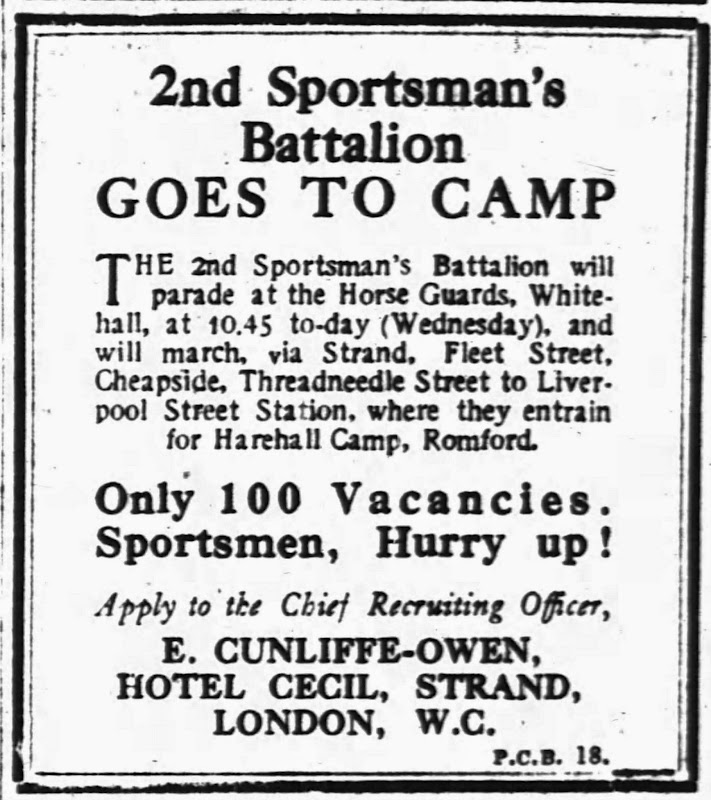
The Times

2nd Sportsman’s Battalion

GOES TO CAMP

The 2nd Sportsman’s battalion will parade at the Horse Guards, Whitehall, at 10.45 to-day (Wednesday), and will march, via Strand, Fleet Street, Cheapside, Threadneedle Street to Liverpool Street Station, where they entrain for Harehall Camp, Romford.

Only 100 Vacancies. Sportsmen, Hurry up!

Apply to the Chief Recruiting Officer,

E. CUNLIFFE-OWEN, HOTEL CECIL, STRAND, LONDON, W. C.

Western Times

A GOOD SEND OFF

Departure of the 2nd Sportsman’s Battalion

FROM EXETER

The 2nd Sportsman’s Battalion, which has been raised in the West-country through the instrumentality of Capt A. E. Dunn, and which has since its formation had its headquarters in Exeter, left the City yesterday to go into camp to complete their training for whatever service is before them. The send-off was as encouraging and enthusiastic as could well be, and the cheering crowds that thronged the streets were tribute to the popularity of the Battalion and to a fine body of men.

No won who saw the Battalion – fresh, smart, athletic, and fit as the men are – march through the City with that litheness and swing which betokens perfect physical fitness and vigour, could help congratulating Capt. Dunn on having the proud command of such a splendid body of men. In the best of spirits and keen for service, the men responded cheerily to the ready outbursts of the citizens, the waving of hats and handkerchiefs, and good wishes which were evident on every side. They were not downhearted: they said so themselves many times as they swung through the street between unbroken lines of civilians.

The “fall in” was at 8 o’clock at the top of St. Sidwell’s, and the Battalion mastered promptly and in full force. It numbers 323 of all ranks, and, besides the O.C., the officers are Lieuts Enderby, W.G. Perkins and F. Templeman, with Co. Sergt.-Major C. T. W. Finch.

The Battalion Band, under Sergt. Brock, was there to lead the way with martial music. The band itself, like the Battalion, has made splendid progress and now numbers 20. The played lively and patriotic airs, with “Soldiers of the King” and “Sons of Our Empire” among the numbers rendered.

The route take was through Sidwell-street, High-street, and Queen-street, passing the statue of Devon’s hero, General Buller, and then on to St. David’s Station, where a special train was in waiting. Numbers of friends managed to get on to the platform and there was much hand-shaking and exchange of wishes for good luck. To secure this latter for his battalion on stalwart member had been decorated with an old horseshoe tied with ribbon in the colours of the Allies, which, notwithstanding its hug dimensions, he bravely ad proudly wore upon his breast. The men were soon comfortably aboard the train, which, amid a perfect hurricane of cheering, steamed away on the stroke of 9 on its journey east.

London Standard

BASKET BALL.

An interesting match has been arranged between some members o f the Sportsman’s Battalion of the Royal Fusiliers, commanded by Lord Maitland, and a London basket-ball team. The military side will include Hayes and Hitch, the well-known Surrey cricketers, and amongst their opponents will be J. G. Lee, who has taken an important part in the work of organizing Y.M.CA. recreation tents in various military centres, and Dr. Robert le Cron, the well-known ice-hockey player. No charge will be made to witness the game, which will take place at the Central Y.M.C.A. Tottenham Court-road, on Saturday, at 7.45 p.m.

March 16, 1915

London Standard

SPORTSMAN’S NEW CAMP.

COMFORT FOR THE SECOND BATTALION.

When the 2nd Sportsman’s Battalion (24th Royal Fusiliers) removes its headquarters tomorrow from London to Romford it will enter into the occupation of the most commodious, up-to-date field barracks ever constructed. The new camp in the grounds of Hare Hall, near Gidea Park station on the Great Eastern Railway, has accommodation for the 900 men already enlisted in this battalion, and there is ample room for the erection of many more huts when they are required.

Lieutenant and Quartermaster Stuart, formerly of the 16th Lancers and the Buffs, showed one of our representatives over the officers’ quarters in Hare Hall and the camp in the grounds yesterday.

The only reason why the Hare Hall camp is the best of its kind yet constructed is that it embodies all the very latest improvements that the experience of War Office experts during the past six months could suggest. There are, for instance, a couple of dozen cubicle shower baths, with hot and cold water laid on; the thirty beds in each dormitory hut, though made of wood, owing to the scarcity of iron bedsteads, turn into the wall in the day time, overlapping each other to form seats, and occupying the minimum of space; each hut is lit by electric light; the bookmaker’s, the post office, the tailor’s, and the barber’s stand in a row, and the wet and dry canteens are spacious and extremely comfortable.

In the hall itself the bedrooms have been neatly and simply furnished to accommodate 36 officers. The subalterns sleep four in a room. The colonel has one of the smallest rooms, looking out over the camp, and as simply fitted as the rest. The canteens and store-rooms yesterday were fully stocked with every possible requirement. A hospital with 24 beds had been provided; the drugs were ready in the doctor’s surgery, and sergeant and five men of the R.A.M.C. from Colchester will form the nursing staff.

Already there is a talk of a 3rd Sportsman’s Battalion being formed, but there are still places to be filled in the 2nd. Four companies of 270 men each will be going to the front in June or thereabouts, and 5th and 6gh depot companies will have to be formed to keep the camp going and fill any gaps that may occur in the other companies.

The First Sportsman’s Gazette – No. 10

EDITORIAL

It is a curious fact that many of us—keen though we were on “getting a smack” at our friend the enemy in those feverish days which preceded enlistment, are now losing touch with the issues at stake in this world conflict.

The reason is not far to seek, for are we not putting our energies into, becoming efficient soldiers?

Our new mode of life scarcely permits of much reading or speculation as to what is happening abroad, and what is more, except on those rare occasions when our Navy gets busy, there is a terrible monotony in the news served up to us by the London papers—-trench fighting, does not permit of rapid progress—so, after a hurried glance at the headlines, our erstwhile favourite journal is tossed on one side.

I firmly believe that if we have each week in the “First Sportsman’s Gazette.” an article on the doings of our boys at the front, written by some member of the Battalion,, in whose soul burns the fire of literary genius, it will serve to keep our minds on the game we are learning to play.

You will remember our eagerness after hearing the news of Scarborough, and the thrill we experienced when we were told of that big fight off the Falkland Islands, and it just comes to this, I want someone to write an inspiriting weekly “leader” on the war, which, by chronicling the deeds of brave men, and telling of Britain’s greatness, shall re-invigorate us, and make us all the more determined to go in and win.

It’s rather nice to think that you and I are not like the man who ought to go and does not. We have left comfortable homes, and have made sacrifices of which we alone can know, in order to serve our country in our country’s need, and afterwards, when we come back—if we do—we shall be proud to say we did not shirk.

We have to rough it a little now—we shall have to rough it still more, but what of it? It is a grand and manly life, and we are doing something.

I know one man, a relative of General Paris, the defender of Antwerp, who almost cried when age precluded him from joining the army. He would say, “If only I could do something. Sitting on an East Coast rock with a gun in my hands would be loafing, but loafing with a difference, for I should feel that I was helping.” That man left for France on Saturday last as a Red Cross orderly, and when he told me the news he was overjoyed.

Thanks to a special concession, we older men in the First Sportsman’s should consider ourselves fortunate indeed.

Some there are amongst us who at the beginning of things took badly to saluting. Most of us regard it differently now, and it was only the other day that I found out why. I was going along the High Street when the strains of martial music told me that the boys were returning from trench digging. I stepped to the edge of the pavement sprang smartly to “attention,” and it was with a keen pleasure that I saluted Lord Maitland, and the officers who marched past at the head of their Companies; for in a flash it came to me that I was paying my respects to the might of Britain in the person of those who hold the commissions of His Majesty King George the Fifth. I may not have yet succeeded in mastering the subtle niceties of saluting, but I intend to do so, for it behoves us all so long as we are soldiers to cultivate that smartness which stamps the good soldier wherever you may see him.

The appointment of Sub-Editor, Financial Manager and Secretary, and Advertising Manager, has not been definitely settled, and the Editor will be pleased to receive further applications.

A Cartoonist, someone used to sporting journalism to report the Battalion Soccer matches and a “Things we want to know” reporter for most of the Huts are still urgently needed.

If improvements are to be effected in this our Battalion journal, volunteers should come forward without delay.

Contributions of interest are cordially invited, and it is pointed out that to facilitate early publication of the “Gazette” these should reach the Editor not later than 6 p.m. each Monday for publication in the next issue.

THE GREAT FIGHT AT THE N.S.C.

Private Jerry Delaney—our Jerry—easily defeats Jack Denny of New Orleans.

When first I saw Delaney I never imagined that I was looking at a truly tine boxer, who had studied the art, and fitted himself by strict training to more than hold his own at that Mecca of “the fancy,” the National Sporting Club.

Thanks to the concession to members of the 23rd, secured through the good offices of Mr. Bettinson, a large number of the boys booked seats, and being granted special leave, proceeded to town in time to enjoy a good dinner before occupying their seats at the Club.

My first impression of the ring was peculiar, it called up recollections of pictures I have seen showing the Roman populace in the amphitheatre awaiting some great contest of skill; but whilst in those bad old days cruelty was the thing most loudly applauded, now all brutality has gone and only science remains.

There were no villainous faces, as one has read of in books written by the early Victorian authors— just a gathering of well-bred gentlemen who love sport for its own sake, and have the courage to follow their inclinations.

The auditorium was almost full, and khaki strongly mingled with the black and white garb of peace.

I noticed more than one Staff Officer, whilst amongst those were several from our own Battalion,

After a little waiting the Gladiators entered the arena for the first bout. After two somewhat uninteresting bouts for the semi-finals of welter-weight novices, and a six-round contest in which Joe Conn of Bow beat Harry Moyes of New Cross in one round, there came the twenty-round contest between Young Fox of Leeds and Alec Lafferty of Glasgow, in which the former had an easy win on points.

Then came the great contest of the evening.

Jerry Delaney we all know, so there is no need to say much about him here. He's a good plucked ’un,” and a true “sport,” so all of us are glad to think he proved himself the better man.

Jack Denny is game enough too, but he was out-boxed by one who is cleverer than he, and he knew it before the first round was over. When they stripped I somehow felt that our man had a tough job in front of him, for the American seemed to be better developed; however, as the fight progressed, it was easy to see that Jerry’s wiry frame represented hard training and genuine fitness.

I do not pretend in this article to minutely describe the various phases of the right—you have already read of it in the pages of the sporting papers, but I will instead record the impressions of an eye-witness for the benefit of those who were not present.

In the very first round Jerry’s superiority showed, and although Denny kept up to it, Jerry put in some clever two-handed work, which began to have real effect.

In the third round Jerry quickly scored, and the bell only just saved Denny, as was the case in many of the succeeding rounds.

There was a good deal more holding on in the fourth round, in which Jerry’s right fist made constant acquaintance with the American’s jaw.

Delaney seemed to do just what he liked with the American in the two next rounds, and I firmly believe that had he pressed his advantage the contest would have ended with the sixth round.

Denny “came up to it” a little in the seventh round, but Jerry’s lightning left became very busy, and the American was very badly punished. All through those left-hand jabs of Jerry had a nasty habit of finding their mark, and Denny knew about it, for as the fight progressed he showed signs of the severe gruelling he was experiencing, and the audience expressed no wonder when after the fourteenth round his seconds announced that he had “given in.”

All honour to “our” Jerry, and may he find just as easy a victory when he meets Freddy Welsh.

There can be no doubt that Jerry owes a good deal to his trainer, Private Joe Jagger, whose solicitude and care during the last few weeks have been most marked. Some mention must be made of Private Hooper, who recently defeated Kid Vinton of Gateshead at St. James’ Hall, Newcastle-on-Tyne. Hooper has been one of Jerry’s sparring partners, and I hope to reproduce a photograph of the trio in my next issue.

Jerry is back in camp again, still wearing the smile which worried Denny so much; and he said when I asked him to put his impressions on paper that he’d much sooner fight a round than write a single line—so as “A nod is as good as a wink to a blind horse,” I pleaded urgent business at the Editorial sanctum and cleared.

GENTLEMEN, THE KING.

In the report of “C” Company’s dinner which appeared in our last issue, the Chairman was reported to have stated that it was the first occasion on which the health of His Majesty the King had been drunk by the 23rd Royal Fusiliers.

“Ichabod” points out that this toast was proposed by our Colonel at the Burns’ Anniversary Dinner on January 23rd last, and loyally drunk by the Scottish contingent of the Regiment.

FOOTBALL NOTES.

RUGBY

THE FIRST SPORTSMAN’S versus THE 17th (SERVICE) BATTALION R.F.

A fortnight ago the Sportsman’s Battalion, quartered at Hornchurch, sustained its first defeat at the hands of the 17th (Service) Battalion R.F. at Whyteleafe. The conditions were shocking, but the play was excellent, and neither side deserved to lose. The visitors, just when they seemed all over the 17th, were beaten on the post by the only try scored in the game, and they naturally looked forward eagerly to the return. Meanwhile, on Saturday week, at Walton-on-Thames, they beat the undefeated H.A.C. The latter had such a big reputation that the Sportsman’s had some misgivings as to the result, but right away from the kick-off a scrum was formed on the H.A.C. line, and Henri nipped over. Henri is an old Shirburnian, and should he be given a fair trial is sure to make a great name for himself. Only a few minutes had elapsed when Wadham, the old U.C.S. boy, who played for Middlesex in 1903 and 1904 (not in the “nineties,” as given by a slip of the pen in these notes last week), added to the visitors’ lead. They continued to force the pace. Wadham on one occasion running over the line with three men hanging to him, but being adjudged “held up.” There was no further score, the Sportsman’s winning a fine game on their merits.

They were naturally elated by this, and as the side, reconstituted in the three-quarter line, where Pearce has immensely strengthened the attack, is improving every week, they fully expected to get their own back against the 17th on Saturday. Farr, the Christ’s Hospital boy, who played—and played well— at full back, has been replaced by R. G. Scott, who represented Queensland, and is one of the cleverest and safest full backs in the country. The ground was in excellent condition except for one bad spot in the centre, and the Sportsman’s had the satisfaction of reversing the verdict. Henri was again very conspicuous, and shortly after the start he scored a typical try—dropping over very cleverly. Then after Williams had converted from a wide angle a really brilliant try was gained. The Shirburnian set his line going, Wadham passing to Pearce, who gave to Henri, the latter returning the compliment, and Pearce scored. In the second half Pearce ran in again after good combination, and Cook, the Black- heathen, kicking a very fine goal from a penalty for the visitors, the Sportsman’s won by 11 points to 3.

The Rugby Club on Saturday the 27th inst. play St. Thomas’s Hospital at Chiswick. The team and supporters will meet on the Drive at 9.15 a.m.

THE SPORTSMAN’S RUGBY CLUB.

“NIPPY” HALF-BACK.

Lieut. H. A. Taylor was educated at the Royal High School, Edinburgh. In 1908-9 he obtained his football colours as a full back, but later on, secured the position of scrum half. Judging from his play for the Sportsman’s Club, this is his correct place as the skill he has displayed during the season has been highly commendable. Since leaving school he played regularly for Edinburgh Dental Hospital. He has always been associated with good class football and both the captain and vice-captain of his school during the time he was in residence obtained their caps for Scotland, viz., J. Hume (scrum half) and A. D. Laing (forward).

ASSOCIATION.

BROMLEY VERSUS THE BATTALION.

The 1st Sportsman’s Battalion are rapidly making themselves acquainted with the cream of London’s amateur clubs. Their opponents last week-end were Bromley, whom they succeeded in defeating, after a capitally contested game, by live goals to two. Both sides were well represented, Bromley, save for the continued absence of McWhirter, being at full strength. They made the running in the first half, and scored two excellent goals (through the agency of James and Harkness) to one by the Battalion (Littlewort).

The visitors showed to excellent advantage from the time Owers headed an equalising goal for them a quarter of an hour from the restart. Yet, although the subsequent goals scored by Owers, Clunas, and Hendren were all well worked for, they never deserved to win by a three-goal margin. E. Hendren was the most prominent player on the ground, his touch-line runs and centres betraying the master mind. Littlewort was predominant in defence, and held up the Bromley forwards time after time.

SHOOTING.

Will twelve members of the First Sportsman’s Battalion who are good shots on the Miniature Range send in their names and hut number to Sergt.-Major Williams (Musketry Instructor), as it is intended to arrange a match with the members of the Gidea Park Riile Club at an early date.

POSTAL INFORMATION.

Letters are despatched daily at 10 a.m., 12.45, 6.30 and 8 p.m. from Camp Post Office. All registered letters and packages should be applied for daily between 9 a.m. and 12.45 p.m., also between 4 p.m. and 7 p.m. The Office is open on Sundays from 5.30 to 6.15 p.m., and letters are despatched at 6.30 p.m. Telegrams are despatched about every half-hour during the hours the Post Office is open, but the Sergeant in charge is in no way responsible for delay in transmission after handing them to the Government authorities.

FAMOUS CRICKETERS IN THE BATTALION.

ERNEST G. HAYES (SURREY).

An Impression.

The Battalion boasts many celebrities, but none is more famous, perhaps, than Ernest G. Hayes, the well-known Surrey County and All England cricketer, now a private in “B” Company.

Upon first acquaintance Hayes does not exactly fill the imagination as a performer of doughty deeds, the dear-cut lace and square jaw which. usually betokens the successful athlete are missing, but the quick eye is there, and somehow the sense of his thoroughness grows upon you. The workmanlike manner in which he applies himself to his present training gives some little indication of the qualities which have made his name a household word in the held of sport.

First into prominence with the Honour Oak Club where he had a habit of scoring a century every week, he was invited to join the Surrey Club Start in 1895. He quickly proved his worth by scoring 130 against Northampton in his first 2nd XI match. Promoted to the senior side in the following season, his first match for the County was against a very strong Australian combination. For a man with the century habit this presented no terrors, and he totalled the excellent score of 60 before being' dismissed. It is almost unnecessary to add that he has been in the side ever since with credit both to the County and himself.

His first trip abroad was made in 1898, when he went as a coach to the Craddock Cricket Club in Cape Colony.

His experiences since have been as varied as they have been interesting, for he has represented England with Lord Brackley’s team in the West Indies, Mr. P. F. Warner’s team in South Africa, and Mr. A. O. Jones’ team in Australia, besides figuring prominently against Australia and the South Africans at Home.

Hayes for several years has been an early choice for the Players in the representative matches against the Gentlemen, and last year he captained the professional side.

He has distributed his favours equally, his highest score of 2/6 being made against Hampshire, while his best bowling performance of 7 wickets for 25 runs was registered against Middlesex. His best all-round performance was perhaps the scoring of 120 runs, followed by 8 wickets for 13 and 5 wickets for 40 at the expense of Somerset. Truly Hayes’ day out.

When Surrey last season gained championship honours after being in the wilderness for so long, Hayes and the veteran Tom Hayward were the only members of the championship side of 15 years ago. He did his share in the revival too, scoring 1,300 runs, with an average of 38, and taking a fair proportion of wickets. This record might have been even better, but illness kept him out of the side for a month.

There would appear to be some connection between the bat and the shovel, for Hayes on ,his showing at Benfleet can wield one equally as well as the other.

Amongst his other hobbies he has the habit of occasionally conceiving the hut to be a menagerie, and while his descriptions of the inmates of the various cages can hardly be described as things of beauty, they are certainly to those fortunate enough to hear them, a joy for ever.

A thorough sportsman and a true friend, Hayes possesses in an exceptional degree that steadiness which is demanded of all of us when on parade.

It is doubtful whether the Battalion, “B” Company, or hut 14, are the more proud of him as a member.

THE VICTORIA COTTAGE HOSPITAL, ROMFORD.

An institution which has been of service to the Battalion, and for which subscriptions were recently invited by a “ Private Patient” in the pages of this journal.

HORNCHURCH.

The Village, Hornchurch.

There are many in our Battalion whose relatives and friends Will welcome some particulars of this wonderful Essex village in which we are quartered, so I have persuaded the Editor to grant me some space for the reproduction of pictorial representations of the Parish Church and the High Street.

The village is pleasantly placed on the main road between Romford and Upminster, and is bounded on east and west by the rivers Ingrebourne and Rom.

The Church of Saint Andrew is a relic of past ages, intimately connected with the days of knightly chivalry. The curious carving of the Bull’s head with horns is a feature that is unique, and savants interested in archaeology make pilgrimages to view it.

The old village in the days of Edward the Confessor, was of greater importance than Romford, and many are the Royal personages famed in history who have visited the neighbourhood.

Mayhap in those early days of Britain’s history this delightful and well-wooded countryside was the haven to which the Vikings steered after effecting a landing on the coast of this fair county.

Perhaps some local gentleman blessed with a better knowledge of the neighbourhood may now be induced to contribute an article which contains a fuller account of our present home to a future number of the “Gazette.”

Lastly, I would just venture a word on another matter. We must think of those at home who are naturally anxious to see pictures of the camp in which we live, so I have asked the Editor to reproduce pictures of the Cook House, Institute, &c., and he has promised to comply with my wishes.

Hornchurch Parish Church.

CORRESPONDENCE.

WAR AND BUSINESS.

February 23rd, 1915.

Dear Mr. Freer,
     I hasten to answer your letter of Feb. 2'2nd, and while I should like very much to do exactly as you say, I am, as you quite understand, extremely busy and to take the necessary hour or two or three to prepare properly an article for your paper is really something (as much as I regret it) I am unable to do.
     If there is anything in the following lines, however, which you. can use, you are welcome to: —
     If War was always taking place as it was in the Middle Ages—if we were, as a Nation, always either trying to take something from someone else, or were trying to protect, from some encroaching hand, that which we have, then there would be but one career open to the men of red blood and energy, viz., that of a soldier or sailor. Fortunately, however, War has become only an occasional catastrophe and the life of a soldier as full of excitement and of credit and of glory as it is, at this moment, cannot continue indefinitely in the opportunity to do the brave or glorious things.
     Next in the list of opportunities seems to me to stand the great game of Commerce, which holds its arms out to the whole world and says, “Come into my sphere, there is room and to spare for all.”
     A day’s business may be as exciting, as interesting, as full of novelty and of charm as any day’s work can be and the whole thing can be considered a great, splendid game and played with the same energy, aggressiveness and goodwill as is a game of football or cricket.
     I hope, when the War is over, that those men who have proved their worth and courage in the defence of their country, will find themselves drawn toward that great sphere of activity, “ Commerce,” second only to that of a soldier, and by their everlasting energy help win and hold for Great Britain always the leading place in the world’s Commerce.
     Yours faithfully
          H. GORDON SELFRIDGE.

February 22nd.

Dear Mr. Editor,
     May I offer a word of congratulation to you and the other very “Sporty” Sportsmen who have decided to “carry on” with the Gazette, notwithstanding innumerable difficulties.
     I like your leading article, it is manly and tolerant. Long may you occupy the Editorial Chair, and may the ink flow from your pen Freer and Freer. (Excuse me). . !
     This is the sincere wish of,
           ONE OF THE SPORTSMEN’S WIVES.
     (Or rather)
          WIFE OF ONE OF THE SPORTSMEN.

To the Editor, “ First Sportsman’s Gazette.”
     I have thought out a great scheme to end the war, if it can be worked. It suggested itself whilst looking back on many happy days of fishing on the Gulf, and of which I hope to write you later. If at first sight it should appear treasonable I must explain that I have been out of England for the past 25 years; and the prevailing climate “ makes me tired”; for whilst I gave up everything and came over 3,000 miles to try and do my bit, the climate and malaria knocked me out of the “ Sportsman’s/’ and as the authorities will not recognise my many extraordinary qualities, I am “ frozen out.” Therefore, if I cannot win a V.C.—and V.H.C. at Cruft’s seems to be as near as I can get to it—I don’t see why I should not try for an iron Cross ! Do you ? eh ! what ! This scheme would be far more effective than the present German blockade and must 'bring England to her “ marrow bones,” and give her 11 cold feet.” It is so simple that I wonder they have not threatened us with it before. My only uncertainty is as to whether to offer it to the Kaiser or to Messrs. Haldane, McKenna & Co. I thought of L.G., but he would want to tax me on “ unearned increment” or something*. If you or any of your readers can advise me as to this ! shall be glad to let you in on the Iron Cross business. Any of you who know the _game of “freeze out” should be able to advise.
     This scheme would find employment to the hyphenated—-a long word with a short meaning— Americans. Sorry I forgot, I have not told you yet what it is. Simply divert the course of the Gulf Stream from these shores, and there you are ! So-long and good luck
     Yours, MALARIA,
         “Brookroyd,” Ilkley, Yorks.
P.S.—None of your readers have told me where I can get some Rack pointers yet !

FREEMASONRY.

The Editor would like to hear from Freemasons in the Battalion as to whether a re-union dinner of all Members of the Craft is desirable.

February 18, 1915

Daily Mirror

SPORTSMAN’S CAMP.

Messrs. Hennen and Company, of Quality court, Chancery lane, W.C., write to state that Sir Herbert Raphael Bart, M.P., has no interest in the Hare Hall Estate, Gidea Park, on which estate the Second Sportsman’s Battalion will encamp. This estate is the property of Major Charles Ernest Castellan, 2nd Essex Battalion R.F.A. (T.), and Major Victor Edward Castellan, 1st Essex Battalion R.F.A. (T.). The Daily Mirror regrets it was misinformed in stating that this was one of Sir Herbert’s estates.

February 17, 1915

Daily Mirror

PRIVATE RAPHAEL, BARONET AND M.P., SETS A GOOD EXAMPLE TO THE MEN OF THE COUNTRY.

Leaving home. Private Raphael (x) marching through the Strand.

Sir Herbert H. Raphael, Bart., M.P., a great banker, a trustee of the National Gallery, and a man of many weighty public affairs, whose country seat is Allestree Hall, Derby, is now known as Private Raphael. He has joined the 2nd Sportsman’s Battalion, and will shortly go into camp at Gidea Park, which is on one of his own estates. Here Private Raphael will live in a hut. Sir Herbert has deliberately enlisted as a private to set an example to other men. He is very popular with the battalion.

THE SPORTSMAN’S BATTALION GOES ON A RECRUITING MARCH.

This photograph shows Colonel Paget and staff officers watching the march past of the Sportsman’s Battalion after they had been on a recruiting march. The Sportsman’s Battalion includes any number of athletes and men who are prominent in the racing world. But practically every branch of athletic and sport is now represented in the ranks of the battalion, which has become exceedingly popular.

February 5, 1915

Chelmsford Chronicle

SHORT RATIONS AT ROMFORD

A CARTAGE AGENT CHARGED WITH THEFT.

At Romford yesterday Joseph Bysouth, 43, a cartage agent, of Milton Road, Romford, was charged with stealing 28lb. of bacon, 3lb. of mutton, 3lb. of beef, 1 ½ lb. of dripping, seven loaves of bread, and 1lb. of tea, value £2, the property of the Officer Commanding the Sportsman’s Battalion, at Hornchurch, on Jan. 30.

The case was begun on Monday, when Lieut. and Quartermaster Robert de Vere Stacpoole said that for a considerable time he had received complaints regarding a shortage of rations at the men’s meals. He knew that the full issue of rations had been made, so he suspected they were being stolen. On Saturday he instructed the sergeant of the guard to examine all vehicles leaving the barracks. The sergeant subsequently reported to him that the things mentioned in the charge had been found in the defendant’s van. Witness identified them as the property of Colonel Viscount Maitland, the officer commanding. Defendant had no authority to take the goods away.

Pt. C. F. Branson said he was on sentry duty, and he stopped the defendant’s van. He saw Sergt. Gille take a loaf of bread from a sack in the van. Defendant said, “That’s all I’ve got; I got it from the pig-tub.” Sergt. Gille found another loaf, and then took the accused to the guard-room.

Lance-Sergt. F. M. Gille said he asked the defendant what he had got in the van? Defendant replied, “Nothing, only some hay for the horses.” Witness found two loaves of bread. He also turned out two sacks that were in the van, and found the bacon, beef, tea, loaves, and other things. Defendant said, “I picked them up from the pig-tubs.”

Police-Sergt. Crowe said that when charged by Supt. Mules, the accused said, “I have a contract to take the swill away, and I saw two bags standing against the tub. I thought they were rubbish, and I put them in my van.”

Yesterday the case was again remanded for a week.

Daily Express

THREE-GUINEA RECRUITS.

MRS. CUNLIFFE-OWEN'S SILENCE ON THREE QUESTIONS.

WHAT IS THE RENT?

Mrs. E. Cunliffe-Owen has ceased to be amiable—to the “Daily Express.” Only yesterday we printed a letter from her in which she said, “ I have scarcely had breathing time this morning, and owe you an immense debt of gratitude for the wonders you are working for me. When you have the time, do come and see me. as I am sure we ,should work well together.”

When a “Daily Express” representative, glowing with pleasurable anticipation of the cordial welcome that awaited him, called yesterday at the Indian Room of the Hotel Cecil, however, Mrs. Cunliffe-Owen would not see him.

He might as well have been a postman – “a real, grimy, horny-handed son of toil,” to quote Mrs. Cunliffe-Owen’s own words.

The “Daily Express” representative went to the Indian Room, the recruiting headquarters of the Sportsman’s Battalions, for the purpose of receiving Mrs. Cunliffe-Owen’s reply to the questions asked in yesterday’s “Daily Express” with reference to the cost of raising and equipping the battalions, recruits for which are told that they must pay not less than three guineas each and be of the upper and middle classes.

The questions are: —
1. How much money has been received?
2. How has the money been spent?
3. What is the present balance or deficit ?

“TOO MUCH ENGAGED.”

These seem very reasonable and pertinent questions, in view of Colonel Viscount .Maitland’s statement that he has recruited 255 men at an advertising cost of 7s.. while Mrs. Cunliffe-Owen has, as she has said, spent about £2,300 on recruiting, and altogether about £7,000 more than she expects the War Office to refund.

The “ Daily Express ” representative handed his card to the orderly in attendance inside the doors of the Indian Room. This is a very large apartment, the far corner of which is shut in with screens, so placed that the chair in which Mrs. Cunliffe-Owen sits at her desk commands a view of the area just inside the doors. Any one who steps beyond the waiting-corner comes “under fire.’’

The orderly took the card inside the screens, and after a few moments returned.

“Mrs. Cunliffe-Owen is too much engaged to see you,” he said with a faint smile.

The “Daily Express” representative asked the orderly to go back and say that he would like to see Mrs. Cunliffe-Owen at some later time.

“She can’t see you,” said the orderly, shaking his head.

“I should like to have Mrs. Cunliffe-Owen’s reply,” the “Daily Express” representative said.

“That is her reply,” the orderly answered; “she is unable to see you.”

ANOTHER DAY.

Asked if the “Daily Express.” representative was to understand that Mrs. Cunliffe-Owen refused to see him at any time, the orderly repeated: “She is unable to see you.”

So for the present we are unable to give Mrs. Cunliffe-Owen’s answers to the above questions. Perhaps she will oblige our readers another day.

The “ Daily Express ” was told yesterday about a thoroughly good recruit, who would have been particularly useful in the regiment, but who was immediately rejected by Mrs. Cunliffe-Owen when he said that he could not pay.

It would be interesting to would-be recruits for the Sportsman’s Battalions if Mrs. Cunliffe-Owen would announce:

What rent has been paid, and is being paid, for the Hotel Cecil quarters?

The “ Daily Express ” representative intended yesterday to ask Mrs. Cunliffe-Owen if the rent is £40 a week, as it is said to be.

It might also be stated whether the usual rent includes the use of one of the largest rooms in the Hotel Cecil, in which the recruits of the 2nd Battalion drill on wet days—wearing rubber shoes in order to save the floor.

READERS' OPINIONS.

As to the taste of Mrs. Cunliffe-Owen’s announcement that the battalions are only for “gentlemen” of the “upper and middle classes,” the “Daily Express” continues to receive many letters of protest, among them the following:—

"USURPED."

To the Editor of the “Daily Express.”
     Sir, – I am glad you have called attention to the preposterous suggestion of asking in future an entrance-fee of three guineas and upwards to the Sportsman’s Battalions, and that the recruiting should be confined to men of the upper and middle classes, as such a demand must surely be most “un-sportsman”-like.
     I prefer to think that the men of this country, from whatever class they may be drawn, enlist solely from patriotic motives, and in that case are willing and prepared to serve together and to face every kind of hardship that may fall to their lot.
     Those who could only be induced to join, to use Mrs. Cunliffe-Owen’s words, “by giving them the best that is procurable in the way of equipment, food, beds, and so on,” are not made of the the real fighting stuff, but when an important position as chief recruiting officer, requiring sound judgement and common sense, is usurped by a woman, it is not surprising such blunders arise.
     That such a fine body of gallant men as the Sportsman’s Battalions are known to be should be liable to misrepresentation, and may I say, ridicule, through no fault of their own, is much to be regretted.
          AN OFFICER’S WIDOW.

POSTMAN V.C.

T0 the Editor of the “Daily Express.”
     Sir, – one would gather from Mrs. Cunliffe-Owen that the Sportsman’s Battalion is hardly being prepared for the trenches.
     Of what service will clothes of a superior cut and the best of equipment in the way of beds, etc, be to them when the battalion takes its place on active service?
     I have had fifteen years in the Post Office service, but have not yet met the “real, grimy, horny-handed sons of toil,” but that may be because I have not met Sergeant Hogan, the Postman V.C.
     Would Mrs. Cunliffe-Owen inform him that he would be out of place and not at home among gentlemen?
          A. J. WEST.

THE VERY LIMIT.

To the Editor of the “Daily Express.”
     Sir. – You may well ask “ Why Mrs. Cunliffe-Owen?” for all of the snobbery I have ever read surely the very  limit and a bit more than has been reached in this case.
   Fancy having to tell two postmen “tactfully” that they were not “gentlemen”! Did you ever hear such inane rubbish?
     Hammersmith, E. CRABBE

January 28, 1915

Toledo Blade

SPORTSMEN EAGER TO JOIN RANKS

Woman’s Appeal Draws More Than 3,000 Into English Army.

London, Jan. 22 – Passengers on board the transatlantic liners need not be surprised if they are met at the pier here by recruiting officers for Mrs. Cunliffe-Owen’s Sportsman’s Battalions.” Polo players, tennis, cricket, football, and even baseball stars are joining with rowers, runners and boxing celebrities of the National Sporting Club, in responding to Mrs. Cunliffe-Owen’s appeal and needless to say these battalions, the first organized by a woman since Lady Gordon organized the Gordon Highlanders a hundred years ago, are getting on splendidly.

“Our call is being answered from far and near,” said Mrs. Cunliffe-Owen. “Incoming steamships from America bring us recruits and outgoing steamships carry our appeals for more. We have passed the three thousand mark, and Col. Viscount Maitland, commanding the First battalion, and Col. A de B. V. Page, commanding the Second, are greatly pleased.

Kitchener Approves Plan.

“The idea of forming the Sportsman’s Battalion occurred to me while I was on a shopping tour in Bond Street. I informed Lord Kitchener of it and he approved at once. Since then I have been at work every minute in the organization. Yes, it is quite true that I personally see every recruit and give my personal attention to every detail of our camps at Hare Hall and Romford, in Essex.

“See this rubber coat, for example. I have just ordered many of them at a good bargain. They are for practicing trench digging. I can’t have my men get soaking wet.”

Mrs. Cunliffe-Owwen explained that her love of outdoor life, before a severe illness last year, caused her to think of lovers of sport for her battalions. She how has to be wheeled about the camps in an arm chair, but she gets everywhere and finds time for her executive duties at headquarters besides.

Both Viscount Maitland and Col. Paget are member of the king’s bodyguard. The former was mentioned in despatches in the South African war, is a fine shot and one of the foremost billiard players in the country. Col. Paget commanded the Second battalion of the Durham light infantry, which was renowned for sport during its tour in India. Its polo team won everything before it four years in succession.

Imposing List of Recruits.

There is a spirit of democracy among all the sporting celebrities who have enlisted, boxers of local fame at the National Sporting Club fraternizing with polo players and college cricket champions.

Among those who have already enlisted are: W. Burlton Stuart, well known polo player; Reginald Cooper, big game hunter; P. G. Sadd, captain of the Burton Rugby football team and middleweight champion of the Midland counties; William H. Denton, skater, runner, boxing champion and swimmer and a son of “Charley” Mitchell, boxer; C. P. McGahey, formerly captain of the Essex cricket eleven; McIvor Jackson, the Surrey cricketer; Harry Packer, Welsh Rugby, forward; Lewis R. Lewis, Welsh international player; Robert M. Miles, captain of Pembroke college Cambridge cricket and football teams; “Jack” Cartmell, the Brentford football player, and E Henderson, the Middlesex cricketer.

Sir William Cooke, owner of Hornets Beauty, Gravelotte and other famous race horses, has enlisted as a private; S. Smith, formerly champion runner, has enlisted, and others who have joined include W. Albany, D. G. Cordery, T. Wingate and T. Robinson, the well known professional oarsmen.

Aberdeen Evening Express

ABERDEEN RECRUITING WELL MAINTAINED.

Scottish Centres Compared.

There was again a heavy list of recruits at Castlehill Barracks, Aberdeen, yesterday. The 2nd Reserve Field Company of the Royal Engineers received an addition of about half a dozen men. This morning there were four enlistments in the city Territorial reserve battalion of the Gordon Highlanders, and the aggregate of recruits for the Naval Brigade (Aberdeen company) is mounting steadily.

The men who joined Kitchener’s Army numbered 13, as follows: --

William Watson – Banff (Army Service Corps).
William Bruce – Fraserburgh (Army Service Corps).
William Gilbert – Tough. (Army Service Corps).
Alexander Scorgie – Perty (Army Service Corps).
Matthew Gordon – Alford (Gordon Highlanders).
George Bonar – Peterhead (Army Service Corps).
Alexander Robertson – Logierart (Sportsman’s Battalion).
Robert Smith – Drumoak (Royal Engineers).
George C. Maitland – Peterhead (Army Service Corps).
Frederick B. Peddie – Peterhead (Army Service Corps).
Henry W. Johnson – Zetland (Scots Guards).
William Laird – Metbliek (Gordon Highlanders).
Jacob Carle – Fraserburgh (Army Service Corps).

The First Sportsman’s Gazette – No. 5

THE YOUNG HELPERS’ LEAGUE CONCERT

The concert held by the above Society at the Drill Hall, Hornchurch, last Tuesday, was a distinct success. The Programme was given almost entirely by members of the Sportsman's Battalion. The Regimental Band, ably conducted by Sergt. Thompson, was a very welcome addition, and judging by the applause was much appreciated by the large audience, especially the Piccolo Solo. Miss Kathleen Laud looked very1 fetching as a Spanish Maiden, and danced in a very sprightly manner. Lance-CorpL Wharton provided the comic turns in his usual inimitable style. The Tango Tea was greeted by the audience with roars of laughter, and his “Potted Bacon" was considered by the Sportsmen immensely superior to “Bully beef." Lance-Corpl. Pearce described in the programme as a card manipulator produced cards from various parts of his anatomy in a most unexpected manner, and if he can extract money from an empty pocket in the same way Rockefeller must certainly look to his laurels. Sergt. Noyes related some amusing American stories with the correct accent. Corpl. Gille, Ptes. Davey, Moir, Howarth, Steele, Morris, all contributed towards making the evening a most enjoyable one.

MAINLY About PEOPLE.

Notes concerning members of the Sportsman’s Battalion.

Albany, W. (Private).—World-famous professional sculler. Since 1907 has been a member of the Britannia Rowing Club, which is affiliated to the National Amateur Rowing Association. Carried all before him during his first two years as an amateur, winning every event in connection with the N.A.R.A., and thus justifying his adopting sculling as a profession. Albany, as all the world knows, has rowed three great races against Barry, the present world’s champion, winning on two of these occasions. Albany has travelled round the continent training other men. Last year his pupils won 14 out of 15 events, including 4 championships. Is also something of a boxer, being a member of the Columbia Boxing Club. The war prevented another match for the world’s championship last autumn against Barry.

Anderson, J. W. (Private).—Was in Klondyke three years, at Dawson; started and worked a claim there but drew a blank. Has been sealing for two years in the Behring Sea, and relates many interesting stories of his varied experiences in British Columbia, Alaska, and the Arctic Seas. Is well qualified to stand the rigour and inconvenience of the trenches.

Battishill, J. H. (Private).—Educated at Blundell’s School, Taunton. Has travelled and worked in India and South America. Has also studied law, and been interested in land agency. Breeds horses. His sports include hunting, shooting, cricket, and tennis.

Bretherton, W. (Private).—Educated Rugby and Cirencester Agricultural College. Interested in competition motor cycling. His sports include golf, shooting and hockey.

Cooper, Wm. Freeman (Private).—Land Agent. Has travelled extensively in Europe, Africa and America, including cycling tours through the greater part of the country now comprising the battlefields of Northern France and Belgium. Motor cyclist, tennis player, and expert photographer. An authority and writer on Ecclesiastical architecture and history. Private Cooper, although not yet thirty years of age, has three nephews serving in the H.A.C. and Queen’s Westminster Rifles, one of whom has recently been wounded while in the first line of trenches.

Gaskell, C. E. (Private).—A cotton manufacturer of Manchester. Is one of the finest all-round Sportsmen in the North of England, having taken part in nearly every kind of sport—running, cricket, football, golf, lacrosse, hockey, lawn tennis, bowls, billiards, shooting, and hunting. He won the championship of his club at Lawn Tennis, and was also three times champion of his Bowling Club. Has run against Scotland (10 miles) at Ayr and finished inside the hour, and also been close to winning the “Powderhall” at Edinburgh. Educated in Manchester. Has travelled in Germany and Russia. He is the “Baby” of Hut 25, “Unity Hall.”

Noyes, R. T. (Sergeant).—Born in Winnipeg and educated at Manitoba University. Was present with the Gordon Relief Expedition to Khartoum. Holds the Egyptian medal and the Khedivial Star, 1884-86. Travelled extensively and written for newspapers, magazines, and other periodicals. His sports include hunting, fishing and rowing. Sergeant Noyes read about the Sportsman’s Battalion in a New York paper, arrived in England on September 29th last year, and joined on the following day. He was a member of the advance party. Is a brilliant raconteur and entertainer.

Richards, H. B. (Private).—Mining Engineer. Born in Truro in 1869. Educated at Tavistock Grammar School and Camborne School of Mining. Has lived in Rhodesia, on the Coast, British Columbia, and the Transvaal. Was instrumental in starting the Ivanhoe mines. When war broke out Private Richards returned from West Africa on a German finer, but was landed in Liberia, and from there came through on an Elder Dempster boat. Was one of the first to join the Sportsman’s Battalion. Was attached to the Intelligence Department during the Boer War. Is a good shot, has done a great deal of big game shooting, and plays golf. Private Richards has a brother who is a fleet-surgeon at Chatham in charge of the Royal Naval Hospital.

THE SPORTSMAN’S BATTALION IN THE TRENCHES.

Breakfast at seven, was the new order. It might have been the middle of the night. Blinking and shivering, we sat down to our first meal of the/ day, wondering what was in store for us. Certainly, this first morning was anything but inviting for “grave-digging.” Still, having regard to the humorous scribe who styled us the ‘Hard-as-Nails’ corps, we had to live up to our much-vaunted reputation. So we grimly set our teeth to face the worst. There was to be no shirking that day, for the sportsmen engaged on ‘special duties’ had the choice between a novel experience or squad drill at 9.30. Needless to say, the majority preferred the former, the ranks being thereby considerably augmented.

By the time the “Fall in” was sounded, the grey light of dawn had spread over the camp, and the roll having been called, there marched out of the gates a body of men who could not have failed to excite profound admiration from “Kaiser Bill” himself. Led by the band to the stirring tunes of “It’s a long way to Tipperary,” and “Who’s your Lady Friend,” our blood began to tingle through our veins as the inhabitants who were not yet astir greeted us from their bedroom windows.

At Hornchurch Station, unfortunately, we were obliged to leave the band behind. As we waited on the platform, in exceptionally good time for most of us when we generally set out to catch a train, an express dashed through the station, the passengers of which, judging from the cheering and handkerchief waving, were under the impression that we were off to the front.

While some of us were wondering how the whole battalion was to be crammed into one train, the problem was immediately solved by the appearance of a long line of third-class coaches, including one first-class coach. Into the latter, probably through force of habit, jumped some of the men. They were speedily informed that they had made a mistake by a corporal standing near, who will assuredly earn another stripe for his presence of mind. We are pleased to record that not a hitch occurred in the arrangements, not a single man was left behind (no, nor married one either), and there was seating accommodation for all.

Eventually we pulled up at— (passage deleted by Censor) from where we had to march about two miles to our destination, a place called —— (passage deleted by Censor). Here we halted, then left the road to climb a slight eminence, which we negotiated rather gingerly for fear of making our boots muddy. We at length established ourselves on the summit, and having discovered that no enemy was in sight, waited for tools to be served out.

Though splendid discipline was maintained, it was noticeable that every man was consumed with a burning desire to possess a tool—one would have thought that they had neither seen nor used a pick or spade in their lives before.

With the necessary implements slung across their shoulders in pioneer fashion, sons of peers, great land-owners, company directors, well-known men in every profession and every branch of sport trooped to a fresh field of labour.

Work began in real earnest. “Every man to his trade,” or “Back to the Land,” were remarks often heard. Picks were soon found to be of little use in soft sticky clay, the result being spades were trumps. The wind was cold, and the men worked furiously.

Enviously watching their subordinates beginning to steam with the strenuous exertion, some of the officers who could not resist the temptation, threw off their jackets and directed the men by practical demonstrations. Prominent among these were Captain de Bourbel and Lieutenant Hayes. The former officer commenced by showing us a method of making facines. Stakes were driven into the ground to form cradles wherewith to lay branches cut from the bushes nearby, which were to be wired up in bundles of about a yard long and nine inches in diameter. In this manner some first-class facines were made, the men becoming so proficient in this work that Captain de Bourbel was enabled to direct in a like practical manner the digging operations.

Lord Maitland, Lt.-Col. Gibbons, and the Adjutant, took a lively interest in the work, encouraging the men by words of praise and helpful advice.

As illustrating the extraordinary vim displayed by certain sportsmen, a few spades were returned broken in half.

When the bugle sounded the joyful notes of “Come to the Cook-house Door,” it was with some difficulty the workers were persuaded to leave their tasks. Although only two hours had elapsed since the commencement of work, in many instances the trenches had been dug to the required depth of—— (passage deleted by Censor).

To the student of natural history trench digging must be most fascinating. Worms of various species were found in large numbers. One sportsman discovered a nest of hibernating newts on the bank of a pool, which another declared were either lizards or tadpoles, and a lively argument ensued as to what genus these little creatures belonged. A petrified frog, in an excellent state of preservation, was unearthed by another digger. And so we proceeded until the time came to roll home. Back into the train, sleepy but fit. The band met us at Hornchurch Station and played us to the camp. The Sports had spent their first day in the trenches, the pi elude of many days to come, and—tell it not in Gath—a prominent War Office engineer has expressed the opinion that the trenches dug by the Sportsman’s Battalion are among the finest in the country.

H. R. MAY.

THE MAN IN THE HUT.

By (Private) Campbell Rae-Brown.

When at home he resides in a Castle—
Does Percy de Willoughby Cust;
The name (see Debrett for all details),
Is so old 'twas beginning to rust.
Still Percy—he always kept going;
Did everything—everyone—BUT
When war broke out Percy broke with it,
And now—he's a man in a hut.

He's simply a private is Percy,
His puttees he coils with the rest;
On parade spick and span lie's the plain soldier man,
Just a “Tommy" a-doing his best.
He tells you squad drill's beastly rotten,
It bores him no end, he says, BUT
A de Willoughby Cust is no slacker and MUST
Do his bit as a man in a hut.

On muck-parade Percy is splendid,
His “shorts" are the talk of the place;
But the girls can't see too much of Percy,
That's why early “birds " join in the chase.
He's a wonder at wobbling and sprinting,
Get him going he just seems to fly;
Yes, you bet Percy's always in training
For doing an opportune “guy."

Oh yes, Percy has always kept going;
He'll go for the Germans all right;
He has his own ways, and perhaps he wears stays,
What’s that if he stays in a fight?
He hates “forming fours" like the devil;
He can’t do “ saluting " for nuts.
“But damme," says Percy, “it might be much worse,"
“And so might the men in the huts."

As hut-orderly Percy's impressive,
His “special" yarns sparkle with fun;
His chum keeps on laughing—and working;
And the chum somehow gets the work done:
Then Percy drawls quite absent-minded
“We've done jolly well, I say—what?
I must go and wash my hands, really,—
This orderly work's filthy rot! "

And so, you see, Percy keeps going,
He gets a bit fed-up—who don't?
But lie's not a bad chap, and once in a scrap
Whoever gives in, Percy won't.
At the “White Hart" he’s seen fairly often;
And he's careless of time, but—Tut-tut!
When a “pot's "on the spree its so easy you see,
To forget he's a man in a hut.

But when Percy's on leave, that's the time!
His pass in his pocket—oh my!
His kit's his own special, his boots
And his spirals are dernier cri.
He swanks in the West like a lord,
He's a Tommy no doubt, and he’s proud,
But a gentleman private, he lets you know that,
And he looks it, it must be allowed.

While on leave you bet Percy keeps going,
His week-end's a wonderful time,
He looks up old friends; how he borrows and spends,
And plays h-ll without reason or rhyme;
He is dined, he is wined—and caressed,
His best girl’s all over him—
BUT Poor Percy wakes up just to find
He's simply a man in a hut.

TO MEN OF THE SPORTSMAN’S BATTALION.

A hearty invitation and a cordial welcome awaits you at the Baptist Schoolroom, North Street, which is opened every evening from 6 o'clock for your exclusive use for homely comforts. There is convenience for reading, writing, games, music, &c., light refreshments (non-alcoholic) at lowest charges. General public not admitted to the Social Room.

THE HOSPITAL AND STAFF.

THE CONNING TOWER

ITEMS OF NOTES AND NEWS.

The Misses Taylor of Havering-atte-Bower have kindly offered to give a theatrical entertainment in Hornchurch, the proceeds of which it is proposed to devote to the Battalion Widows’ and Orphans’ Fund. This should prove an interesting evening, and the promoters are hoping for a large attendance. Further details will be given in our next issue.

We regret to note the demise of our lively and popular contemporary The Pow-wow, late the journal of the University and Public Schools Brigade, in training at Epsom. The Editor writes in his final issue that he is “fed up.”

It affords us much pleasure to acknowledge the generosity and kindness of a number of ladies and gentlemen in the locality who have put in a great deal of unselfish work in connection with The Rest Room in North Street, Hornchurch. That their efforts are appreciated in the Battalion is evidenced by the popularity of the Institution in question, and we sincerely trust that its promoters will receive their reward in still larger attendances.

In an early issue we hope to include an article on our Regimental Band, which by its spirited playing has added a new zest to our marching, and thoroughly merited the gratitude of the Battalion. Bandmaster Thompson has secured material for his band which should make it if not the, at any rate, one of the finest bands in Kitchener’s Army.

At the invitation of Mr. G. F. Vincent, a party from the camp visited the Gidea Park Club on the evening of the 16th inst., when a most enjoyable programme of music was rendered by various local artistes, including Miss Ida Cooper, Miss Rita V. Frost, Miss W. Humphrey Davies, who recited “ The Old Trooper’s Story ” from our third number; Miss Hilda Richardson, who sang “ Hunters for the Hun,” from our second number; Mr. George Tinney, and Mr. G. F. Vincent, who is a well-known pianist and composer. He is the composer of, among other songs, “The Flag that flew at Trafalgar.” Mr. Vincent hopes to bring over a concert party to Grey Towers some time during the next few weeks.

There is to be a dance at Gidea Park Club tomorrow, Saturday, Jan. 23rd. The tickets are 2/3 each; and the Committee would welcome as many of the Sportsman’s Battalion as care to come. Dancing 8—12. Tickets can be obtained at the Editor’s office.

Will the member of the Sportsman’s Battalion who travelled to Emerson Park Station by the 8.30 train from Romford on Sunday evening, Jan. 17th, and left his stick in the rack, communicate with T. A. Capron, Esq., Solicitor, Grays, who will be pleased to return same to the owner.

A COOK-HOUSE SCENE

CORRESPONDENCE.

YOUNG HELPERS’ LEAGUE CONCERT.

To the Editor.

Sir,
May I beg the hospitality of your columns in order to convey on behalf of the Hornchurch Branch of the Y.H.L. (in connection with Dr. Barnardo’s Homes), our grateful thanks to those members of the Battalion who individually and collectively made so great a success of the concert on Tuesday last, and also to the Battalion generally for purchasing so large a number of tickets. At the moment we have not been able to complete our accounts, but from the figures we have at our disposal it is quite clear that a substantial sum amounting to not less than £30 will be left in the Treasurer’s hands to send to the excellent Institution for which we work.

          Yours faithfully,
                    SARAH E. VARCO-WILLIAMS,
                              (President).

THE EDITOR OF “ BRIGHTON AND HOVE SOCIETY.”

Dear Sir,
I am extremely delighted with No. 1 of the First Sportsman’s Battalion Gazette, and congratulate you on its bulk and varied features. I am reviewing it in our column “ Things Military,” in “ Brighton Society.” Could you favour me with the loan of one of your photo blocks to accompany the review as we have several Brightonians members of the Battalion, and Mr. Rokeby Hallen, whose article you will see in the enclosed copy was the Hon. Recruiting Officer for this district. If you are able to grant me the request, and I may make a suggestion, I should most appreciate the loan of the photo block on page 4 of the Officers of the 1st Sportsman’s Battalion, but failing this should be well pleased to accept the loan of any, and to return it to you as soon as it has been taken off our machines.

I may mention incidentally that I have been giving paragraphs and notices of the Sportsman’s Battalion for many weeks past (from the moment the idea was first mooted).

          I am, dear sir,
                    Yours faithfully,
                              CAYLEY CALVERT,
                                        Editor.

SPORTSMAN’S BATTALION ASSOCIATION FOOTBALL.

Leytonstone v. Sportsman’s Battalion.

On Saturday, January 16th, Leytonstone’s visitors were a strong combination, especially in defence, Higgins and Rawlings as a pair being the finest backs seen on the ground this season. The home side was not fully representative of even this season’s available men. The result—victory for the Sportsmen by 3 goals to 2—provided a fair index of the exchanges. The visitors’ defence continually checked efforts by the Stones’ forwards, whose efforts in this half were very disjointed, and Owers—the Leytonstone player of a few years ago, and until recently with a prominent league club—Bates and Hendren, the last-named the finest forward on the field, were always threatening danger. One particularly fine movement saw Sandham strike the upright, and McKee the next instant save a return shot by Bates from eight yards range in brilliant manner. Corners to either side followed, and then, after Owers and Bates had each narrowly missed, Hendren put the ball into the goal-mouth where Owers’ head steered it into the net. One of Hendren’s best efforts produced his side’s second goal, for he obtained nearly on the half-way line and finished a clever run by giving McKee no chance with his shot. Just before the interval Monaghan got in several good centres from the home left. Pearce and Stoodley each got possession once, but their elevation was at fault. Jones was too unwell to turn out for Leytonstone in the second half, but the visitors allowed a substitute. The opening movement favoured the soldiers, Owers shooting over in the first minute, but their opponents quickly turned the tables. A passing run by Monaghan and Stoodley gave Holloway a capital opportunity, and he had the opposing custodian completely beaten. Interest in the game was greatly increased by this success, and the next minute Pearce nearly succeeded in levelling the scores. He beat the opposing back and shot, the ball striking the goal-keeper’s legs and flying away to the wing. The home side would not be denied, however, and showing capital combination, had the opposing defence in a tangle on several occasions. Corners were conceded, and from one of these Holloway again put the ball into the net. From this point the game was of a very even character. Both goals 'were repeatedly assaulted, Kirtain once saving on his knees a low drive by Pearce, and McKee cleverly repelled a hot shot by Bates. Hendren and Clunas brought about the winning goal, forcing a corner to which Owers put on the finishing touch, and although Leytonstone strove hard to get on terms again they failed to do so.

Leytonstone—W. 'McKee, F. P. Teskey, P. R. Ward, C. Jones, F. Mills, C. A. Morrison, W. Felton, R. Holloway, C. H. Pearce, H. H. Stoodley, J. C. Monaghan.

Sportsman’s Battalion—Pte. Kirtain, Pte. Higgins, Pte. Rawlings, Pte. Lewis, Pte. Littlewort, Lieut. Hayes, Pte. Sandharn, Pte. Bates, Pte. Owers, Pte. Clunas, Pte. E. Hendren, Referee, Mr. H. G. Tyler.

The Battalion team travels next Saturday to play Brentford Southern League at Brentford.

A scratch game between recruits was played on Sunday last, Captain Inglis acting as referee, and although it was rather of the rough and tumble description, it gave the committee a chance of seeing the form of aspirants to the Battalion team.

SPORTSMAN’S RUGBY UNION CLUB.

Great disappointment was caused in the Rugby circles of the camp when, last Thursday, we received a telegram from the 17th Empire Battalion Royal Fusiliers postponing the match until Saturday, the 23rd instant.

Of late several good players have come to light, and this fact gives us good reason to believe that we shall prove a formidable combination. The following will represent the Battalion on the date mentioned: —

Back—Pte. J. P. Farr. Three-Quarters—Ptes. L. Williams, H. F. Wadham (capt.), G. H. Salvesen, G. T. Franey. Half-Backs—Pte. P. R. Henri, 2nd Lt. H. E. Taylor.

Forwards—Ptes. L. J. Sharland, W. J. Stretton, H. L. Lyster, G. V. Spurway, Capt. A. B. de Bourbel, Ptes. D. L. Clemetson, S. Thompson, J. M. Gilmour. Reserves—Pte. Currie, Pte. Scott-Tucker. Trainer—Pte. F. G. Harris.

ANENT THE BAND.

The band was playing right merrily on the drive. The boys were lined up in readiness for their departure to Pitsea, and the sun shone fitfully in a January sky.

Just as the amiable, though sardonic, Bandmaster was getting warmed up to his work, one of our most zealous Sergeants stepped behind him, and tapping him impatiently on the shoulder, shouted “Stop playing, I say—“Stop playing.” But still the stick wagged on. “Stop playing, do you hear? How the blazes do you think I can call my roll while your infernal band is making such a d——d row.”

Utter collapse of the Bandmaster, who has our deepest sympathy.

ILFORD HIPPODROME.

As we were going to press we received the programme of the Ilford Hippodrome for week commencing January 25th, 1915. Mr. J. Bannister Howard presents JACK AND THE BEANSTALK, with full West End Company.

SMALL ADVERTISEMENTS.

(The charge for insertion in this column is at the rate of 6d. per line. Minimum 5 lines, 2/6). Mayfield, Parkstone Avenue, Hornchurch.—To be let furnished. Three sitting-rooms and three bedrooms, bath h. & c., every convenience. Rent 50/- weekly, without plate and linen. Can be seen at any time.

December 5, 1914

Mining and Scientific Press

Two days ago I went to the Hotel Cecil to see the Sportsman’s Battalion, which assembles at that famous hostelry. More particularly I went to see my friend J. H. Curle, the author of “The Gold Mines of the World,” a writer well known on both sides of the Atlantic, and a former special contributor to the Press. The battalion consists of such men as himself, over age according to the recruiting requirements, but fit for military service and anxious to fight for their country. From 10 to 15 per cent of those now in the battalion are too old or otherwise unfit, but the rest are first-rate material. Curle tells me that they have come from every corner of the map. He himself had just returned from Guiana, another in his section hailed from Trinidad, another from the Argentine, a fourth from Singapore, and a fifth from the Gold Coast. Among those in this battalion, which is attached to the Royal Fusiliers, are several mining men. J. H. Curle, W. S. Holloway, F. P Bray, A. G. Bevan, G. R. Nicholas, and W. H. Rundall. They have now gone into camp at Romford, in Essex, to prepare for active service. Curle has a high opinion of his comrades; he says that he would go with them anywhere. They will give a good account of themselves, no doubt.

November 14, 1914

LOCAL RESIDENT IN THE SPORTS BATTALION.

Mr. R. Sargood Williams has sent us the following interesting insight to the Sportsman’s Battalion which he has just joined.

Mr Sargood Williams lived in Hastings for 13 years, and made a great many friends in walks of life, and he will be long remembered for his energetic connection with the Hastings and St. Leonards Cycling Club.

He is now soldiering, and local people will wish him the best of luck. In his letter he says: –

“The Battalion was formed about the beginning of October, and until last Wednesday the Headquarters and most of the Battalion were in London. Daily marches were made to various parts of London to harden the men whilst the camp at Hornchurch was being prepared. Anyone who has not seen what an enormous amount of work is required to complete a Battalion in every detail can have no conception what a tremendous task it is.

Last Wednesday, 4th November, as reported in the daily papers, we marched 1,300 strong, from headquarters, the Cecil Hotel, to Hyde Park, where we were reviewed, and then marched through the City to Liverpool station, and entrained to Romford. Grey Towers Camp is well situated on a gentle slope. The huts are built of corrugated iron, lined with match boarding, and are very comfortable. Each hut holds 30 men, 15 beds on a side, and a long table down the centre. There is a large institute or concert hall, hospital, and all of the usual offices connected with a camp. The whole place is lighted with electricity, generated in the camp. The morning Reveille sounds at six o’clock. The fall in for Swedish drill and exercises from 7 to 8, 8 to 9 breakfast, 9 to 12.30 roll call, inspection, and drill, 12.30 to 2.30 dinner, 2.30 to 4.30 drill or march out, 4.30 to 5.30 tea and on fine nights a route march of one or two hours, so you can see our time is well occupied.

In the Battalion are many of the leading sportsmen and athletes in the kingdom, and “The Hard as Nails” Battalion as a nickname is well earned. All the men are very keen at their drill, and are making wonderful progress. The commanding Officer and other Officers are doing their very best for our comfort and proficiency, and we hope to be a credit for to their training. The Sportsman’s Battalion has been incorporated in the Regular Army with the Royal Fusiliers.

“I should also be very glad to receive and distribute any presents of tobacco, cigars, and cigarettes, etc, which any kind friends are willing to send for the Privates in the Battalion.

“Our great ambition is to be able to enter Berlin with the rest of the troops when the German menace is crushed, as it surely will be.”

Mr. Sargood Williams’ friends will be interested to hear that his address is: Hut 29, Sportsman’s Battalion, Royal Fusiliers, Grey Towers Camp, Hornchurch, Essex.

Leaving London for Hornchurch: Perspectives

Hard As Nails
Michael Foley, 2007

Before leaving for Hornchurch, the Battalion was inspected by the commanding officer Viscount Maitland.

They then marched from Hyde Park, opposite Knightsbridge Barracks, where they had been drilling, to the city through streets lined with crowds of cheering people.

The route took them past Buckingham Palace, Wellington Barracks and the Houses of Parliament onto the embankment. They were then addressed by at the Mansion House by the Lord Mayor.

The 23rd (Service) Battalion Royal Fusiliers (First Sportsman's)
Fred W. Ward, 1920

All things come to those who wait, however. We were to move to Hornchurch—the first step to active service. We had our uniforms, we even had white gloves, and at last we fell in, by the Hotel Cecil, with a band at our head, and off we went. Funnily enough, some of us felt this break with London more than we felt anything afterwards. It was really our first introduction to "the Great Unknown."

Had the Guards been marching away they could not have had a greater and a more enthusiastic send-off. The streets of the City were packed; it was a struggle to get through. At Liverpool Street we were reduced to a two-deep formation, and even then it became a case of shouldering your way through those who had gathered to wish us "God speed." But we were entrained at last; we detrained at Romford, and we marched to Hornchurch. We were in the camp.

Hornchurch During the Great War
Charles Thomas Perfect, 1920

After a march through London, from Hyde Park to the City, past the Mansion House – where the Lord Mayor (with whom was Mrs. Cunliffe-Owen) delivered an address of welcome to the men – and on to Liverpool Street Station, where they entrained, the Battalion arrived on the afternoon of November 4 at the Camp. Their reception in London was of a most enthusiastic character, crowds of cheering citizens lining the streets, and according them a splendid welcome.

It fell to [the Cottage Homes Band] to lead the Sportsman's Battalion to their Camp at Grey Towers. The band, under the direction of Mr. H.W. Alden (bandmaster), met the battalion on its arrival at Romford Station, with a letter to Col. Lord Maitland, offering the service of the lads, which was gladly accepted. To see those little chaps, whose stride was only half the length of that of the men of the battalion, stepping it out, was distinctly inspiring, although one cannot help feeling that the men found short stepping some what trying.

Hornchurch folk extended a similar greeting to them, as, headed by the Cottage Homes Band, they marched in magnificent order through Grey Towers gates for the first time.

The following verses were written to commemorate the arrival of the Battalion:

WELCOME TO THE SPORTSMAN’S BATTALION
November 4th, 1914.

We’ve waited for you – “Hard as Nails” – and now at last you’ve come,
   We saw you march through London Town, we heard the fife and drum,
We heard the tramp of martial feet, we saw the bunting fly,
   We heard the Lord Mayor’s greeting as your ranks went swinging by,
We saw the throng of cheering folk, we heard their mighty shout,
   And then we heard your answering cry : – “We won’t be be bothered about!”

And now Our Village welcomes you, yes, every mother’s son,
   From the buck “officially” forty-five to the lad not twenty-one.
We love you, and we’re proud of you, for answering the Call
   Of King and Home and Country – Soldiers and Sportsmen all,
And well we know you’ll play the game when guns and cannon roar,
   And, like true Sportsmen, do your bit to make a winning score.

Fame you have won in times of peace on many a playing field,
   Where mimic battles bravely fought but barren victories yield,
But now a sterner fight is yours, where you will show your grit,
   And prove what manly sport can do to make a nation fit,
And when you make your final stand against the German Huns,
   Just keep your wickets up, lads, while they make all the “runs.”

CHAS. THOS. PERFECT