A record of the Sportsman's Battalions during the First World War, including a database of soldiers who enlisted in - or served with - the 23rd, 24th and 30th Royal Fusiliers, originally raised by Mrs. Emma Cunliffe-Owen in September 1914. If you have any questions or comments, please send to fmsketches@macbrem.com, thanks!
Showing posts with label Hotel Cecil. Show all posts

April 10, 1915

The Times

1st and 2nd SPORTSMEN’S BATTALIONS ROYAL FUSILIERS, Colonel-in-Chief, the King. C. O. 1st Battalion, Col. Viscount Maitland. C.O. 2nd Battalion, Col. A. de B. V. Paget (His Majesty’s Bodyguard). Sportsmen, aged 19 to 45 upper and middle class only. Wanted at Once. Only a few vacancies now left. Entrance fee 3 guineas, or kit. No other financial obligations. Head Recruiting Office, E. Cunliffe-Owen, Hotel Cecil, London. Hours 10 a.m. to 6 p.m. daily.

April 4, 1915

Sunday Mirror

SOLDIERS AT RUGBY.

The Artists won the match against the Sportsman’s Battalion on Richmond Athletic ground yesterday by three goals (one dropped) and two tries to two tries – 20 points to 6. Vaccination and other things prevented the Sportsman’s from mustering its best side; but for all that it was a great game and it was only in the last few minutes, when the Artists put on a couple of goals, that they took a commanding lead.

Quinn dropped a superb goal to begin with, and then followed tries by Padbury and Edlmann – two old Richmond men, who were the Artists’ halves. Tries by Clementson and Curwen for the Sportsman’s left it anybody’s match. But in the last few minutes Fox placed two goals from tries by Quinn and Padbury, for the Artists. The Sportsman’s scrimmage worked very hard, but the side missed the help of its brilliant half backs, Henri and Taylor.

Sunday Mirror

Only 100 Vacancies now left in the

2nd SPORTSMAN’S BATTALLION

(ROYAL FUSILIERS)

In addition to Special Reserve of 500 for 1st and 2nd Battalions.

Colonel-in-Chief – THE KING.

The only Battalion accepting recruits up to 45 years of age.

Age 19 to 45.

Height 5 ft. 6 in. and upwards. Pay and Separation Allowances at Army Rates.

Apply to the Chief Recruiting Officer E. CUNLIFFE OWEN.

HOTEL CECIL, STRAND, LONDON, W.C.

March 24, 1915

Hull Daily Mail

SPORTSMAN’S BATTALION.

MR & MRS T. R. FERENS AT THE PARADE.

Mr T. R. Ferens and Mrs Ferens, also Alderman Taylor and Mrs Tayor, of Hull, were present on the Horse Guards’ Palace Whitehall, as the 2nd Sportsman’s Battalion marched past. The Hull men in the 2nd Sportsman’s Battalion are Lieutenant Frank Edwards of Brunswick Chapel, and Corporal H. Matthews, of Cottingham, Hull.

The 2nd Sportsman’s Battalion of the New Army have left London for their new quarters at Hare Hall, Essex, and they made a brave show as they marched through the Strand and the City to entrain at Liverpool-street.

The 1st Battalion is already in camp near Romford, and the 2nd Battalion’s headquarters have been at the Hotel Cecil. From the hotel they marched to the Horse Guards Parade to be inspected by Brigadier-General Kellet, commanding the brigade to which the Sportsmen are attached.

Drawn up on the lower side of the Parade, the Battalion presented a fine martial appearance, with every man at attention.

CHEERS FOR THE FOUNDERS.

The Brigadier-General evidently thought so, for he addressed the men in terms of high praise.

“I am very proud to have the honour to command such a battalion,” he said, “and, please God, I shall be able to lead you against the enemy in a very short time.”

“I know very well,” he remarked, “the great sacrifices which a large number of you must have made, sacrifices in property and position, to answer your country’s call, and we all thank you. The nation thanks you.

“I am proud to see the makings of such a fine battalion before me. There is much hard work before you – to train the body and brain. The spirit is already trained.”

When the Brigadier-General referred to the splendid work done by Mr and Mrs Cunliffe Owen in raising the battalion, the men’s enthusiasm broke out in a general cheer from all ranks.

March 23, 1915

Dominion

The Sportsmen’s Battalion – Raised by a Lady.

A very interesting account is given in the “British Australasian” just to hand of the raising of the Sportsmen’s Battalion in England by Mrs. E. Cunliffe-Owen. Like so many of the important things of life, it all apparently happened by chance. The lady in question was walking down Bond Street with her son when she met two well-known big game hunters of her acquaintance and gently rallied them upon not being at the front. They told her they had volunteered but had been rejected because of the age limit. Half-humorously, half-seriously, the suggestion was made that Mrs. Cunliffe-Owen should raise a corps of sportsmen without giving undue prominence to their birth certificates. The lady communicated with Lord Kitchener and, to shorten the story, the Secretary of War gave permission for a battalion of 1600 to be formed.

The duties of recruiting officer were performed by Mrs. Cunliffe-Owen herself, with headquarters at the Hotel Cecil, and so efficiently did she discharge them that on the full strength of the first battalion having been enrolled the War Office requested that a second battalion, also 1600 strong, should be formed, and to this second voluntary task the lady, with the assistance of a competent staff, is now devoting herself. The second battalion is under the command of Colonel a. de V. B. Paget, and both battalions enjoy the distinction of having the King as their honorary colonel. Mrs. Cunliffe Owen is therefore the first lady to raise a regiment since the beautiful and famous Duchess of Gordon “raised the Gay Gordons with a kiss” a century or so ago. A further interesting feature of this battalion is the fact that a very large number of Australians and New Zealanders figure among the commissioned and non-commissioned officers as well as among the ranks. Colonel Viscount Maitland is in command of the first battalion.

Western Times

Sportsman’s Battalion

Although the 2nd Sportsman’s Battalion are now in camp, E Company has still its headquarters at the Hotel Cecil, London, awaiting completion of the extra huts , which, owing to the difficulty of getting supplies of wood, etc., has been delayed. Recruiting is still going on at the Hotel Cecil as before for men up to 4t years of age, and all applicants are greatly welcomed.

E Company is under the command of Capt. A. E. Dunn, who raised an entire West of England company for the Sportsman’s Battalion in the Exeter District. Capt. Dunn served three months in the ranks of the 1st Sportsman’s Battalion. The character of the battalion has attracted recruits quite as much as the extension made by the War Office in the Age limit.

March 17, 1915

Devon Exeter Gazette

Au Revoir!

Yesterday the West of England Company of the Sportsman’s Battalion Royal Fusiliers left Exeter, under the Command of Captain A. e. Dunn, after a lengthened period of training.

Devon Exeter Gazette

SPORTSMAN’S BATT.

EXETER DEPARTURE.

The “C” (West-Country) Company of the 24th Service Battalion Royal Fusiliers (2nd Sportsman’s), left Exeter yesterday morning tor camp. The men, numbering 323, assembled at the dinking fountain, in Sidwell-street just before 8 o’clock. Under the command of Captain A.E.Dunn, with Lieuts. Enderby, W. G. Perkins, and F. Templeman and headed by the band of 20, the men marched by way of High-street and Queen-street to S. David’s Station. En route the band, under Sergt. Brock, rendered in spirited fashion the marches “Soldiers of the King” and “Sons of Our Empire.” Despite the comparatively early hour, the streets were thronged with people, and the men were cheered enthusiastically. A special train awaited the men, who responded with a thunderous “No!” to the cry of “Are we downhearted?” Although the railway officials made some attempt to keep the crowds of civilians from thronging the platforms, the station was quickly filled with the friends of the “Tommies.” Cheers were given for the officers and Exonians, and the train, from the windows of which miniature flags were freely displayed, steamed out amid much enthusiasm.

The Times

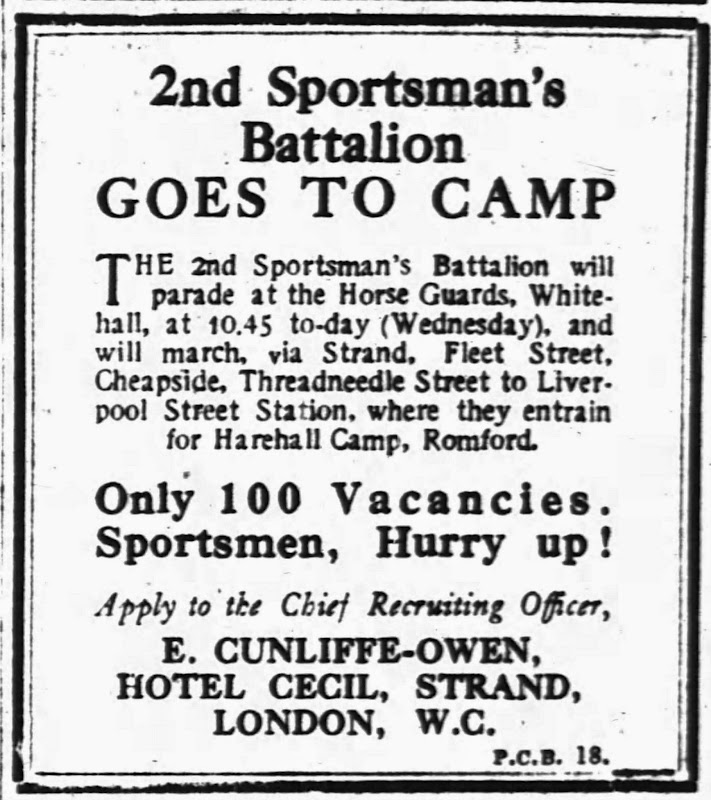
2nd Sportsman’s Battalion

GOES TO CAMP

The 2nd Sportsman’s battalion will parade at the Horse Guards, Whitehall, at 10.45 to-day (Wednesday), and will march, via Strand, Fleet Street, Cheapside, Threadneedle Street to Liverpool Street Station, where they entrain for Harehall Camp, Romford.

Only 100 Vacancies. Sportsmen, Hurry up!

Apply to the Chief Recruiting Officer,

E. CUNLIFFE-OWEN, HOTEL CECIL, STRAND, LONDON, W. C.

Western Times

A GOOD SEND OFF

Departure of the 2nd Sportsman’s Battalion

FROM EXETER

The 2nd Sportsman’s Battalion, which has been raised in the West-country through the instrumentality of Capt A. E. Dunn, and which has since its formation had its headquarters in Exeter, left the City yesterday to go into camp to complete their training for whatever service is before them. The send-off was as encouraging and enthusiastic as could well be, and the cheering crowds that thronged the streets were tribute to the popularity of the Battalion and to a fine body of men.

No won who saw the Battalion – fresh, smart, athletic, and fit as the men are – march through the City with that litheness and swing which betokens perfect physical fitness and vigour, could help congratulating Capt. Dunn on having the proud command of such a splendid body of men. In the best of spirits and keen for service, the men responded cheerily to the ready outbursts of the citizens, the waving of hats and handkerchiefs, and good wishes which were evident on every side. They were not downhearted: they said so themselves many times as they swung through the street between unbroken lines of civilians.

The “fall in” was at 8 o’clock at the top of St. Sidwell’s, and the Battalion mastered promptly and in full force. It numbers 323 of all ranks, and, besides the O.C., the officers are Lieuts Enderby, W.G. Perkins and F. Templeman, with Co. Sergt.-Major C. T. W. Finch.

The Battalion Band, under Sergt. Brock, was there to lead the way with martial music. The band itself, like the Battalion, has made splendid progress and now numbers 20. The played lively and patriotic airs, with “Soldiers of the King” and “Sons of Our Empire” among the numbers rendered.

The route take was through Sidwell-street, High-street, and Queen-street, passing the statue of Devon’s hero, General Buller, and then on to St. David’s Station, where a special train was in waiting. Numbers of friends managed to get on to the platform and there was much hand-shaking and exchange of wishes for good luck. To secure this latter for his battalion on stalwart member had been decorated with an old horseshoe tied with ribbon in the colours of the Allies, which, notwithstanding its hug dimensions, he bravely ad proudly wore upon his breast. The men were soon comfortably aboard the train, which, amid a perfect hurricane of cheering, steamed away on the stroke of 9 on its journey east.

London Standard

BASKET BALL.

An interesting match has been arranged between some members o f the Sportsman’s Battalion of the Royal Fusiliers, commanded by Lord Maitland, and a London basket-ball team. The military side will include Hayes and Hitch, the well-known Surrey cricketers, and amongst their opponents will be J. G. Lee, who has taken an important part in the work of organizing Y.M.CA. recreation tents in various military centres, and Dr. Robert le Cron, the well-known ice-hockey player. No charge will be made to witness the game, which will take place at the Central Y.M.C.A. Tottenham Court-road, on Saturday, at 7.45 p.m.

March 5, 1915

Aberdeen Weekly Journal

WELL-KNOWN FOOTBALLERS IN THE SPORTSMAN’S BATTALION.

Lewis R. Lewis (on reader’s left), the Army International footballer, is a corporal in the 2nd Sportmen’s Battalion, and has been appointed captain of the football club of the battalion. With him in the picture is Sergt. Adams, of the same battalion, who played for Fulham this year, and was formerly captain of Southend United.
The Cincinnati Enquirer

HOTEL CECIL, LONDON.

Our attention having been called to the fact that there is an impression in America that this hotel has been taken over by the Red Cross Society, we would take the earliest opportunity to inform you that such is not the case.

The hotel is open to receive visitors as usual. Beyond the fact that certain of the public banqueting rooms are being used for the purpose of recruiting for the Sportsman’s Battalion, there is no interference with the usual course of business.

     Yours faithfully,
          F. M. Hornsby, Manager.

February 13, 1915

Daily Express

Mrs. CUNLIFFE-OWEN REPUDIATED.

APPEAL WITHOUT COLONEL PAGET'S APPROVAL.

We have received the following letter from Colonel A. de B. V. Paget, commanding the 2nd Sportsman’s Battalion, recruits for which are expected by Mrs. Cunliffe-Owen, the chief recruiting officer, to pay not less than three guineas each: —

To the Editor of the “ Daily Express.”
     Sir.—With reference to the paragraph in to-day’s “Daily Express” headed "Mrs. Cunliffe-Owen's appeals,” I beg to state that the appeal for funds to the recruits of the 2nd Sportsman’s Battalion was issued without my knowledge or approval, and that I deprecate in the strongest manner communications passing between the organisers of the battalion and the non-commissioned officers and men without my knowledge.
               A. DE B. V. PAGET. Colonel, Commanding 24th (S) Bn. Royal Fusiliers (2nd Sportsman's).
     Hotel Cecil, Feb. 12

Three appeals from Mrs. Cunliffe-Owen, “Chief Recruiting Officer ” of the Sportsman’s Battalions, for contributions to the funds under her control have been quoted in the “Daily Express."

One was to members of the 1st Battalion, another to those of the 2nd Battalion, and the third to a private householder.

In the appeal to the 2nd Battalion, which Colonel Paget repudiates, Mrs. Cunliffe-Owen not merely asked all the rank and file to “help me as much as possible.” but added. “Will you get as many of your friends to help me as you can ?”

Colonel Viscount Maitland, commanding the 1st Battalion, has already repudiated Mrs. Cunliffe-Owen’s three-guinea tax.”

February 10, 1915

Daily Express

FINANCES OF THE SPORTSMANS.

MRS. CUNLIFFE-OWEN'S APPEAL.

An interesting sidelight is thrown on the finances of the Sportsman’s Battalions by a circular which Mrs. E. Cunliffe-Owen, the chief recruiting officer, sent to the men of the 1st Battalion at Hornchurch.

Mrs. Cunliffe-Owen stipulates that recruits shall belong to the “upper and middle classes,” and pay not less than three guineas each on enlistment.

The circular which Mrs. Cunliffe-Owen sent to the men at Hornchurch is dated Hotel Cecil, November 21, 1914, and it begins with the candid statement that “unfortunately the time has come when I am faced with a most serious problem, i.e., the Finance of the Sportsman’s Battalion.”

Mrs. Cunliffe-Owen proceeds to explain that she asked many rich and influential men to subscribe towards the battalion funds and necessaries required for the men over and above what the War Office allowed, but all in vain.

     “My husband and I lost our entire fortunes some ten years ago,” she proceeds. “Had we not done so, I should never have been forced to make any kind of appeal, as we should have been only too proud and glad to finance such a magnificent body of men as you are.
     “At yesterday’s finance meeting my hair nearly turned white, as I have to find sufficient money to pay for the enclosed list of things, for which the War Office will not pay.”

Then follows the list of “things,” which include canteens, hospital (thirty-three beds), barber’s shop, cupboards, mats, looking-glasses, and “administration right up to date.”

    “I do not know,” the circular continues, “if you are aware of the fact that our entire accounts are kept by Messrs. Deloitte, Plender, and Griffiths, chartered accountants, so that all expenditure is carefully watched.
     "Every little helps, and I suggest each hut subscribing whatever the inhabitants feel inclined and disposed to give.”

The circular concludes: “When the work is a little less I hope each hut will ask me to tea, as I should like to get to know each personally.”

February 8, 1915

Daily Express

SPORTSMEN’S EXPENSES.

FIVE DAYS’ SILENCE OF MRS. CUNLIFFE. OWEN.

FIGURES WANTED.

Five days have come and gone, and no more letters to the “Daily Express” from Mrs. E. Cunliffe-Owen! No offer to tell an admiring country all about the terrible expense of raising and equipping the Sportsman’s Battalions, of which Mrs. Cunliffe-Owen is “chief recruiting officer.”

Having roused the wonder and sympathy of her fellow-countrymen by announcing that she has spent £7,000 more than she expects to recover from the War Office, Mrs. Cunliffe-Owen coyly abstains from confiding in the public the little details which might persuade it to throw its money at her feet.

“ Please don’t imagine that we have made any money out of it,” Mrs. Cunliffe- Owen said to a “Daily Express" representative, "for we have not made a single farthing out of it.”

That being so—and Mrs. Cunliffe-Owen volunteered the statement—would it not be better in every way if Mrs. Cunliffe-Owen were to invite the public to come to her aid. instead of asking recruits to pay part of the expense? If the public were told what the money was for, it might subscribe.

Is it that Mrs. Cunliffe-Owen is so busy that she has no time to go into the matter ? If so, the “Daily Express” would be glad to go through the accounts and draw up a statement of receipts and expenditure.

MANY GIFTS.

We understand that many hundreds of pounds have been given—single cheques as large as £200, at least—by men who have joined the Sportsman’s Battalions.

If Mrs. Cunliffe-Owen cared to announce the items on which the money has been spent, some patriotic millionaire might step in and provide for any remaining needs.

She assured a “Daily Express” representative that money has not been spent on luxuries.

“The money in the first instance.” she said last week, “has been expended in clothing, boots, etc., of superior cut and quality.”

It would be interesting to know exactly what price has been paid for these outfits “of superior cut and quality.”

     How much for tunics and trousers? How much for overcoats?
     How much for boots?
     How much for cups?

We understand the War Office allows about £7 10s. for kit per man. Men who think of joining the Sportsman’s—and of paying something towards the £8 to £10 “extra’’—will be glad to know by how much the cost of kit exceeds the War Office figure.

Will Mrs. Cunliffe-Owen say how far these figures differ from those she has paid:

Tunics and trousers ................... 29s.
Overcoats ................................... 35s.
Boots ........................................... 15s.
Caps ............................................ 3s.

That would make a total of £4 2s., leaving £3 8s. for the rest of the kit.

As the “Daily Express” has already stated, Mrs. Cunliffe-Owen and her staff occupy a very large apartment in the Hotel Cecil—large enough for a carriage to drive round in—and on wet days one of the largest halls in the hotel is used for drilling (in rubber shoes); there are said to be a couple of rooms for typists.

MORE QUESTIONS.

It would perhaps induce the public to put up some money if Mrs. Cunliffe-Owen would state:—

How much per week does the recruiting office and work cost?
What allowances are made for expenses?
How much is paid for motor-car hire for the use of the recruiting staff?

The answers to these questions would, at any rate, satisfy the curiosity of men who may have thought of joining the Sportsman's, and may have been deterred from joining by doubt as to bow their money would be spent.

Mrs. Cunliffe-Owen speaks proudly of the camp of the 1st Sportsman’s at Hornchurch.

The expenditure on this camp would, we are sure, be of widespread interest, especially to other less fortunate battalions. How much, for instance, was the furnishers’ bill? What about the officers’ mess?

Were men ever invited to subscribe for plate for the officers’ mess?

UNJUSTIFIABLE.

To the Editor of the " Daily Express.”
     Sir,—As one who has something to do with the control of postmen I must protest against what considerable experience has proved to be an altogether unjustifiable attack on a large portion of the members of his Majesty’s Post Office staff'.
     Mrs. Cunliffe-Owen may have been carried away by the enthusiasm of the cause she has taken up, but surely such au utterance was neither tactful nor called for, and is calculated to cause considerable resentment among a generally cleanly and well-conducted body of public servants.
     Also, judging from the tone of Mrs. Cunliffe-Owen’s statement of Monday night, there appear to be a great risk of one forming the opinion that a strong snobbish element exists in the Sportsman's Battalions—which I, for one, would be extremely sorry to think is so.
          POST OFFICE OFFICIAL.

[There is no reason to suppose that any of the men are snobs.—Ed., “D.E.”]

“ J. F. W.” writes to the “ Daily Express” asking how men can join the Sportsman's Battalions without paying three guineas.

Men are still wanted for the 1st Battalion, of which Viscount Maitland is colonel. The camp is at Hornchurch, Essex. There is no fee for admission.

February 5, 1915

Chelmsford Chronicle

SHORT RATIONS AT ROMFORD

A CARTAGE AGENT CHARGED WITH THEFT.

At Romford yesterday Joseph Bysouth, 43, a cartage agent, of Milton Road, Romford, was charged with stealing 28lb. of bacon, 3lb. of mutton, 3lb. of beef, 1 ½ lb. of dripping, seven loaves of bread, and 1lb. of tea, value £2, the property of the Officer Commanding the Sportsman’s Battalion, at Hornchurch, on Jan. 30.

The case was begun on Monday, when Lieut. and Quartermaster Robert de Vere Stacpoole said that for a considerable time he had received complaints regarding a shortage of rations at the men’s meals. He knew that the full issue of rations had been made, so he suspected they were being stolen. On Saturday he instructed the sergeant of the guard to examine all vehicles leaving the barracks. The sergeant subsequently reported to him that the things mentioned in the charge had been found in the defendant’s van. Witness identified them as the property of Colonel Viscount Maitland, the officer commanding. Defendant had no authority to take the goods away.

Pt. C. F. Branson said he was on sentry duty, and he stopped the defendant’s van. He saw Sergt. Gille take a loaf of bread from a sack in the van. Defendant said, “That’s all I’ve got; I got it from the pig-tub.” Sergt. Gille found another loaf, and then took the accused to the guard-room.

Lance-Sergt. F. M. Gille said he asked the defendant what he had got in the van? Defendant replied, “Nothing, only some hay for the horses.” Witness found two loaves of bread. He also turned out two sacks that were in the van, and found the bacon, beef, tea, loaves, and other things. Defendant said, “I picked them up from the pig-tubs.”

Police-Sergt. Crowe said that when charged by Supt. Mules, the accused said, “I have a contract to take the swill away, and I saw two bags standing against the tub. I thought they were rubbish, and I put them in my van.”

Yesterday the case was again remanded for a week.

Daily Express

THREE-GUINEA RECRUITS.

MRS. CUNLIFFE-OWEN'S SILENCE ON THREE QUESTIONS.

WHAT IS THE RENT?

Mrs. E. Cunliffe-Owen has ceased to be amiable—to the “Daily Express.” Only yesterday we printed a letter from her in which she said, “ I have scarcely had breathing time this morning, and owe you an immense debt of gratitude for the wonders you are working for me. When you have the time, do come and see me. as I am sure we ,should work well together.”

When a “Daily Express” representative, glowing with pleasurable anticipation of the cordial welcome that awaited him, called yesterday at the Indian Room of the Hotel Cecil, however, Mrs. Cunliffe-Owen would not see him.

He might as well have been a postman – “a real, grimy, horny-handed son of toil,” to quote Mrs. Cunliffe-Owen’s own words.

The “Daily Express” representative went to the Indian Room, the recruiting headquarters of the Sportsman’s Battalions, for the purpose of receiving Mrs. Cunliffe-Owen’s reply to the questions asked in yesterday’s “Daily Express” with reference to the cost of raising and equipping the battalions, recruits for which are told that they must pay not less than three guineas each and be of the upper and middle classes.

The questions are: —
1. How much money has been received?
2. How has the money been spent?
3. What is the present balance or deficit ?

“TOO MUCH ENGAGED.”

These seem very reasonable and pertinent questions, in view of Colonel Viscount .Maitland’s statement that he has recruited 255 men at an advertising cost of 7s.. while Mrs. Cunliffe-Owen has, as she has said, spent about £2,300 on recruiting, and altogether about £7,000 more than she expects the War Office to refund.

The “ Daily Express ” representative handed his card to the orderly in attendance inside the doors of the Indian Room. This is a very large apartment, the far corner of which is shut in with screens, so placed that the chair in which Mrs. Cunliffe-Owen sits at her desk commands a view of the area just inside the doors. Any one who steps beyond the waiting-corner comes “under fire.’’

The orderly took the card inside the screens, and after a few moments returned.

“Mrs. Cunliffe-Owen is too much engaged to see you,” he said with a faint smile.

The “Daily Express” representative asked the orderly to go back and say that he would like to see Mrs. Cunliffe-Owen at some later time.

“She can’t see you,” said the orderly, shaking his head.

“I should like to have Mrs. Cunliffe-Owen’s reply,” the “Daily Express” representative said.

“That is her reply,” the orderly answered; “she is unable to see you.”

ANOTHER DAY.

Asked if the “Daily Express.” representative was to understand that Mrs. Cunliffe-Owen refused to see him at any time, the orderly repeated: “She is unable to see you.”

So for the present we are unable to give Mrs. Cunliffe-Owen’s answers to the above questions. Perhaps she will oblige our readers another day.

The “ Daily Express ” was told yesterday about a thoroughly good recruit, who would have been particularly useful in the regiment, but who was immediately rejected by Mrs. Cunliffe-Owen when he said that he could not pay.

It would be interesting to would-be recruits for the Sportsman’s Battalions if Mrs. Cunliffe-Owen would announce:

What rent has been paid, and is being paid, for the Hotel Cecil quarters?

The “ Daily Express ” representative intended yesterday to ask Mrs. Cunliffe-Owen if the rent is £40 a week, as it is said to be.

It might also be stated whether the usual rent includes the use of one of the largest rooms in the Hotel Cecil, in which the recruits of the 2nd Battalion drill on wet days—wearing rubber shoes in order to save the floor.

READERS' OPINIONS.

As to the taste of Mrs. Cunliffe-Owen’s announcement that the battalions are only for “gentlemen” of the “upper and middle classes,” the “Daily Express” continues to receive many letters of protest, among them the following:—

"USURPED."

To the Editor of the “Daily Express.”
     Sir, – I am glad you have called attention to the preposterous suggestion of asking in future an entrance-fee of three guineas and upwards to the Sportsman’s Battalions, and that the recruiting should be confined to men of the upper and middle classes, as such a demand must surely be most “un-sportsman”-like.
     I prefer to think that the men of this country, from whatever class they may be drawn, enlist solely from patriotic motives, and in that case are willing and prepared to serve together and to face every kind of hardship that may fall to their lot.
     Those who could only be induced to join, to use Mrs. Cunliffe-Owen’s words, “by giving them the best that is procurable in the way of equipment, food, beds, and so on,” are not made of the the real fighting stuff, but when an important position as chief recruiting officer, requiring sound judgement and common sense, is usurped by a woman, it is not surprising such blunders arise.
     That such a fine body of gallant men as the Sportsman’s Battalions are known to be should be liable to misrepresentation, and may I say, ridicule, through no fault of their own, is much to be regretted.
          AN OFFICER’S WIDOW.

POSTMAN V.C.

T0 the Editor of the “Daily Express.”
     Sir, – one would gather from Mrs. Cunliffe-Owen that the Sportsman’s Battalion is hardly being prepared for the trenches.
     Of what service will clothes of a superior cut and the best of equipment in the way of beds, etc, be to them when the battalion takes its place on active service?
     I have had fifteen years in the Post Office service, but have not yet met the “real, grimy, horny-handed sons of toil,” but that may be because I have not met Sergeant Hogan, the Postman V.C.
     Would Mrs. Cunliffe-Owen inform him that he would be out of place and not at home among gentlemen?
          A. J. WEST.

THE VERY LIMIT.

To the Editor of the “Daily Express.”
     Sir. – You may well ask “ Why Mrs. Cunliffe-Owen?” for all of the snobbery I have ever read surely the very  limit and a bit more than has been reached in this case.
   Fancy having to tell two postmen “tactfully” that they were not “gentlemen”! Did you ever hear such inane rubbish?
     Hammersmith, E. CRABBE

February 4, 1915

Daily Express

THREE-GUINEA RECRUITS.

VISCOUNT MAITLAND’S REBUKE TO MRS. CUNLIFFE-OWEN.

MORE QUESTIONS.

Mrs. Cunliffe-Owen’s position and doings as “chief recruiting officer” of the Sportsman’s Battalions continue to excite the liveliest interest.

The 1st Battalion, of which Viscount Maitland is colonel, is training at Hornchurch, in Essex, and Mrs. Cunliffe-Owen is now engaged in raising a 2nd Battalion at her recruiting office in the commodious Indian Room at the Hotel Cecil.

It might be supposed that Mrs. Cunliffe-Owen, as “chief recruiting officer,” would have filled up the 1st Battalion to its proper strength before undertaking the raising of a 2nd Battalion, the cost of which is, she says, so heavy that recruits are “expected to pay a minimum of three guineas and to be of the upper and middle classes.”

The 1st Battalion, however, is not yet complete, although Mrs. Cunliffe-Owen states that she has spent £7,000 more than she expects the War Office to refund to her.

VISCOUNT MAITLAND.

This point is made clear in the following letter which the “Daily Express” received yesterday from Colonel Viscount

To the Editor of the “ Daily Express.”
     Sir,—I much regret that a matter of principle should have forced me into public controversy with Mrs. Cunliffe- Owen.
     All who have seen the magnificent battalions she has been instrumental in raising must admit that tin country in general, and the War Office in particular, owe this energetic and capable lady both thanks and gratitude.
     If I may say it, she fails only in one respect—she does not recognise her own limitations.
     Raising a regiment is one thing, training a regiment is another, and this latter is as much beyond the scope of the most capable of women as of any inexperienced civilian.
     Mrs. Cunliffe-Owen has raised this battalion; I, with the assistance of my officers, am training it, and I shall be proud if, in my sphere, I prove to be as successful as she has been in hers.
     Mrs. Cunliffe-Owen asserts that I have no practical concern with recruiting in my battalion.
     Since the middle of November my recruiters have enlisted 255 men without the expenditure of one cent, of public

(cont)

February 3, 1915

Daily Express

THREE-GUINEA RECRUITS.

“SPORTSMAN’S" LEVY NOT SANCTIONED BY WAR OFFICE.

“KIT” AND EXPENSES

     War Office, Feb. 2,1915.
To the Editor of the “ Daily Express.”
     Sir,—In reply to your letter of to-day, Sir Reginald Brade desires me to say that the War Office have no information officially of the levying of a three-guinea entrance fee from recruits enlisting in the Sportsman's Battalion, and it has not received the sanction of the Army Council.
     H. C. GORDON, Private Secretary.

The “Daily Express” yesterday received the above letter with regard to the three-guinea-entrance-fee for Sportsman’s Battalions.

A “Daily Express” representative afterwards saw Mr. and Mrs. Cunliffe-Owen at the recruiting office of the Sportsman's Battalions in the spacious Indian Room of the Hotel Cecil, and asked for an answer to the five questions in yesterday’s “Daily Express” about the battalions, recruits for which are “expected to pay a minimum of three guineas and to be of the upper and middle classes.”

First of all as to the mystery of Mrs. Cunliffe-Owen being “Chief Recruiting Officer” of the battalions.

It is a curious circumstance that both Mr. and Mrs. Cunliffe-Owen have the one initial “E.” Mr. Edward Cunliffe-Owen, C.M.G., is the secretary to the Metropolitan Electric Supply Company. Mrs. Emma Cunliffe-Owen is the daughter of the late Sir Philip Cunliffe-Owen, K.C.B.

MUST BE A MAN.

“We wrote to the War Office and offered to raise a Sportsman’s Battalion,'’ Mrs. .Cunliffe-Owen said to the “Daily Express” representative, “and they authorised us to do so. Mr. Cunliffe-Owen is the responsible person—it has to be a man, but,-’ added Mrs. Cunliffe-Owen with a smile, “I really am Mr. Cunliffe-Owen.

“ Mr. Cunliffe-Owen cannot be here all day, so I am here, and for five months I have sat here from morning until night, acting as chief recruiting officer.

“ Please don’t imagine we have made any money out of it,” she said, “for we have not made a single farthing out of it.”

“The fact is,” said Mr. Edward Cunliffe-Owen, “that the expenses in connection with the first battalion amount to a sum which we are afraid will be over £7,000 more than we shall get repaid by the War Office. Then there is the second battalion.

“ We are responsible for the money. We have to pay for this recruiting office and the recruiting staff and the drill hall and advertising—printing and advertising have cost about £2,300 already —and other things.

“ What we wanted,” Mr. Cunliffe-Owen added, “was something special—men who would not enlist in other battalions—a better class of men.

" Me have men with their own butlers and footmen and three motor-cars!” Mrs. Cunliffe-Owen said, with much pride. “Men like that would not care to come down to sleeping on sacking!”

“ What about stipulating that men must be ‘of the upper and middle classes’?” the “Daily Express” representative asked.

“What else could we say?” Mrs. Cunliffe-Owen replied; " we could not say ‘Only clean men wanted; dirty men need not apply’!”

SIZING THEM UP.

“ How do you decide whether an applicant belongs to the upper or the middle class, or some other class?” she was asked.

“ Oh,’ said the “chief recruiting officer” with a laugh, “I see them all myself here, and I size them up.

“ If a man comes in whom I think unsuitable,” she added, “I tell him as kindly as I can that the battalion is only for gentlemen. He sees at once that he would not feel comfortable in the battalion, and says. ‘Oh, it’s no place for me, lady,’ and we send him to another recruiting office.’’

“ You know how uncomfortable your servants are if they have to sit down with you.” Mrs. Cunliffe-Owen said, sympathetically.

Asked if the War Office approved of men being expected to pay not less than three guineas each, Mrs. Cunliffe-Owen said, “ So long as we comply with the War Office requirements we can do what we like. It is a private enterprise, done for King and country out of pure patriotism,” she added proudly.

Mrs. Cunliffe-Owen showed the “Daily Express ” representative a copy of the form which applicants for the three-guinea battalions have to sign. One of the questions is: “How much are you prepared to pay towards the extra cost (£8 to £10) of your outfit? ”

“Does the outfit cost £8 to £10 more than the War Office allows?” the “Daily Express” representative asked.

“No,” Mrs. Cunliffe-Owen replied, but there are all the other expenses, and we estimate it all works out at £8 to £10 a man, but you could not print it like that, so we put it down as kit.”

“I APPOINTED LORD MAITLAND.”

To the Editor of the “Daily Express.”
     Sir,—Referring to my interview with your representative which you published in your issue of to-day, I am reported to have said that I appointed Lord Maitland to the position as Commanding Officer to the 1st Battalion.
     Your representative must have misunderstood me—what I did say was that Lord Maitland’s name was suggested to me by the military authorities, and his appointment was made by them after an interview with me.
          E. CUNLIFFE-OWEN.
               Chief Recruiting Officer.
     Hotel Cecil, Strand, Feb. 2.

[Mrs. Cunliffe-Owen used the words, “I appointed Viscount Maitland.” This statement seemed so incredible that the “Daily Express” representative challenged it twice, urging on the second occasion—“But surely, Mrs. Cunliffe- Owen, it must have been the King or the War Office authorities who made the appointment?” Mrs. Cunliffe-Owen was insistent, however, repeating: “I appointed him. I selected his name from a number of others before me.” She made no mention of his name having been suggested to her by the War Office authorities, or his appointment having been made by them after an interview with her.]

February 2, 1915

Daily Express

SNOBBERY AND ENLISTMENT.

REPUDIATION of the £3 3 0 FEE BY THE COLONELS.

‘THE SPORTSMAN’S.’

Colonel Viscount Maitland, commanding the 1st Sportsman’s Battalion, sends the following letter to the “Daily Express” in connection with Mrs. Cunliffe-Owen’s remarkable statement that men joining the Sportsman’s Battalion in future will be expected to pay a minimum of three guineas and be of the upper and middle classes : –

Grey Towers, Hornchurch, Essex.
To the Editor of the “ Daily Express.”
     Sir,—In justice to the battalion under my command, permit me to state that no “entrance fee ” is, or ever will be, imposed on recruits joining the 1st Sportsman’s Battalion, as you infer by applying the plural in your criticism of the “Sportsman’s Battalions in your issue of January 30.
     All men offering their services to the King through my orderly-room are welcomed to our ranks, the sole qualifications being a good record and compliance with our somewhat high physical standard.
     MAITLAND, Col. Commanding 23rd (Service) Bn., Royal Fusiliers (1st Sportsman’s).

THE ORIGINAL LETTER.

It was not the “Daily Express,” but Mrs. Cunliffe-Owen, that was responsible for the words “Sportsman’s Battalions” — in the plural. In proof of this we append Mrs. Cunliffe-Owen’s original letter on the subject of the three-guinea fee and the exclusion of any but “the upper and middle classes.”

    THE SPORTSMAN’S BATTALIONS. Royal Fusiliers.
Officers Commanding—
1st Batt.: Colonel Viscount Maitland.
2nd Batt.: Colonel A. de B. V. Paget.
     Hotel Cecil, Strand, London,
          January 29, 1915.
To the Editor of the “Daily Express.”
     Sir,—I have to thank you for your valuable help in making the Sportsman's Battalions, which my husband and I are raising, known throughout Great Britain, and to ask if you will add to our indebtedness by letting the public know that men joining this battalion in future will be expected to pay a minimum of three guineas and be of the upper and middle classes. There are no other financial obligations whatever.
     I would also like to remind the public that these battalions are the only ones permitted to recruit up to forty-five years, thus giving them seven years' extension over every other corps. Camp, food, and equipment are of the very best. Thanking yon in anticipation for making these facts known,
          E. CUNLIFFE-OWEN,
Chief Recruiting Officer.

The italics are ours.

COLONEL PAGET'S VIEW.

Colonel A. de B. V. Paget, the officer commanding the 2nd Sportsman’s Battalion, of which Mrs. Cunliffe-Owen is the “chief recruiting officer,” in an interview with a “ Daily Express ” representative at the Hotel Cecil yesterday, said : —

     “I cordially agree with the views expressed by Lord Maitland in his letter which you have just read to me, and personally I strongly deprecate any announcement that recruits are expected to pay a three-guinea fee and be of the upper and middle classes.’
     “At the same time I am powerless in the matter, inasmuch as until the men have actually enlisted they are not under my command. ’’

The colonel added that the “ three-guinea’’ announcement has caused great indignation among both officers and men of his battalion.

The “Daily Express” has asked four questions:—
     (1) Why pay at all?
     (2) Why this snobbery?
     (3) What has Lord Kitchener to say to this form of recruiting?
     (4) Are the Sportsman’s Battalions not intended for the front?

We now supplement this by the further question: —
     Why Mrs. Cunliffe-Owen?

THE DEFENCE.

In an interview with a “Daily Express” representative last night Mrs. Ounliffe-Owen stoutly defended her action.

    “The reason for asking a minimum entrance-fee of three guineas,” she said, may be found in the fact that the cost pe man, over and above what the War Office allows us, is from £8 to £10, and this cost is still rising.

“The money, in the first instance, has been expended in clothing, boots, etc., of superior cut and quality.

“The cost of advertising, stationery, hire of drill hall, office expenses, and a host of other things too numerous to mention, has also been very heavy.

“This payment of three guineas is being asked with the full knowledge and consent of the War Office.

“The Sportsman’s Battalions are certainly going to the front. They will be among the first.

“The only other outstanding question, so far as I am able to gather, is: Why say that men who wish to join this battalion will be expected to be of the upper and middle classes?

“Well, for the simple reason that by confining the battalion to gentlemen, and also by giving them the best that is procurable in the way of equipment, food, bed, and so on, we induce a number men to enlist who would not otherwise do so.

“Are we to allow men who are not clean who do not wash, men who would not be welcomed as associates by those already in the battalions, to come in and make discord?

“We had two would-be recruits – postmen I believe they were – in here a short time ago, real, grimy, horny-handed sons of toil.

“I told them as tactfully as I could that I was sure they would not be at home in our battalion, which was composed of gentlemen, and I referred them, as I have referred many others previously, to the recruiting office at New Scotland-yard.

“At the same time, it is true we have admitted gamekeepers and fish market employees to our battalions, and fine fellows they are.

“As to Lord Maitland’s letter, he has no practical concern with recruiting in his battalion. I appointed him, and I raised both battalions.”

January 23, 1915

Birmingham Evening Despatch

SPORTSMAN’S BATTALION.

Display of Boxing and Appeal for Recruits.

At the Drill Hall, Stoney Lane-lane, Sparkbrook, on Monday night, 15 February, Sergt. P. G. Sadd and Pte. C. Mitchell, of the 2nd Sportsman’s Battalion, Royal Fusiliers, will give an exhibition of boxing, and afterwards Sergt. Sadd will address the audience and appeal for recruits for the battalion.

Sergt. P. G. Sadd was middle-weight champion of the Midland Counties 1913-14 and for three years was captain of the Burton Rugby football team. Pte. C. Mitchell, son of the famous Charley Mitchell, is an extremely clever boxer.

Mrs. Cunliffe-Owen, to whom the raising of these battalions is wholly due, intends to travel down from London specially to be present, so does Capt. Enderby, the Adjutant, Mr. Hamilton Adams, the trustee of the battalions, and various senior officers of the “Second Sportsman’s.” The exhibition is in aid of the relief of distress among dependants of men serving with the 3rd South Midland Brigade, R.F.A. and is under the patronage of the Lord Mayor.

The Sportsmen of the upper and middle classes who are under forty-five and fit are invited to apply to the Chief Recruiting Officer of the 2nd Sportsman’s Battalion, Hotel Cecil, Strand. They can fill up their enrolment form, and can be medically examined and attested at their nearest recruiting station without the trouble of going to London.

The corps need to not interfere with the formation of any other, as the two Sportsman’s Battalions are the only corps in the Army for which the age limit has been specially extended to forty-five, thus giving them the advantage of seven years in age over all others. The Sportsman’s Battalion includes some of the most famous cricketers, football players, golfers, and big game hunters of the day. Friends are especially invited to join together; every effort will be made, not only to keep them in the same company, and train them together, but to have them living in the same hut.

January 16, 1915

Land and Water

THE SPORTSMAN’S BATTALIONS.

To the Editor of LAND AND WATER.

DEAR SIR, - May I ask you to help me raise the necessary funds for the 2nd Sportsman’s Battalion! The facts briefly are these: -

A battalion of 1,400 men costs £8 to £10 per man over and above the money allowed and repaid by the War Office, and this amount the individuals raising the battalions have to find. The money is not for luxuries, but for ordinary necessary comforts which mean so much to a man undergoing strenuous training, and prevents illness, discontent and other troubles. Out of this fund also administration expenses, advertising and printing have to paid, which are necessarily heavy items. It would be most kind if your readers would send me cheques towards this fund, and so help me in the big national work I have undertaken. The cheques should be made payable to E. Cunliffe-Owen, and crossed 2nd Sportsman’s Battalion, London Joint Stock Bank, Ltd., Strand.

Any sum will be gratefully received and acknowledged at once, and every care is taken in the expenditure of the funds.

Thanking you in anticipation for doing the best in your power to help in this matter, believe me to be, yours faithfully,

E. CUNLIFFE-OWEN.
Hotel Cecil, Strand, London,

Nottingham Evening Post

PLAY UP NOTTS!

A COMPANY FOR SPORTSMEN’S BATTALION.

RECRUITING COMMENCED.

The sportsmen of Notts. have an unequalled opportunity of serving their King and country in the ranks of the 2nd Sportsmen’s Battalions, a representative from headquarters being at present in Nottingham making the necessary arrangements for the formation of a Notts. company.

The marked enthusiasm which has been infused into the battalions in London, and the fine type of sportsmen recruited, bespeaks a ready response to the appeal which will shortly be made for the new company, and we are informed that his Worship the Mayor is to be asked to lend his civic support to the proposal. That this will be of inestimable value of course goes without saying, and as a company only numbers about 200, it is “up to” intending recruits to immediately get into touch with the recruiting sergeant at the Mechanics’ Hall.

Sportsmen and gentlemen are synonymous terms, and although not a few have left the city and district to join the battalion in London, there remains a numerous company of golfers, cricketers, footballers, and racing men who will be glad to wear the khaki, and fraternise with their own kind in this splendid battalion. They will be known as the Notts. company of the 2nd Sportsmen’s Battalion, and enlistment will be confined to natives of Nottinghamshire. In fact, it has already commenced, and the first detachment of ten men will go up to London on Monday to report themselves. The camp at Romford, Essex, will claim the recruits after about a fortnight’s training in the metropolis.

The First Sportsman’s Gazette – No. 4

THE SPORTSMAN’S ALPHABET.

A is our Adjutant; how he can ride!
B’s our Battalion, his worry and pride.
C the Canteens; when you’re dry, try the wet,
D is our Doctor; good man and good “vet.”
E is our Empire; for her we must fight,
F’s for “Form Fours”; can we yet do it right?
G is the Guard Room; beware of its cell,
H is for Hornchurch, the place where we dwell.
I is the Institute; I call it draughty;
J are the Jim Jams; O shun them, ye crafty!
K’s for the Kaiser; we’ll fair give him sox,
L is for London; we liked the “Coal Box.”
M is John Merrick, of merit he’s full
N’s Private Neville, who saw a sick bull.
O’s Mrs. Owen; we owe her our thanks,
P is for Pitsea, where we’ve trenched and made banks
Q’s the Query if soon to the war we’re away,
R the Rifles we’re hoping to handle some day.
S are the Sportsmen; who said “hard as nails”?
T (ea) the mixture (plus extras) they give us in pails
U, I hope, are each doing your bit, every one,
V’s the Viscount, our Colonel, we’ve proved him A1.
W is the War; at tis end we shall cheer,
X with a minus, the strength of our beer.
Y’s is the man who takes things as they come,
Z is the Zeppelin, pride of the Hun !

I. F. W.

THE SECOND BATTALION.

Our representative visited the Hotel Cecil last Saturday. Recruiting is proceeding at a satisfactory rate, and Capt. Enderby, the Adjutant, expressed the opinion that in three weeks time the 2nd Battalion might be expected to arrive at its new Headquarters, Hare Hall, near Gidea Park, Romford. Many famous sportsmen have joined during the last few weeks. Among others there are C. P. McGahey, ex-captain of the Essex County cricket eleven; Mclvor Jackson, the Surrey cricketer; Harry Packer, Welsh Rugby forward; Lewis R. Lewis, Welsh International player; Robert M. Miles, late captain of Pembroke College Cricket and Football teams; Jack Cartmell, Brentford footballer, and E. Henderson, Middlesex cricketer. Other recruits include W. Burlton Stuart, a well-known pig-sticker and polo player; Reginald Cooper, big game hunter; P. G. Sadd, Captain of the Burton Rugby Football team and twice middleweight champion of the Midland Counties; William H. Denton, a skater, runner, and champion swimmer; Rev. Frank Edwards, of Brunswick Church, Hull; and finally, a young son of Charley Mitchell, the boxer.

CORRESPONDENCE.

“KISSING-CUP’S RACE.”

To the Editor, “First Sportsman’s Gazette.”

Sir,

Since the appearance in a recent issue of the “Daily Express” of an article dealing with the above perhaps too popular sporting ballad some of my gallant brothers-in-arms of our honoured Battalion inform me that a good deal of discussion— of a more or less heated character, as it would be in so electric an atmosphere—has been going on as to whom the guilt was to be attached of having given to the world, in its every habitable part, the irrepressible “ Kissing-Cup’s Race.” Well, naturally, being a “Sportsman,” I am undesirous that the blame of so heinous a literary crime should fall on innocent shoulders, and I herewith hasten to own that I alone did it. But let me also hasten to add that it was, after all, a very youthful indiscretion—as you may believe when 1 tell you it was thrown off at a single sitting in a fit of red-hot sporting enthusiasm after, as a mere lad, having seen my first Derby; moreover, it was one of the grandest struggles ever witnessed for the much- coveted “Blue Riband,” in which that greatest of all jockeys in a tight finish, Fred Archer, on the Duke of Westminster’s Bend ’Or beat Rossiter on Messrs. Brewster & Blanton’s Robert the Devil by a short head. The year? Perhaps I don’t—or won’t—remember that. It will amuse some of my mellower comrades of “Ours” to look it up for themselves. But I should like to say here that the story of the ballad in question is purely an imaginary one, though many have thought they could trace in it the life-romance of one or another of the then reckless young “sports” of the peerage, the notorious Marquis of Hastings of that time for instance. But this is not so; and if I may be allowed to say so, I think the fact of the “plot ” of the piece being such a characteristically familiar one to all those knowing anything of sporting life is what made it from the first a favourite recitation in all classes of Society; to strike the human note, that is the great thing in all dramatic pieces.

“ Kissing-Cup’s Race ” first appeared in the “ Sporting Times,” better known as the “Pink ’Un,” then owned and edited by my dear old friend John Corlett, and to whose spicy pages I afterwards became a fairly regular contributor; the piece was then published in book form with many of my other ballads of a like nature, by the well-known publishers, Messrs. Samuel French, Ltd., and It was then that it became so widely popular as to prove rather a nuisance to myself as I am sure it must have done to many others. The late Duke of Westminster called one of his racing fillies Kissing-Cup after it; she won the New Stakes at Ascot, by the way, and became the dam of many good winners; and then—to crown all—“The Follies” did a burlesque on it, and now it’s on the “Pictures,” and if that doesn’t kill it nothing will—except a full-blown play I have prepared on the subject, and which, had it not been for the war, would have been duly produced.

As I say, I’m sorry I did it; though it is some consolation to me to think that, out of the twenty or so novels, thirty plays and sketches, and several battalions of pieces for recitation that bear my name, “ Kissing-Cup ” is the only one for which I have felt called upon to apologise.

And now, assuring you, sir, that I would not have ventured to so far trespass on your valuable space save to decide a question on which I have been informed many of your gallant readers are good enough to feel interested.

I am,
          Yours in sackcloth and khaki,
                    C. CAMPBELL RAE-BROWN,
                    (Private) Sportsman’s Battalion.

CORRECTION.

Dear Sir,

I had no idea that I was such a devil of a fellow until I saw it all in your last number. I hasten, however, to correct your correspondent in one detail. I do not hold the world’s record with the M.H. rifle as that is obviously a mistake. I believe I do hold the record at 600 yards with the M.H. carbine. Trusting that you will oblige me by making this correction.

I am, Sir,
         Yours faithfully,
                    NORMAN COCKELL, Lieut.

MAINLY About PEOPLE.

Notes concerning members of the Sportsman’s Battalion.

Aston, Wm, Francis (Private).—Actor and Stage Manager Professionally known as Wallace Aston. Educated at Dulwich Grammar School and travelled extensively in U.S.A. and Canada, and United Kingdom, mostly with that celebrated actress, Mrs. Patrick Campbell; playing the character parts in “ The Second Mrs. Tanqueray,” “ Notorious Mrs. Ebbsmith,” “ Magda,” “ Electra,” and “ Flower of Yamatoo.” Was for several years Stage Manager with Wilson Barrett’s renowned play “The Silver King.” Has also been associated with Lady Tree, Ben Webster, and the late Laurence Irving in numerous West-end successes. Private Aston is no stranger to the Music Hall—having produced and played in his own dramatic sketches at most of the principal Halls in London and provinces. His favourite pastimes—hockey, walking and shooting.

Cooper, V. A. (Private).—Left home when he was 16 and went to South Africa. Has been in turn civil servant, farmer, locomotive engineer, brewer, cook, steward, store-keeper, purser, and soldier. Was in the Cape Civil Service for some time; then farmed in partnership with a Boer at Tulbaagh. Went to sea as a cook’s boy; first journey was a voyage of 10 months from Barry (Wales) to New Zealand and Australia via the United States. Was a store-keeper on a cable ship in Pacific (’Frisco Manilla cable). Worked his way to a pursership and on his last trip had charge of 600 passengers. Has made 18 trips to Australia, an average of 3 a year. His steamer arrived at Antwerp on the night the Belgian army mobilised, but did not drop anchor, escaping under cover of darkness. Private Cooper speaks Dutch and Spanish.

Gibson, C. S. (Private).—Artist, chiefly in landscape painting and reproduction. Useful at military sketching. His sports are tennis and cricket, and his principal hobby is competition motor cycling. Private Gibson is anxious to see a corps of dispatch riders attached to the Battalion, and to join them when they are formed! Is a good shot and oarsman.

Jourdain, Raymond Oliver (Sergeant).—Descended from an old Huguenot family. Born near Manchester and educated at Derby School. Open classical scholar of Magdalene College, Cambridge. Took Classical Tripos. Has travelled in West Indies and parts of South America. One of his brothers commands the 47th Loyal North Lancashire Regt., and another the 5th (Service) Battalion, Connaught Rangers. Sergt. Jourdain is a successful breeder of pedigree cattle (British Holsteins). He has taken a leading part in politics in the West of England, being an Imperialist and a Tariff Reformer.

Kendall, J. M. (Private).—Antiquary; interested in architecture and kindred subjects. A Fellow of the Society of Archaeologists. Has written considerably on archaeological subjects, and done much expert work in that direction for the Government. Spent ten years ranching in California. Educated at University College School and the University of California.

Leigh, H. E. (Sergeant).—Educated at Dulwich College. For some time farmer in Africa, and was for three years in the Natal Carbineers. Was on active service in Zululand when Dinizula was taken prisoner. His hobby is motoring, and his sports include tennis and football. Was in his college fifteen at Rugger.

AMUSING EXPERIENCE OF THE REV. FRANK EDWARDS.

(2nd Sportsman’s Battalion).

During the South African War Mr. Edwards acted as chaplain with the South Wales Borderers, and was promoted to the rank of Captain on the battlefield by Lord Roberts for an act of bravery in carrying despatches. In the Zand River fight he had the lower part of his face badly damaged by a Boer shell, and in consequence was in hospital for some weeks. The next bed was occupied by an old cavalry major of the “Blue” school who generally expressed himself in very sultry superlatives. The major and Mr. Edwards soon became “pals,” and one day the former called out, “Padre, I’ve been thinking.”

“What about, Major,” Mr. Edwards asked.
“What d— good shots those-- Boers are! ”
“Why, Major.”
“Well, they not only hit us fellows, but they jolly well hit us on our strong points. I’m a cavalry man; they’ve got me in the knee and spoiled my saddle grip. You’re a parson; and they’ve got you in the jaw.”

EDITORIAL NOTE.

The committee of the Gazette are more than gratified at the cordial reception given to their first three issues. The circulation reveals a steady improvement, more particularly outside the camp. We now have regular subscribers in all parts of the Kingdom, and there is little doubt that no other regimental journal has been more widely distributed. It only remains for those responsible for its production to maintain the standard which has been set, and for the readers to continue their support, both financially and by way of literary contributions, helpful criticism, and the suggestion of new features. The committee confidently leave these and all kindred matters in connection with the Gazette in the hands of men who are not only soldiers but also sportsmen.

KEY TO OFFICERS’ FOOTBALL TEAM.

Back Row (Left to Right)—Lieut. Williams, Dr. Hill, Lieuts. Hillcoat, Suckling, Murray, Thompson and Taylor. Sitting (Left to Right)—Major Richey, Capt. Inglis, Lord Maitland, Lieuts. Hayes and Foy.

SPORTSMAN’S BATTALION ASSOCIATION FOOTBALL CLUB.

The Battalion played the London Caledonians on Saturday, January 2nd, and suffered their first defeat by 5 goals to 1. Our team was a weak one, Clunas, Littlewort, E. H. Hendren, Lewis, and Bates all being away recruiting. The Callies had a strong team out to meet our boys. We held out till two minutes from half-time before the first goal was scored. The second half our team went to pieces rather more than we expected. Higgins, however, played like a Trojan—but without avail, our opponents improving, and eventually won as stated.

The Battalion eleven paid a visit on Saturday, January 9th, to Dulwich, and played the well-known amateur team Dulwich Hamlet, both teams being well represented, and, as expected, a fine game was witnessed by a considerable number of spectators. Owing to indisposition Lieut. Hayes was unable to play, and Pte. Higgins captained the team.

The game was started at a very fast rate, the ground being in good condition, if somewhat wet. The Sportsman’s, however, played with determination and a combination that had not hitherto been seen in any other match, and which was noticeable particularly among the forwards. After twelve minutes’ play Hendren, with a fine shot, scored the first goal; Owers scored the second, and Hendren the third. This finished the scoring in the first half. Upon changing ends the Hamlet played up and made some spirited attacks, but the defence of Higgins, Rawlings, and Littlewort was superb, time after time robbing the Dulwich forwards and breaking up their combination.

KEY TO B COMPANY’S FOOTBALL TEAM.

Back Row (Left to Right)—Stillwell, Sandham, Parkes, Lee, Atkinson, Lient. Foy, Sawden, Sgt.-Major Merrick.
Sitting (Left to Right)—Williams, Hendren, Sergt. Skewes, Baillon.

Towards the finish, after a combined run of the forwards from the Sportsman’s goal to the half-way line, the ball was passed to Clunas, who worked his way through the Hamlet backs and, after being charged off the ball on three occasions, with a marvellous shot scored the fourth and last goal.

Result—Sportsman’s, 4; Dulwich Hamlet, 0.

The Dulwich officials were much impressed by the play of the Battalion team, being quite certain that it was the best football played at Dulwich this year, and were anxious to arrange a return match, on February 27th, which date was accepted conditionally by the Battalion Secretary.

On Sunday, January 10th, the 2nd Battalion Football Club paid a visit to the camp in order to play the 1st Battalion Club. Notwithstanding heavy rain Lord Maitland, Mrs. Cunliffe Owen, and the officers of both Battalions were present.

Much to the disappointment of the many spectators and the 1st Battalion players, the visitors were poorly represented, and two substitutes had to be found, Sergt. Williams and Private Moffat ably assisting them. The game needs little description. At half-time the 1st Battalion led by six goals to none. The game eventually resulted as follows:—1st Battalion, 8 goals. 2nd Battalion, 2 goals. The ground towards the finish was in a dreadful condition and prevented accurate play.

On Saturday the 1st Battalion Eleven play one of the strongest amateur teams in the London District, e.g., Leytonstone.

The railway fare is sevenpence provided a certain number travel, and 45 minutes from Hornchurch is the utmost time taken. The Leytonstone ground adjoins the Midland Station. The kick-off is at 2.45 p.m.

THE CONNING TOWER.

ITEMS OF NOTES AND NEWS.

We think the following paragraph, quoted from Mr. Solomon Eagle’s notes on current literature in The New Statesman, worthy of still wider circulation:—

That vivacious periodical, the Book Lover, of Sydney, has just printed what it regards as the real Australian national anthem. It’s author’s name is given as “ Den,” and, although it is cryptic, it is immeasurably superior to most national anthems, and especially to the Canadian song,“The Maple Leaf,” of which both the words and the music are vapid to the last degree. The i Australaise ’ is too long to be quoted in full, but here is a typical verse and its chorus: —

Fellers of Australia,
Blokes an’ coves an’ coots,
Shift yer — carcases,
Move yer — boots,
Gird yer — loins up,
Get yer — gun,
Set the — enemy,
An’ watch the — run.

          Chorus—
          Get a — move on,
          Have some — sense ;
          Learn the — art of
          Self de — fence.

I cannot for the life of me fill in the missing words, but probably most of my readers will be quicker- witted than I. Mr. Shaw might, perhaps, be able to suggest something.”

One of our correspondents writes: Why, oh why did you call the Gazette by its present title which means nothing to anyone outside the Camp? Had it a more general title it might have been worked into a good general sporting newspaper property. And how could it be the “First Sportsman’s Gazette” ? Surely the first sportsman by a very long chalk is not a member of the present battalion? Why not “The Sportsman’s Battalion Gazette ? ” But I think a good chance of securing a future good press property has been lost in not calling it something like “The Sporting and Military Gazette,” being the Organ of the Sportsman’s Battalions. Trusting my remarks may not appear presumptuous, C. C. R-B.

The Hon. Secretary of the Sportsman’s Battalion Football Club desires us to acknowledge the kindness of the following:—F. H. Wall, Esq., Football Association, for the gift of two new balls; The Daily Express, gift of two new balls and one pair of boxing gloves. The Secretary is anxious also to hear from the Company secretaries regarding subscriptions. He may be found in Hut 37.

The formation of a Rink Hockey Club has been suggested. Those desirous of joining are requested to communicate with the Editor.

The Scotch pipers have approached us on what is to them a very important matter. There are eight of them, and they are extremely anxious to wear the kilts (Lord Maitland’s clan). Not a bad idea!

Will any B.P. warrant scoutmasters now serving in the Sportsman’s Battalion kindly send in their names to Quartermaster-Sergeant Cole, together with the troops they represent. This information is required at the Scouts’ Headquarters.

THE LOOK-OUT MAN.

THE CULT OF THE NON-ESSENTIAL.

Why must the Soldier wear a Moustache ?

it is a fair assumption that the men forming the Sportsman's battalion are animated by a common desire to do their part in upholding the honour of British arms and in overthrowing the power which seeks to dominate not only Europe but the world.

Now, nobody with any sense joined for the fun of the thing, or (expected to have a rosy time.

The period or training was regarded as a necessary but unpleasant prelude to the active service abroad which, we take it, is the goal of every man’s ambition, and the determination is keen so to work as to make this period as short as possible. Always keeping in sight the object for which we joined, every duty is weighed, consciously or unconsciously, by the test of its utility for the end in view. Thus, the cook-house fatigue is not one which is in any way sought after by reason of its inherent attractiveness, but its necessity is so obvious for the achievement of our purpose that it is accepted cheerfully and performed, we think, efficiently. It requires but a small effort of imagination to see in every onion peeled a potential nail in the. Kaiser’s coffin. We are prepared to believe that there may be a definite connection between our reiterated attempts to achieve “a steady ’alt, bringing the right foot up to the left,” or the ability to do the “three distinct motions in the erect slope” and the smashing of Prussian militarism. This, too, is accepted cheerfully, and performed, we trust, efficiently.

But it passes the wit of man to discover any possible connection between the reason for which we joined and the army regulation which compels us all to submit to the disfigurement of a moustache. Many of us have attained maturity cherishing a clean upper lip as a woman cherishes her virtue, and now every morning beholding our unnatural face in a glass, we are constrained to register silently or otherwise, another item to the Kaiser’s account.

It would be interesting to know when and by whom this order was promulgated. It certainly has no great force of tradition behind it. We know that the Duke of Wellington did not wear a moustache, and he died little more than sixty years ago. Nor does the practise seem to have been obligatory in the Crimean days, so the custom is of quite recent growth, and open, we think, to criticism on many grounds. It cannot be enforced for reason of cleanliness, nor for the sake of uniformity. A glance down the ranks on any parade ground would show that uniformity could be achieved only by a ruthless sacrifice of all the fantastic excrescences which their owners dignify by the name of moustaches.

Why then is this rule enforced? It has been suggested that it is to prevent the intrusion of adventurous females into the ranks, several authentic cases of which are on record.

(Incidentally we venture the assertion that any enterprising lady who could worm her way into the ranks of the Sportsman’s Battalion would have the time of her life—but this is by the way).

Perhaps somebody with knowledge of this regulation will enlighten us as to its inner meaning. We do not mind doing things, but we do like to know why we do them. J. I. H.

January 14, 2015

Daily Express

The latest despatch “SEND MORE MEN!” from the Sportsman’s Battalions

Sportsman’s Battalions, Royal Fusiliers

Colonel in Chief – THE KING. Officer Commanding 1st Bat. Colonel VISCOUNT MAITLAND. Officer Commanding 2nd Bat. Colonel A. De B. V. PAGET. Both of His Majesty’s Bodyguard.

THESE Battalions are sanctioned and authorised by the War Office. Sportsmen, Stockbroker, City Men from upper and middle classes, all who are fit and ready, here is a chance for YOU to serve King and Country, with your brother sporting-men. Age 19 to 45. Height 5ft. 6in. and upwards. Pay and separation allowance same as Regular Army.

Write or Call
Head Recruiting Office, Hotel Cecil, Strand, London,
E. CUNLIFFE-OWEN, Chief Recruiting Officer.

January 13, 1915

The Times

1st and 2nd SPORTSMEN’S BATTALIONS, ROYAL FUSILIERS, Colonel-in-Chief the King. C.O. 1st Battalion, Col. Viscount Maitland. C.O. 2nd Battalion, Col. A. de. B. V. Paget (his Majesty’s Bodyguard). Sportsmen, age 19 to 45, Wanted at Once. There are still vacancies. Head Recruiting Office, Hotel Cecil, London. Hours, 10 a.m. to 6 p.m. daily.

Derby Daily Telegraph

THE SPORTSMAN’S BATTALION.

RECRUITS WANTED.

Mr. W. T. Maulton, a well-known gentleman farmer, of Brailsford, and for several years hon. secretary to the Brailsford and Ednaston Horticultural Society, has joined the Sportsman’s Battalion of the Royal Fusiliers, and writes to us from Hornchurch Camp (Essex) as follows:-

I shall be greatly obliged if you will allow me a short space in your paper, and I feel sure it will bring more men to arms.

The 23rd Service Royal Fusiliers, 1st Sportsman’s Battalion, requires more recruits. and will accept any man of smart appearance up to 45 years of age, providing he is fit and willing to serve for the war. The camp is situated 14 miles from London, and is one of the most comfortable and best fitted up in the country. Men wishing to join will be met at their nearest towns, and if medically fit will be despatched by free pass to the camp. For further particulars, apply : Recruiting 667, Hut 13, Grey Towers Barracks, Hornchurch, Essex.

THE SPORTSMAN’S BATTALIONS.

ROYAL FUSILIERS

Mr. Henry L. Bradley,
Industrial School,
Deaford, Leicester.

Dear Sir,

In reply to your letter I beg to enclose herewith Enrollment Form which please fill up carefully and return to me at your earliest convenience.

The 2nd Sportsman’s Battalion, like the 1st, has been authorised and sanctioned by Lord Kitchener, and forms part of the regular Army. The 1st Battalion is considered second to none in His Majesty’s Army, and I am determined that the 2nd Battalion shall bear the same name.

The Sportsman’s Battalion is the only Battalion in His Majesty’s Army where special permission has been given to enroll up to the age of 45. Pay is at the usual Army rate, and separation allowance as per enclosed slip.

When in camp the men are in most comfortable huts and not under canvas; and the 1st Battalion was entirely equipped on the day it went into camp.

If you really wish to join please do not wait until the numbers are quite complete, but let me have your decision at once.

The Battalion is especially for the upper and middle classes, and beyond the cost of Kit - which is optional, £8 to £10 - there are no other expenses.

Yours faithfully,

E. Cunliffe-Owen

CHIEF RECRUITING OFFICER.

January 12, 1915

Stirling Observer

“BOB” LINDSAY IN LONDON. – “Bob” Lindsay, a well-known Stirling chess and whist player, is now a member of Kitchener’s Army, his corps being the Sportsmen’s Battalion, which is quartered at the Hotel Cecil, London. Physical training is carried out in the mornings at the enclosure behind Somerset House, and in the afternoon there is a route march through some part of the Metropolis. In the evening there is every facility for indoor recreation at the hotel, and chess is a favourite game. “Bob” is worthily upholding the reputation of Sirling chess, and up to the time he was on furlough at Christmas had not been beaten, though a good many had tried to “lick” him. “Bob” is an adept at the King’s Bishop Gambit, and its variations, and owes most of his victories to it.

January 11, 1915

Daily Mirror

DRILL IN A BALLROOM.

Recruits of the Sportsman’s Battalion Training at the Hotel Cecil.

PATRIOT FROM SHANGHAI.

Even ballrooms are being used now for war purposes, and where formerly dancers glided over the polished floors, recruits now march with heads erect and measured tramp.

It is on the beautiful dancing floor of the Victoria Hall in the Hotel Cecil that recruits to the 2nd Sportsman’s Battalion of the Royal Fusiliers receive their first lessons in drill.

After the new recruit has passed the medical examination the first order he receives is this: “Take this card and get measured for your uniform”.

He takes the card, which has his number on it, and goes to a West End tailors. where he is duly measured. Then he is initiated into the mysteries of drill in the ballroom.

In rubber soled shoes he is taught to right turn, right about turn, right incline, form fours, and march.

Then later he is sent with his company on marches through London and to drills in the courtyard at Somerset House or in Hyde Park.

These sportsmen are probably the most cosmopolitan body of men recruited for the new Army, comprising as they do swimmers, footballers, cricketers, cyclists, athletes, actors, theatrical agents and journalists in the ranks.

They have travelled from all parts of the world to join. One athletic figure, the bearer of which cannot be mistaken for anything but an old soldier, came from Shanghai. Another, who left England at a very early age, and who travelled the world for eighteen years, was in America at the outbreak of war. He came home immediately and joined.

More recruits are needed, and anyone with athletic qualification at all can join. The headquarters are at the Hotel Cecil. J.W.H.

The Victoria Hall, Hotel Cecil (date unknown)