A record of the Sportsman's Battalions during the First World War, including a database of soldiers who enlisted in - or served with - the 23rd, 24th and 30th Royal Fusiliers, originally raised by Mrs. Emma Cunliffe-Owen in September 1914. If you have any questions or comments, please send to fmsketches@macbrem.com, thanks!
Showing posts with label Hare Hall. Show all posts

March 24, 1915

Hull Daily Mail

SPORTSMAN’S BATTALION.

MR & MRS T. R. FERENS AT THE PARADE.

Mr T. R. Ferens and Mrs Ferens, also Alderman Taylor and Mrs Tayor, of Hull, were present on the Horse Guards’ Palace Whitehall, as the 2nd Sportsman’s Battalion marched past. The Hull men in the 2nd Sportsman’s Battalion are Lieutenant Frank Edwards of Brunswick Chapel, and Corporal H. Matthews, of Cottingham, Hull.

The 2nd Sportsman’s Battalion of the New Army have left London for their new quarters at Hare Hall, Essex, and they made a brave show as they marched through the Strand and the City to entrain at Liverpool-street.

The 1st Battalion is already in camp near Romford, and the 2nd Battalion’s headquarters have been at the Hotel Cecil. From the hotel they marched to the Horse Guards Parade to be inspected by Brigadier-General Kellet, commanding the brigade to which the Sportsmen are attached.

Drawn up on the lower side of the Parade, the Battalion presented a fine martial appearance, with every man at attention.

CHEERS FOR THE FOUNDERS.

The Brigadier-General evidently thought so, for he addressed the men in terms of high praise.

“I am very proud to have the honour to command such a battalion,” he said, “and, please God, I shall be able to lead you against the enemy in a very short time.”

“I know very well,” he remarked, “the great sacrifices which a large number of you must have made, sacrifices in property and position, to answer your country’s call, and we all thank you. The nation thanks you.

“I am proud to see the makings of such a fine battalion before me. There is much hard work before you – to train the body and brain. The spirit is already trained.”

When the Brigadier-General referred to the splendid work done by Mr and Mrs Cunliffe Owen in raising the battalion, the men’s enthusiasm broke out in a general cheer from all ranks.

March 19, 1915

Chelmsford Chronicle

NEW SPORTSMAN’S BATTALION AT ROMFORD.

On Wednesday the 2nd Sportsman’s Battalion moved from London to their new headquarters at Hare Hall, Romford, near Gidea Park station. The first Battalion is in Quarters at Grey Towers, Hornchurch, two miles away.

The Battalion came by train to Romford. In London they had been inspected before leaving by Brigadier-General Kellett. Cheers were given for the founders of the Battalion, Mr. and Mrs. Cunliffe Owen. On reaching Romford the Battalion formed up under the command of Col. A. de B.V. Paget, with the Adjutant, Major H. H. Enderby, and the Major Percy Elwell. Numbering well over 1,000 men, the Battalion presented a fine appearance. Marching by the main road to Hare Hall, they entered upon the occupation of what are believed to be the most up-to-date field barracks yet erected. It embodies all the improvements that the experience of the War Office in the last six months can suggest. There are a couple of dozen cubicle shower baths, with hot and cold water laid on; the thirty beds in each dormitory hut, though made of wood, owing to the scarcity of iron bedsteads, turn into the wall in the day time, over lapping each other to form seats and occupying the minimum of space; each hut is lit by electric light; the bootmaker’s, the post-office, the tailor’s, and the barber’s stand in a row, and the wet and dry canteens are spacious and comfortable.

In the hall itself the bedrooms have been neatly and simply furnished to accommodate 36 officers. The subalterns sleep four in a room. The colonel has one of the smallest rooms, looking out over the camp, and as simply fitted as the rest. The canteens and store-rooms are fully stocked with every possible requirement. A hospital with 24 beds had been provided; the drugs were ready in the doctor’s surgery, and sergeant and five men of the R.A.M.C. from Colchester will form the nursing staff.

It is understood that four Companies of 270 men each will be going to the Front in June, or thereabouts, and 5h and 6th depot companies will have to be formed to keep the camp going and fill any gaps that may occur in the other Companies.

March 18, 1915

Birmingham Gazette

THE 2nd SPORTSMEN’S BATTALION ON THE MOVE.

The 2nd Sportsmen’s Battalion marching across Trafalgar-square on their way to Liverpool-street to entrain for Harehall Camp near Romford.

Daily Mirror

The 2nd Sportsman’s Battalion marching through the City yesterday. They have gone into camp at Romford, Essex.

GOING INTO CAMP.

This dog has “enlisted” in the 2nd Sportsman’s Battalion as its mascot, and marched with the men through the city yesterday. He is glad to be going into camp. He much prefers the country to the town.
Exeter and Plymouth Gazette

IN CAMP

2nd SPORTSMAN’S BATT.

WEST-COUNTRY BAND

There are few smarter battalions among the New Army than the Second Sportsman’s, which left London yesterday for its new quarters at Hare Hall, Essex. The assembly on the Horse Guards Parade was witnessed by a large crowd of spectators, many of whom had relatives or friends in the ranks. The men, alert and soldierly in their bearing, looked as hard as nails and fit to endure any hardship they may have to encounter. Colonel A. de B. V. Paget, the officer-commanding, congratulated the men on their smart turn-out, their discipline, and zeal. He knew their heart was in the work, and he hoped they would speedily become efficient and ready to go out with the Brigade to help to thrash the Germans. He was sure no battalion would do better than theirs when the opportunity came. Many of them, the Colonel added, had made great sacrifices of property and position, and in other ways, to respond to their country’s call, and the nation thanked them. There was hard work in front of them, and he hoped that in a short time he should be able to lead them against the enemy. He acknowledged the debt of gratitude they owed Mr. and Mrs. Cunliffe-Owen, who had spent time, trouble, and money in the nation’s cause.

The battalion arched to Liverpool street by way of Trafalgar Square, the Strand, Fleet-street, Cheapside, and Old Broad-street. The full band, consisting of 35 instruments, which have been presented by a member who desires to remain anonymous, led the way, and the drum, fife, and bugle section and the Brass Band of C Company, which has been enrolled at Exeter, also accompanied the battalion.

March 17, 1915

Devon Exeter Gazette

Au Revoir!

Yesterday the West of England Company of the Sportsman’s Battalion Royal Fusiliers left Exeter, under the Command of Captain A. e. Dunn, after a lengthened period of training.

Devon Exeter Gazette

SPORTSMAN’S BATT.

EXETER DEPARTURE.

The “C” (West-Country) Company of the 24th Service Battalion Royal Fusiliers (2nd Sportsman’s), left Exeter yesterday morning tor camp. The men, numbering 323, assembled at the dinking fountain, in Sidwell-street just before 8 o’clock. Under the command of Captain A.E.Dunn, with Lieuts. Enderby, W. G. Perkins, and F. Templeman and headed by the band of 20, the men marched by way of High-street and Queen-street to S. David’s Station. En route the band, under Sergt. Brock, rendered in spirited fashion the marches “Soldiers of the King” and “Sons of Our Empire.” Despite the comparatively early hour, the streets were thronged with people, and the men were cheered enthusiastically. A special train awaited the men, who responded with a thunderous “No!” to the cry of “Are we downhearted?” Although the railway officials made some attempt to keep the crowds of civilians from thronging the platforms, the station was quickly filled with the friends of the “Tommies.” Cheers were given for the officers and Exonians, and the train, from the windows of which miniature flags were freely displayed, steamed out amid much enthusiasm.

The Times
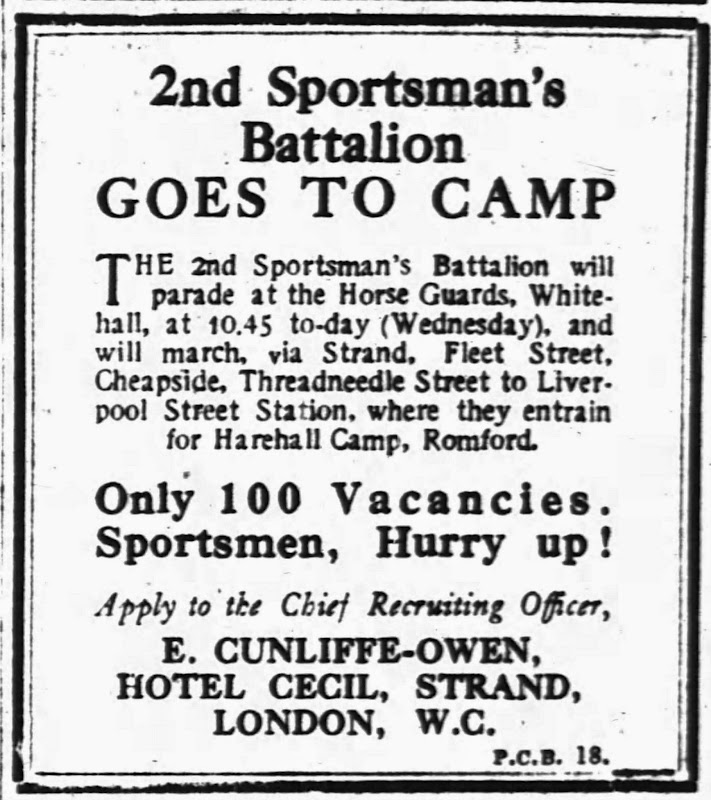
2nd Sportsman’s Battalion

GOES TO CAMP

The 2nd Sportsman’s battalion will parade at the Horse Guards, Whitehall, at 10.45 to-day (Wednesday), and will march, via Strand, Fleet Street, Cheapside, Threadneedle Street to Liverpool Street Station, where they entrain for Harehall Camp, Romford.

Only 100 Vacancies. Sportsmen, Hurry up!

Apply to the Chief Recruiting Officer,

E. CUNLIFFE-OWEN, HOTEL CECIL, STRAND, LONDON, W. C.

Western Times

A GOOD SEND OFF

Departure of the 2nd Sportsman’s Battalion

FROM EXETER

The 2nd Sportsman’s Battalion, which has been raised in the West-country through the instrumentality of Capt A. E. Dunn, and which has since its formation had its headquarters in Exeter, left the City yesterday to go into camp to complete their training for whatever service is before them. The send-off was as encouraging and enthusiastic as could well be, and the cheering crowds that thronged the streets were tribute to the popularity of the Battalion and to a fine body of men.

No won who saw the Battalion – fresh, smart, athletic, and fit as the men are – march through the City with that litheness and swing which betokens perfect physical fitness and vigour, could help congratulating Capt. Dunn on having the proud command of such a splendid body of men. In the best of spirits and keen for service, the men responded cheerily to the ready outbursts of the citizens, the waving of hats and handkerchiefs, and good wishes which were evident on every side. They were not downhearted: they said so themselves many times as they swung through the street between unbroken lines of civilians.

The “fall in” was at 8 o’clock at the top of St. Sidwell’s, and the Battalion mastered promptly and in full force. It numbers 323 of all ranks, and, besides the O.C., the officers are Lieuts Enderby, W.G. Perkins and F. Templeman, with Co. Sergt.-Major C. T. W. Finch.

The Battalion Band, under Sergt. Brock, was there to lead the way with martial music. The band itself, like the Battalion, has made splendid progress and now numbers 20. The played lively and patriotic airs, with “Soldiers of the King” and “Sons of Our Empire” among the numbers rendered.

The route take was through Sidwell-street, High-street, and Queen-street, passing the statue of Devon’s hero, General Buller, and then on to St. David’s Station, where a special train was in waiting. Numbers of friends managed to get on to the platform and there was much hand-shaking and exchange of wishes for good luck. To secure this latter for his battalion on stalwart member had been decorated with an old horseshoe tied with ribbon in the colours of the Allies, which, notwithstanding its hug dimensions, he bravely ad proudly wore upon his breast. The men were soon comfortably aboard the train, which, amid a perfect hurricane of cheering, steamed away on the stroke of 9 on its journey east.

London Standard

BASKET BALL.

An interesting match has been arranged between some members o f the Sportsman’s Battalion of the Royal Fusiliers, commanded by Lord Maitland, and a London basket-ball team. The military side will include Hayes and Hitch, the well-known Surrey cricketers, and amongst their opponents will be J. G. Lee, who has taken an important part in the work of organizing Y.M.CA. recreation tents in various military centres, and Dr. Robert le Cron, the well-known ice-hockey player. No charge will be made to witness the game, which will take place at the Central Y.M.C.A. Tottenham Court-road, on Saturday, at 7.45 p.m.

March 16, 1915

London Standard

SPORTSMAN’S NEW CAMP.

COMFORT FOR THE SECOND BATTALION.

When the 2nd Sportsman’s Battalion (24th Royal Fusiliers) removes its headquarters tomorrow from London to Romford it will enter into the occupation of the most commodious, up-to-date field barracks ever constructed. The new camp in the grounds of Hare Hall, near Gidea Park station on the Great Eastern Railway, has accommodation for the 900 men already enlisted in this battalion, and there is ample room for the erection of many more huts when they are required.

Lieutenant and Quartermaster Stuart, formerly of the 16th Lancers and the Buffs, showed one of our representatives over the officers’ quarters in Hare Hall and the camp in the grounds yesterday.

The only reason why the Hare Hall camp is the best of its kind yet constructed is that it embodies all the very latest improvements that the experience of War Office experts during the past six months could suggest. There are, for instance, a couple of dozen cubicle shower baths, with hot and cold water laid on; the thirty beds in each dormitory hut, though made of wood, owing to the scarcity of iron bedsteads, turn into the wall in the day time, overlapping each other to form seats, and occupying the minimum of space; each hut is lit by electric light; the bookmaker’s, the post office, the tailor’s, and the barber’s stand in a row, and the wet and dry canteens are spacious and extremely comfortable.

In the hall itself the bedrooms have been neatly and simply furnished to accommodate 36 officers. The subalterns sleep four in a room. The colonel has one of the smallest rooms, looking out over the camp, and as simply fitted as the rest. The canteens and store-rooms yesterday were fully stocked with every possible requirement. A hospital with 24 beds had been provided; the drugs were ready in the doctor’s surgery, and sergeant and five men of the R.A.M.C. from Colchester will form the nursing staff.

Already there is a talk of a 3rd Sportsman’s Battalion being formed, but there are still places to be filled in the 2nd. Four companies of 270 men each will be going to the front in June or thereabouts, and 5th and 6gh depot companies will have to be formed to keep the camp going and fill any gaps that may occur in the other companies.

February 18, 1915

Daily Mirror

SPORTSMAN’S CAMP.

Messrs. Hennen and Company, of Quality court, Chancery lane, W.C., write to state that Sir Herbert Raphael Bart, M.P., has no interest in the Hare Hall Estate, Gidea Park, on which estate the Second Sportsman’s Battalion will encamp. This estate is the property of Major Charles Ernest Castellan, 2nd Essex Battalion R.F.A. (T.), and Major Victor Edward Castellan, 1st Essex Battalion R.F.A. (T.). The Daily Mirror regrets it was misinformed in stating that this was one of Sir Herbert’s estates.

February 17, 1915

Daily Mirror

PRIVATE RAPHAEL, BARONET AND M.P., SETS A GOOD EXAMPLE TO THE MEN OF THE COUNTRY.

Leaving home. Private Raphael (x) marching through the Strand.

Sir Herbert H. Raphael, Bart., M.P., a great banker, a trustee of the National Gallery, and a man of many weighty public affairs, whose country seat is Allestree Hall, Derby, is now known as Private Raphael. He has joined the 2nd Sportsman’s Battalion, and will shortly go into camp at Gidea Park, which is on one of his own estates. Here Private Raphael will live in a hut. Sir Herbert has deliberately enlisted as a private to set an example to other men. He is very popular with the battalion.

THE SPORTSMAN’S BATTALION GOES ON A RECRUITING MARCH.

This photograph shows Colonel Paget and staff officers watching the march past of the Sportsman’s Battalion after they had been on a recruiting march. The Sportsman’s Battalion includes any number of athletes and men who are prominent in the racing world. But practically every branch of athletic and sport is now represented in the ranks of the battalion, which has become exceedingly popular.

January 28, 1915

Toledo Blade

SPORTSMEN EAGER TO JOIN RANKS

Woman’s Appeal Draws More Than 3,000 Into English Army.

London, Jan. 22 – Passengers on board the transatlantic liners need not be surprised if they are met at the pier here by recruiting officers for Mrs. Cunliffe-Owen’s Sportsman’s Battalions.” Polo players, tennis, cricket, football, and even baseball stars are joining with rowers, runners and boxing celebrities of the National Sporting Club, in responding to Mrs. Cunliffe-Owen’s appeal and needless to say these battalions, the first organized by a woman since Lady Gordon organized the Gordon Highlanders a hundred years ago, are getting on splendidly.

“Our call is being answered from far and near,” said Mrs. Cunliffe-Owen. “Incoming steamships from America bring us recruits and outgoing steamships carry our appeals for more. We have passed the three thousand mark, and Col. Viscount Maitland, commanding the First battalion, and Col. A de B. V. Page, commanding the Second, are greatly pleased.

Kitchener Approves Plan.

“The idea of forming the Sportsman’s Battalion occurred to me while I was on a shopping tour in Bond Street. I informed Lord Kitchener of it and he approved at once. Since then I have been at work every minute in the organization. Yes, it is quite true that I personally see every recruit and give my personal attention to every detail of our camps at Hare Hall and Romford, in Essex.

“See this rubber coat, for example. I have just ordered many of them at a good bargain. They are for practicing trench digging. I can’t have my men get soaking wet.”

Mrs. Cunliffe-Owwen explained that her love of outdoor life, before a severe illness last year, caused her to think of lovers of sport for her battalions. She how has to be wheeled about the camps in an arm chair, but she gets everywhere and finds time for her executive duties at headquarters besides.

Both Viscount Maitland and Col. Paget are member of the king’s bodyguard. The former was mentioned in despatches in the South African war, is a fine shot and one of the foremost billiard players in the country. Col. Paget commanded the Second battalion of the Durham light infantry, which was renowned for sport during its tour in India. Its polo team won everything before it four years in succession.

Imposing List of Recruits.

There is a spirit of democracy among all the sporting celebrities who have enlisted, boxers of local fame at the National Sporting Club fraternizing with polo players and college cricket champions.

Among those who have already enlisted are: W. Burlton Stuart, well known polo player; Reginald Cooper, big game hunter; P. G. Sadd, captain of the Burton Rugby football team and middleweight champion of the Midland counties; William H. Denton, skater, runner, boxing champion and swimmer and a son of “Charley” Mitchell, boxer; C. P. McGahey, formerly captain of the Essex cricket eleven; McIvor Jackson, the Surrey cricketer; Harry Packer, Welsh Rugby, forward; Lewis R. Lewis, Welsh international player; Robert M. Miles, captain of Pembroke college Cambridge cricket and football teams; “Jack” Cartmell, the Brentford football player, and E Henderson, the Middlesex cricketer.

Sir William Cooke, owner of Hornets Beauty, Gravelotte and other famous race horses, has enlisted as a private; S. Smith, formerly champion runner, has enlisted, and others who have joined include W. Albany, D. G. Cordery, T. Wingate and T. Robinson, the well known professional oarsmen.

Aberdeen Evening Express

ABERDEEN RECRUITING WELL MAINTAINED.

Scottish Centres Compared.

There was again a heavy list of recruits at Castlehill Barracks, Aberdeen, yesterday. The 2nd Reserve Field Company of the Royal Engineers received an addition of about half a dozen men. This morning there were four enlistments in the city Territorial reserve battalion of the Gordon Highlanders, and the aggregate of recruits for the Naval Brigade (Aberdeen company) is mounting steadily.

The men who joined Kitchener’s Army numbered 13, as follows: --

William Watson – Banff (Army Service Corps).
William Bruce – Fraserburgh (Army Service Corps).
William Gilbert – Tough. (Army Service Corps).
Alexander Scorgie – Perty (Army Service Corps).
Matthew Gordon – Alford (Gordon Highlanders).
George Bonar – Peterhead (Army Service Corps).
Alexander Robertson – Logierart (Sportsman’s Battalion).
Robert Smith – Drumoak (Royal Engineers).
George C. Maitland – Peterhead (Army Service Corps).
Frederick B. Peddie – Peterhead (Army Service Corps).
Henry W. Johnson – Zetland (Scots Guards).
William Laird – Metbliek (Gordon Highlanders).
Jacob Carle – Fraserburgh (Army Service Corps).